Clear Sky Science · en
Enhancing carbon sinks in China using a spatially-optimized forestation strategy
Why the Shape of Forests Matters
Planting trees is widely seen as a powerful way to slow climate change, and China has one of the world’s biggest tree‑planting programs. But this study asks a deceptively simple question: does it matter where, exactly, those trees go? The authors show that it is not just how many trees are planted, but how they are arranged on the landscape that determines how much carbon they can lock away. By rethinking forest expansion to avoid overly chopped‑up woodlands full of stressed edges, China could greatly increase the climate benefits of its planned forests.
China’s Big Tree‑Planting Push
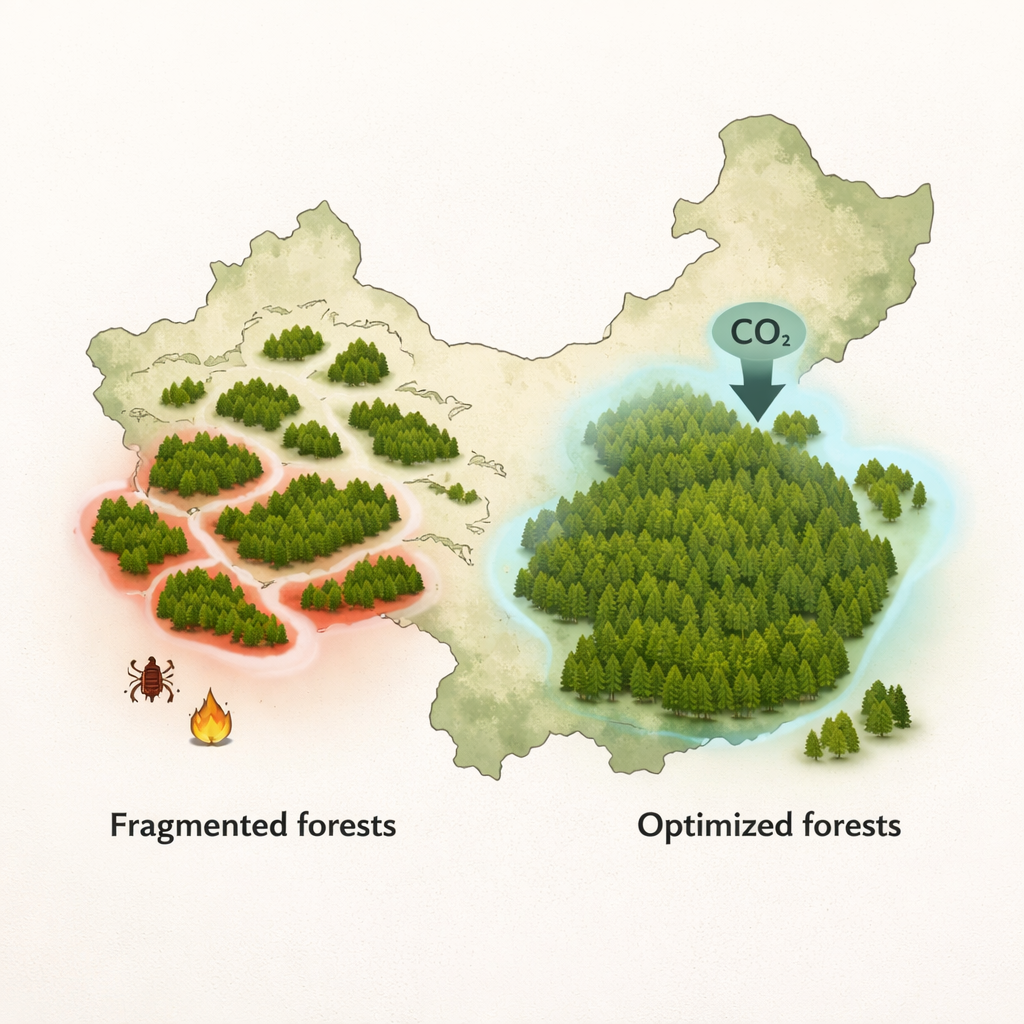
Over the last few decades, China has rapidly expanded its forest cover, in part to fight dust storms, erosion, and desertification. National programs such as the Grain for Green and the Three‑North Shelter Forest have helped raise forest cover from about 12% of the country’s land in 1979 to roughly 23% by 2019. Looking ahead, China plans to add another 49.5 million hectares of new forest by 2050 as part of its pledge to reach carbon neutrality by 2060. Until now, most planning has focused on how much area to plant and which regions are environmentally vulnerable, not on how forest layout might affect tree health and carbon storage.
The Hidden Problem of Forest Edges
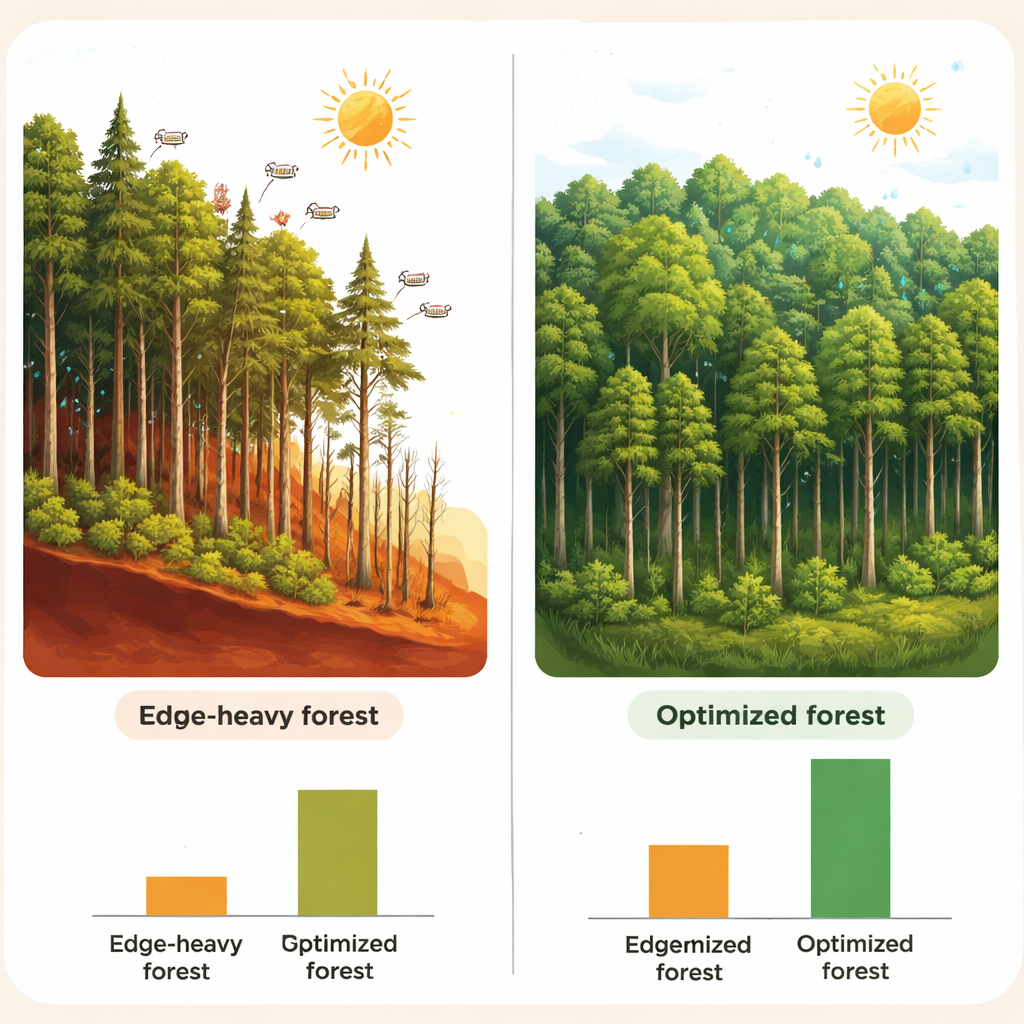
As forests are expanded in a patchwork, they become fragmented into many small blocks separated by fields, roads, or cities. This creates a lot of “edge” – the outer band where forest meets non‑forest. The authors analyzed more than 3 million tree measurements from over 37,000 plots across China and found that trees near edges store far less carbon than trees in the forest interior. In both natural and planted forests, tree biomass (a measure closely tied to carbon storage) increased steadily with distance from the edge. In planted forests, biomass near edges was about 40% lower than in natural forests and rose only modestly toward the interior, suggesting that simply planting more trees at edges does not quickly fix the problem.
Why Edges Are Tough on Trees
To understand why edge forests are poorer in carbon, the team examined disturbance records and human pressure. They found that pests and diseases were the leading sources of damage, and that their frequency and intensity climbed sharply as one moved closer to the forest boundary. Fires and climate‑related stresses also became more common near edges. Human footprint – a combined measure of roads, buildings, farms, and population – rose steeply from the interior to the edge, especially in planted forests. As a result, tree mortality rates were much higher near edges, while the establishment of new trees was slower. Microclimate changes along edges, such as stronger winds, greater swings in temperature, and drier air, further weaken trees. Together, these pressures make edge forests less stable and less effective at storing carbon.
Designing “Smarter” Forest Expansion
Instead of planting trees wherever land is available, the authors tested a “spatially optimized” strategy that deliberately reduces edge exposure and links forest patches together. Using climate, soil, topography, and species suitability data, they mapped out where new forests are most likely to thrive. Then they compared two futures: one where new forests are placed randomly within suitable land, and another where planting is arranged to create larger, more continuous blocks with fewer edges. Both scenarios use the same total planting area and tree types. A machine‑learning model, trained on the national forest inventory, was then used to estimate how much carbon the forests would store up to the year 2060 under different climate conditions.
Gains in Carbon and Nature from Better Layout
The optimized planting plan produced strikingly better results. By 2060, newly planted forests under the optimized layout stored about 34% more carbon than those under random planting. When both new and existing forests were counted together, the optimized design yielded a 51% larger carbon gain – an extra 986 million tonnes of carbon – even though the total forested area was the same. Roughly half of this bonus came directly from reducing edge‑related losses; the rest came from placing trees in locations with more favorable environmental conditions. Importantly, existing forests also benefited: by surrounding them with well‑planned new forests, their own carbon storage increased as damaging edge conditions were softened and patches became more connected.
What This Means for Climate and Conservation
For a non‑specialist, the key message is that tree planting is not a simple matter of filling empty space with green. Forests arranged as many small, isolated patches lose more trees and store less carbon than forests designed as larger, connected blocks. This study shows that by paying attention to forest shape and edge length, China could greatly boost the climate impact of its planned forests while also improving wildlife habitat and reducing the spread of pests and diseases. In other words, “smart” forest planning can turn the same number of trees into a more powerful and resilient carbon sink.
Citation: Dong, Y., Yu, Z., Pugh, T. et al. Enhancing carbon sinks in China using a spatially-optimized forestation strategy. Nat Commun 17, 1576 (2026). https://doi.org/10.1038/s41467-026-68288-5
Keywords: forest fragmentation, carbon sequestration, afforestation, forest edges, China forests