Clear Sky Science · en
Cross-species dissection of saline-related genes by genetically deciphering a euryhaline microalga Chlorella sp
Why a tiny green alga matters for salty soils
Rising soil salinity is quietly shrinking the world’s farmland, making it harder for crops to grow. In this study, scientists turned to an unexpected ally: a microscopic green alga called Chlorella sp. MEM25 that can thrive in both fresh water and extremely salty ponds. By decoding its complete genome and tracking how its genes and chemicals respond to salt, the researchers uncovered a toolkit of “salt genes” that not only help this alga survive, but could also be used to build more salt-tolerant crops.
A survivor between ocean and pond
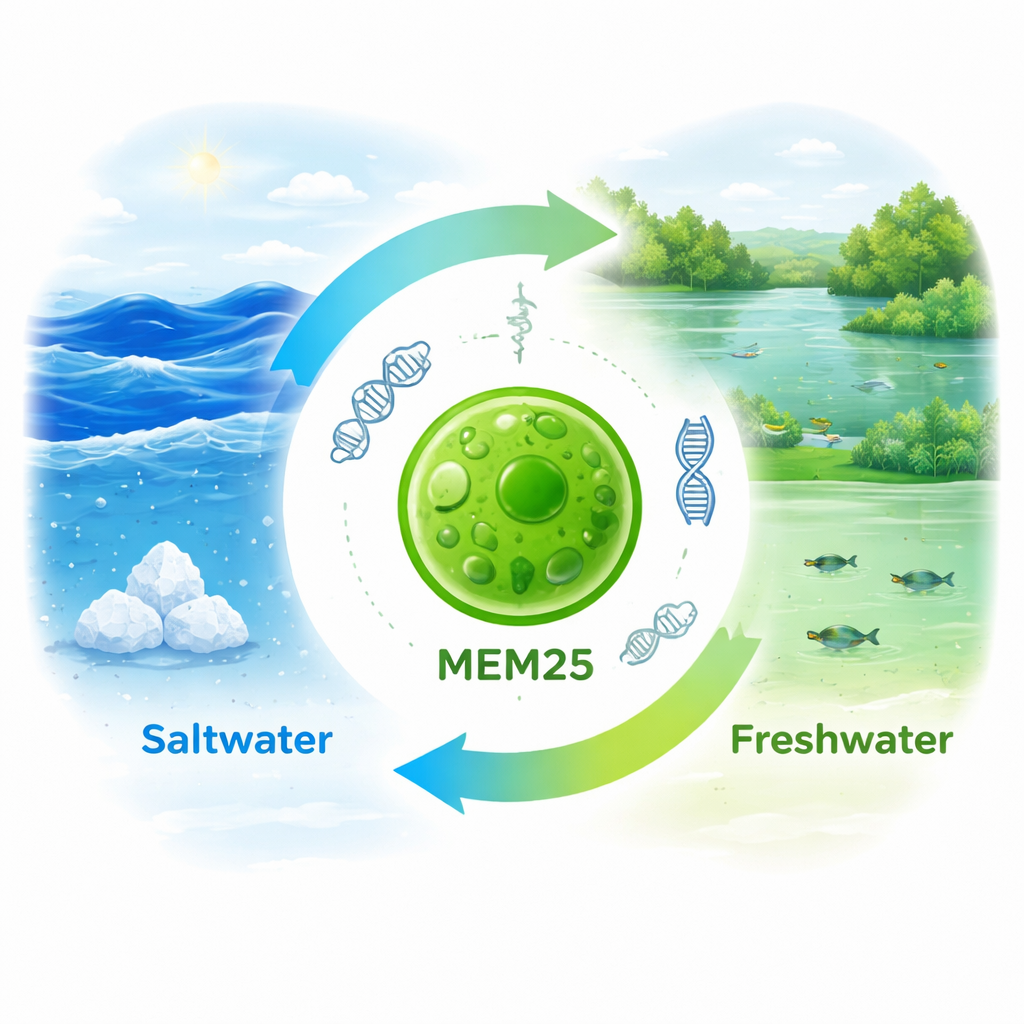
MEM25 was discovered in an inland saline pool on Hainan Island, China, where the water is saltier than most seawater and stays hot year-round. Remarkably, this microalga grows from zero salt all the way up to more than three times the salinity of the ocean, with peak growth at about twice seawater strength. The team assembled a near-perfect, chromosome-level map of its DNA, showing 16 chromosomes with clearly marked chromosome centers and tips. This level of detail allowed them to compare MEM25 to dozens of other green algae and land plants, and to see where in evolutionary history it branched off from other lineages.
An evolutionary crossroads for life in salty water
By building family trees from hundreds of shared genes across 38 green algal species and several plant and bacterial outgroups, the researchers found that MEM25 sits close to one of the split points between saltwater and freshwater green algae. Molecular dating suggests it emerged over 600 million years ago, making it one of the older known chlorophyte lineages. When the team looked at which gene families tend to appear in salty versus fresh habitats, MEM25 turned out to be unusual: it carries many of the hallmark “saltwater genes” and also a surprisingly large number of “freshwater genes.” In statistical analyses, this dual identity made MEM25 the saltwater species that clustered closest to freshwater algae, reinforcing the idea that it occupies an evolutionary bridge between the two environments.
Shared tools and custom tricks for handling salt
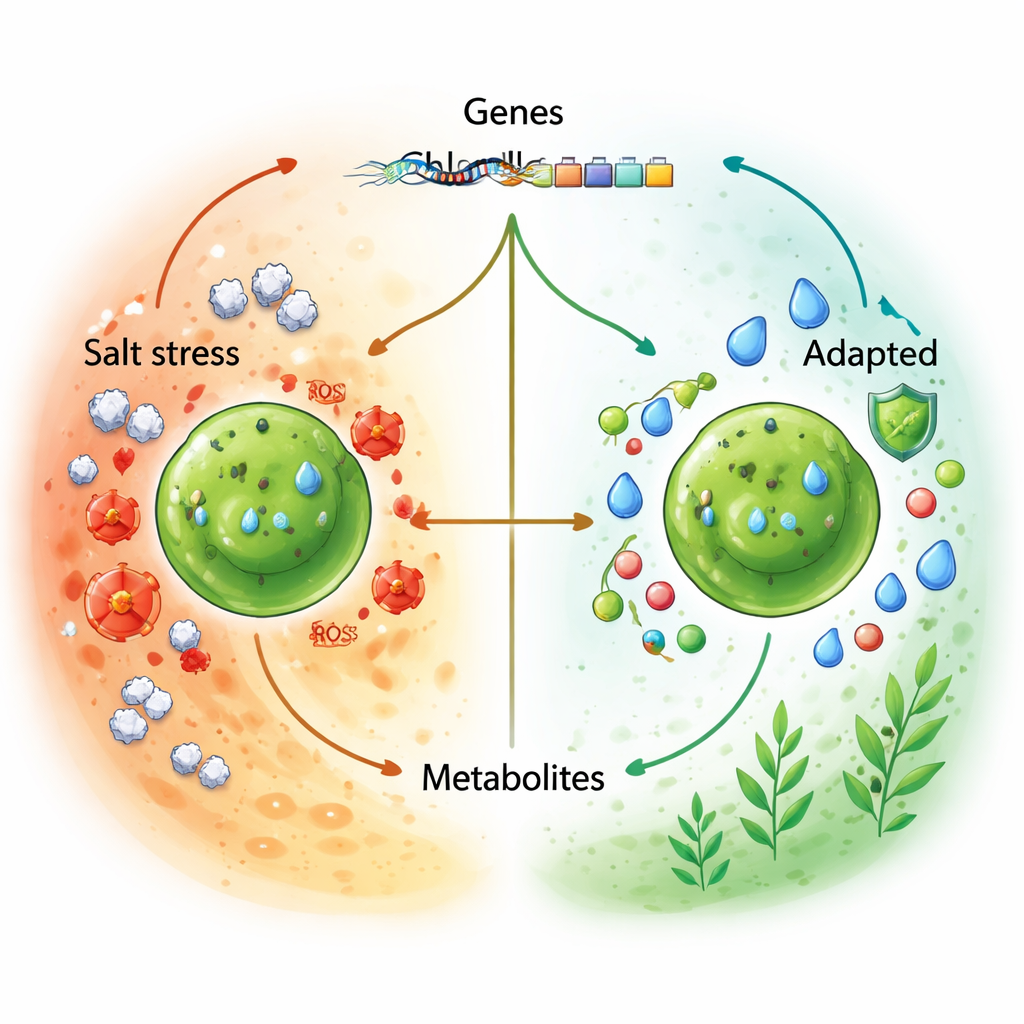
To understand how MEM25 copes with sudden changes in salinity, the scientists compared its active genes and small molecules to those of a closely related freshwater Chlorella strain. Using network analyses, they grouped thousands of genes and hundreds of metabolites into modules linked to salt level and species type. Some modules were shared between fresh and salt species, pointing to a common set of “ancestral” tools: for example, genes that manage oxidative damage, move small molecules in and out of cells, and produce classic protective compounds such as proline, sugars, and certain lipids. Other modules were unique to MEM25 and turned on only during salt stress, hinting at special strategies that have not been described before.
Borrowed genes and active defenses
Genome-wide comparisons showed that 89 gene families are expanded in MEM25 compared with freshwater relatives. A few of these are ancient and also found in land plants, including genes that help detoxify reactive oxygen, adjust cell volume, and tag proteins for destruction when conditions change. Most, however, appear to be MEM25-specific. One striking example encodes a protein related to bacterial enzymes that protect against osmotic stress, suggesting that this alga may have acquired it from bacteria. Many of these expanded genes became more active when the salt concentration increased, and the alga simultaneously boosted metabolites such as proline, unsaturated fatty acids, sugars, and vitamins. Together, these shifts indicate a coordinated defense system that strengthens cell membranes, balances water and ions, and cleans up harmful by-products generated under salt stress.
From lab mutants to future salt-tolerant crops
To test whether the candidate genes truly affect salt tolerance, the team created tens of thousands of MEM25 mutants and used genome-wide association methods to link DNA changes to growth under high salt. This highlighted several members of a protein-tagging gene family known as E3 ligases. The researchers then edited selected “salt-sensitive” genes in another alga that prefers moderate salinity; deleting any of six such genes increased its growth at high salt. They went a step further and removed plant versions of one MEM25 gene, called RMI1, in the model plant Arabidopsis. Plants lacking RMI1 grew longer roots under salty conditions, revealing that this gene acts as a brake on salt tolerance from algae up to higher plants.
What this means for life in salty worlds
To a non-specialist, the message is that MEM25 represents an evolutionary testbed where nature has tried out many ways to cross the boundary between ocean and fresh water. Some of its salt-response genes are ancient tools shared with land plants, while others are new inventions or even borrowed from bacteria. Because many of these genes clearly influence how organisms cope with salt, they form a practical menu of targets for improving crops on increasingly salty soils. In essence, by reading and experimenting with this alga’s genome, the researchers have begun to translate its survival tricks into strategies that could help secure future food production in a changing climate.
Citation: Wang, A., Gan, Q., Xin, Y. et al. Cross-species dissection of saline-related genes by genetically deciphering a euryhaline microalga Chlorella sp. Nat Commun 17, 1577 (2026). https://doi.org/10.1038/s41467-026-68287-6
Keywords: salinity tolerance, microalgae, Chlorella, salt stress genes, crop improvement