Clear Sky Science · en
Magneto-ionic control of magnetism through voltage-driven carbon transport
Turning Electricity into a Magnetic Switch
Modern technologies, from computer memories to brain–machine interfaces, increasingly rely on tiny magnetic elements that can be turned on and off with minimal energy. This article explores a new way to control magnetism using voltage—not by heating or applying a magnetic field, but by gently pushing atoms inside a material. The twist is that the key moving atom is carbon, a familiar element in everything from pencil lead to living cells, opening doors to magnetic devices that are not only efficient but also biocompatible.
A New Way to Move Atoms with Voltage
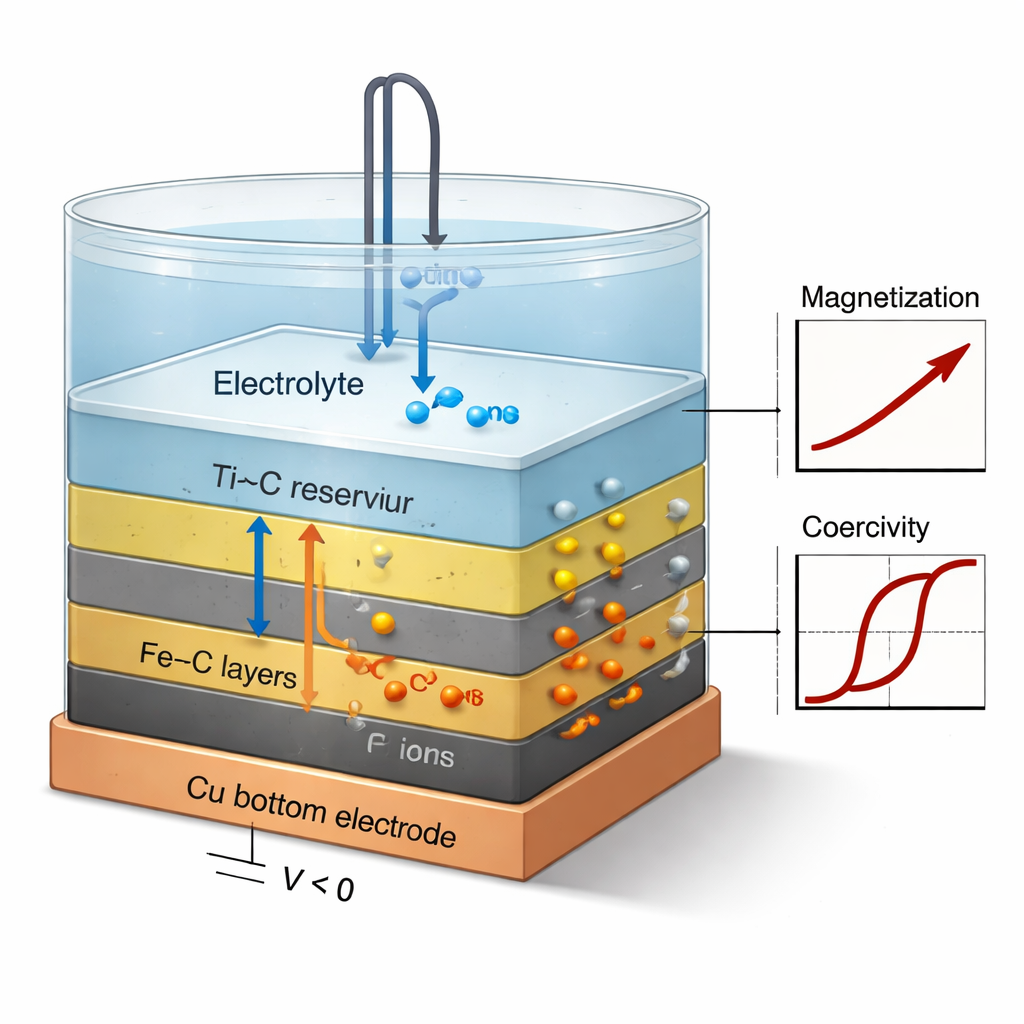
Traditional magnetic devices change their state using electric currents, which waste energy as heat. An emerging alternative, called magneto-ionics, uses voltage to nudge ions—charged atoms—through solids, quietly reshaping their magnetic behavior. Earlier work focused on ions like hydrogen, oxygen, or nitrogen. In this study, the researchers asked whether carbon itself could play that role. They built a carefully layered thin film made mostly of iron and carbon on a silicon chip, topped with a titanium–carbon cap and bathed in a liquid electrolyte. By applying a voltage between the bottom metal layer and a wire in the liquid, they created strong electric fields that could pull different atoms in opposite directions.
Carbon and Iron March in Opposite Directions
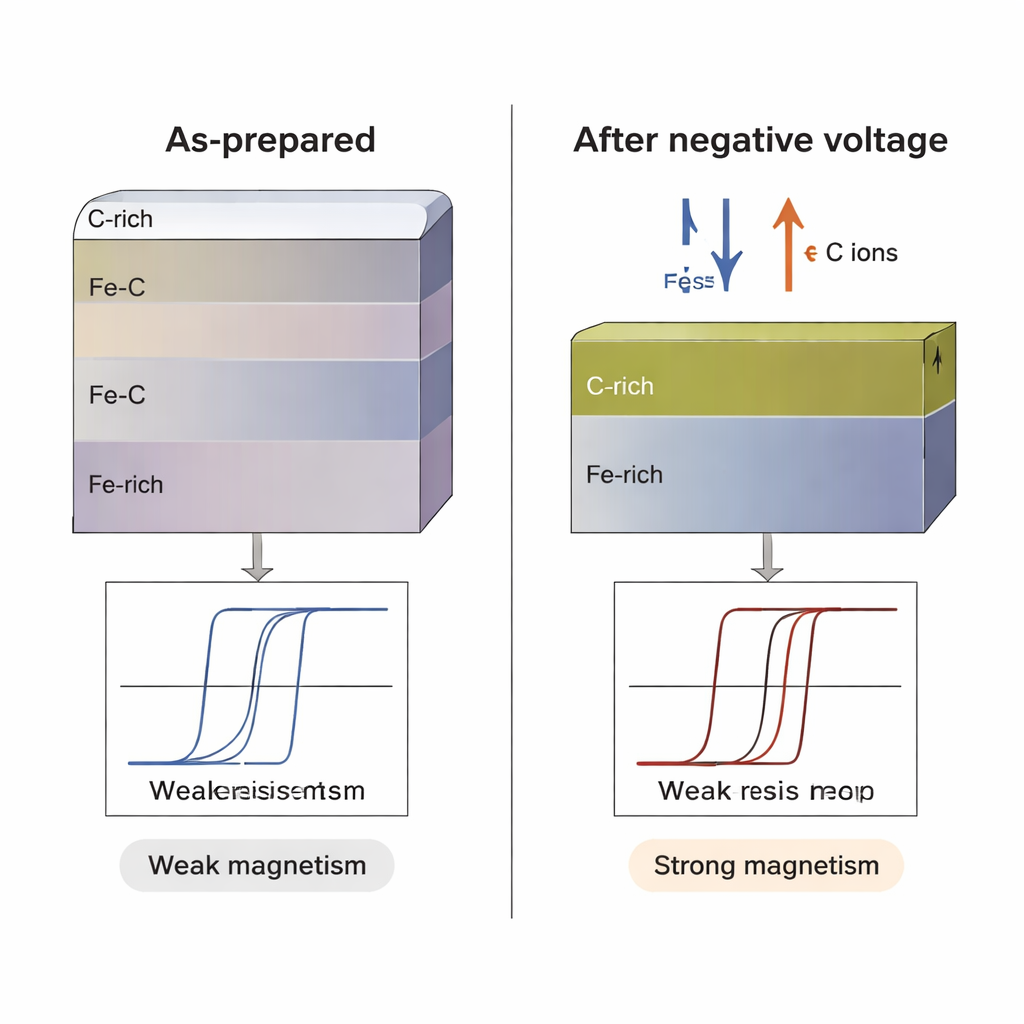
The film starts out in a state where iron is partly locked up in iron carbides—compounds of iron and carbon—that are only weakly magnetic. When the team applied a negative voltage, they found that carbon and iron both moved, but in opposite directions: carbon drifted upward into the titanium–carbon cap, while iron migrated downward, concentrating in a deeper region of the film. This motion took place in a nearly flat, advancing front, like a wave sweeping through the layered structure. As carbon left some regions and iron gathered there, those parts transformed from iron carbides into iron-rich areas with much stronger ferromagnetism.
From Weak to Strong Magnet in Minutes
Magnetic measurements showed just how dramatic this transformation was. After voltage treatment, the material’s saturation magnetization—a measure of how strongly it can be magnetized—increased by more than a factor of five, and the coercivity, which reflects how hard it is to flip the magnetization, jumped about twenty-five-fold. These changes developed quickly at first and then slowed as the system approached a stable configuration, a behavior the authors modeled with a standard growth equation. Advanced microscopy confirmed that the original four-layer iron–carbon stack collapsed into two main layers: a carbon-rich, nearly iron-free top and a thicker, iron-rich bottom with improved crystallinity and fewer defects. Spectroscopic measurements further backed up the picture of carbon moving upward and iron moving downward under voltage.
Reversible, Fast, and Comparable to the Best
The researchers also tested how reversible this magnetic switch could be. Applying an opposite, positive voltage partially undid the changes, reducing the magnetization while leaving key magnetic features like coercivity largely intact. Full return to the initial weakly magnetic state required reheating the sample, which helps carbon and iron remix into carbides. Even so, cycling the voltage between negative and positive values repeatedly showed that the magnetic state can be modulated back and forth in a controllable way. The speed and strength of these changes are on par with, or better than, many existing magneto-ionic systems based on oxygen or nitrogen, but now using carbon, which is less toxic and more compatible with biological environments.
Magnetic Materials that Play Nicely with Biology
In essence, this work proves that carbon can serve as an active ion in magneto-ionic devices, working together with iron in a coordinated “push–pull” motion to turn magnetism up or down with voltage. Because iron, carbon, and their carbides are relatively safe for living tissue, this approach suggests future magnetic components that could be integrated into biomedical tools—such as implants or brain–machine interfaces—without introducing highly toxic materials. The study is a proof of principle, but it shows that by choosing the right elements and carefully designing the layers, it is possible to build low-power, tunable, and potentially biocompatible magnetic systems driven by the quiet motion of ions.
Citation: Tan, Z., Ma, Z., Privitera, S. et al. Magneto-ionic control of magnetism through voltage-driven carbon transport. Nat Commun 17, 1568 (2026). https://doi.org/10.1038/s41467-026-68283-w
Keywords: magneto-ionics, carbon ions, iron carbides, spintronics, biocompatible magnetism