Clear Sky Science · en
Space-time superoscillations
Light That Beats Its Own Speed Limit
Light waves are usually thought to obey strict limits: their wiggles in space and time cannot be faster than what their overall color and shape allow. This study shows that, under special conditions, light can briefly “cheat” those limits, oscillating much faster than expected both in space and in time at the same tiny spot. This peculiar behavior, called space-time superoscillation, could one day help us see, measure, and control matter on far smaller scales and faster times than conventional optics allow.
When Waves Wiggle Faster Than They Should
In everyday terms, a superoscillation is a clever trick of wave interference. Imagine a piece of music that contains no notes higher than middle C, yet in a short passage your ear briefly hears something as sharp as a much higher note. With light, a similar effect can occur: even when a beam only contains relatively modest spatial and temporal frequencies, its local pattern can include fleeting regions where the oscillations are much faster than any component in its overall spectrum. Previously, such superoscillations were studied either in space (to make extremely fine light spots) or in time (to resolve ultrafast events), but not both together at the same point.
Doughnut Pulses as Wave Laboratories
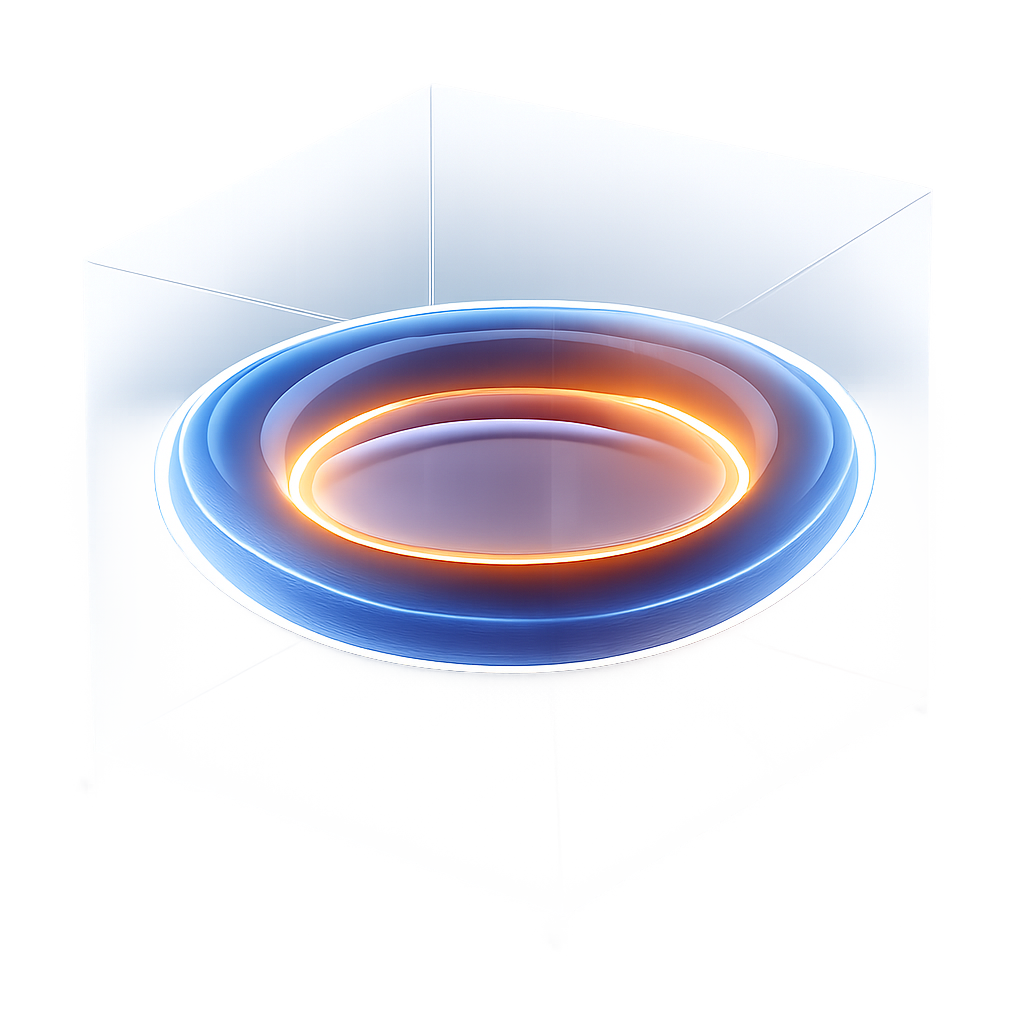
The authors focus on an exotic family of light pulses known as supertoroidal pulses, which look like flying doughnuts of electromagnetic energy. These pulses are “space-time nonseparable,” meaning their shape in space and their evolution in time are tightly intertwined, and they are exact, finite-energy solutions of Maxwell’s equations. By mathematically trimming these pulses so that their spectrum is strictly limited in both space and time—no frequencies above a chosen cutoff—they build a clean testbed: a wave that, in theory, should never locally oscillate faster than those chosen bounds.
Finding the Hidden Fast Zones
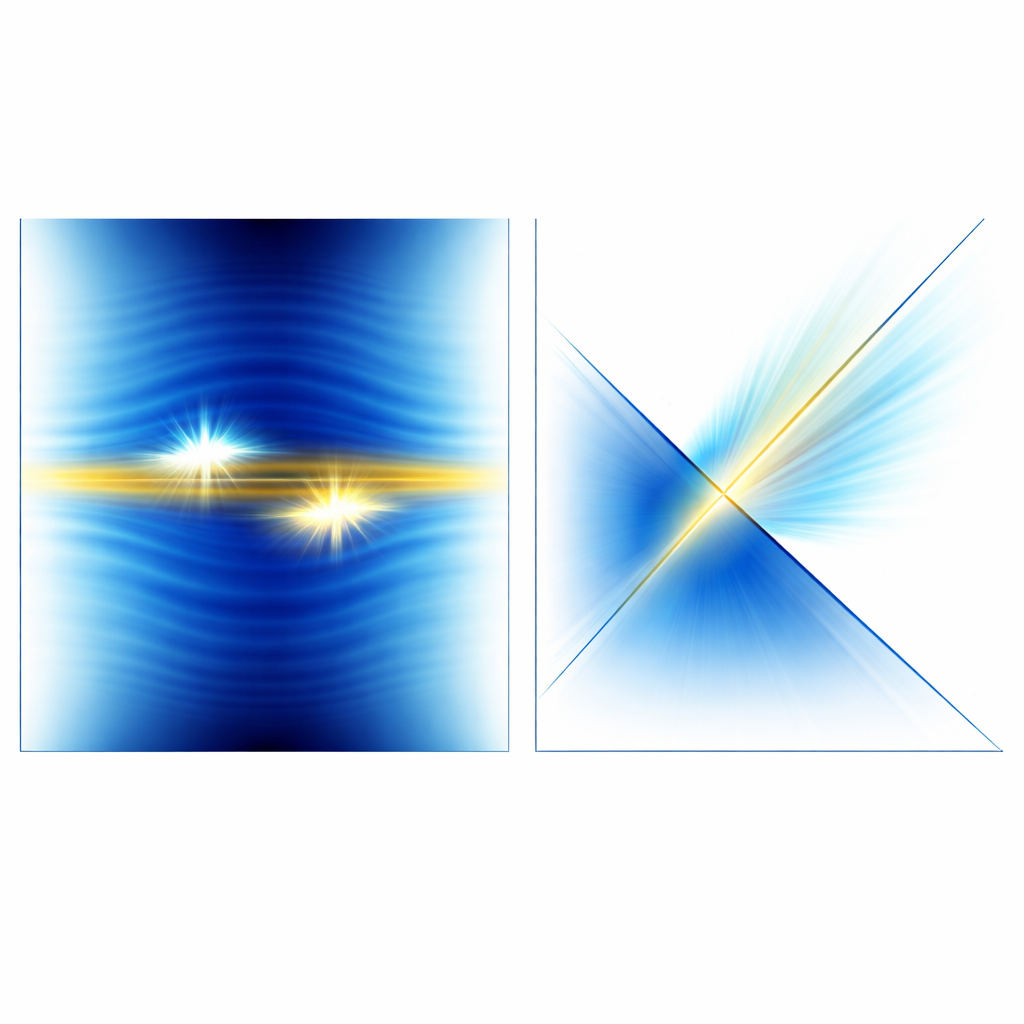
Within this band-limited doughnut, the team maps out the local behavior of the electric field as it evolves. They look at how quickly the phase of the light changes with distance (a measure of local spatial frequency) and with time (a measure of local temporal frequency). For simple doughnut pulses, only small regions show faster-than-allowed changes in time, and not in space. But for more complex pulses—controlled by a parameter that increases their internal structure—the picture changes dramatically. The researchers find off-center zones where both the spatial and temporal wiggles simultaneously exceed the global limits, revealing genuine space-time superoscillations. These hotspots occur in regions of low field amplitude and are linked to subtle flows of energy that can even briefly reverse direction.
Signatures Beyond the Light Cone
To confirm that these surprising wiggles are not artifacts, the authors examine the spectra of tiny space-time segments around each superoscillating hotspot. While the overall pulse spectrum sits neatly on the “light cone” (the usual boundary that relates spatial and temporal frequencies for light in free space), the local spectra from the superoscillating regions spill slightly beyond this cone. In other words, when you zoom in on those small patches, the light behaves as if it contains frequency components that the global pulse does not seem to have. The strength and extent of these out-of-cone components grow as the internal complexity of the pulse increases.
How Far Can This Be Pushed in Practice?
Using realistic laser parameters, the authors estimate how far space-time superoscillations could sharpen focus. For a common ultrafast laser in the near-infrared, the usual limits would give spatial details around 400 nanometers and temporal features about 4.6 femtoseconds long. In the superoscillating regions of a suitably engineered doughnut pulse, the same light could, in principle, form hotspots roughly five times smaller in space and seven times shorter in time—down to tens of nanometers and well below one femtosecond. Remarkably, even though these hotspots hold only about 0.1–1% of the pulse’s energy, that fraction is comparable to what has already been exploited successfully in superresolution microscopes based on spatial superoscillations.
Why This Matters for Future Technologies
The work shows that simultaneous superoscillations in space and time are not just mathematical curiosities, but can exist in finite-energy light pulses that modern optical setups could plausibly generate. Because spatial superoscillations have already enabled imaging and measurements beyond the traditional diffraction limit, and temporal superoscillations are beginning to enhance spectroscopy, combining both offers a route to probes that are extraordinarily sharp in space and ultrafast in time. Such pulses could help us track electron motion, control magnetic interactions, or sense nanoscale structures with unprecedented precision. The underlying mechanism is general to waves, suggesting that similar space-time superoscillations might one day be harnessed in acoustics, matter waves, or other wave-based technologies.
Citation: Shen, Y., Papasimakis, N. & Zheludev, N.I. Space-time superoscillations. Nat Commun 17, 2053 (2026). https://doi.org/10.1038/s41467-025-68260-9
Keywords: superoscillations, structured light, ultrafast optics, superresolution imaging, electromagnetic pulses