Clear Sky Science · en
Bulk-cusp microstructure for controllable multi-directional liquid spreading
Guiding Tiny Droplets Without Any Pumps
Making liquids move exactly where we want them to go—without motors, pumps, or power—could transform how we cool electronics, lubricate machines, and run chemical tests on a chip. This study introduces a simple, flat surface pattern that can steer a single droplet of liquid in up to four different directions at once, using only the natural pull of surface tension.
A Flat Surface That Acts Like a Traffic Controller
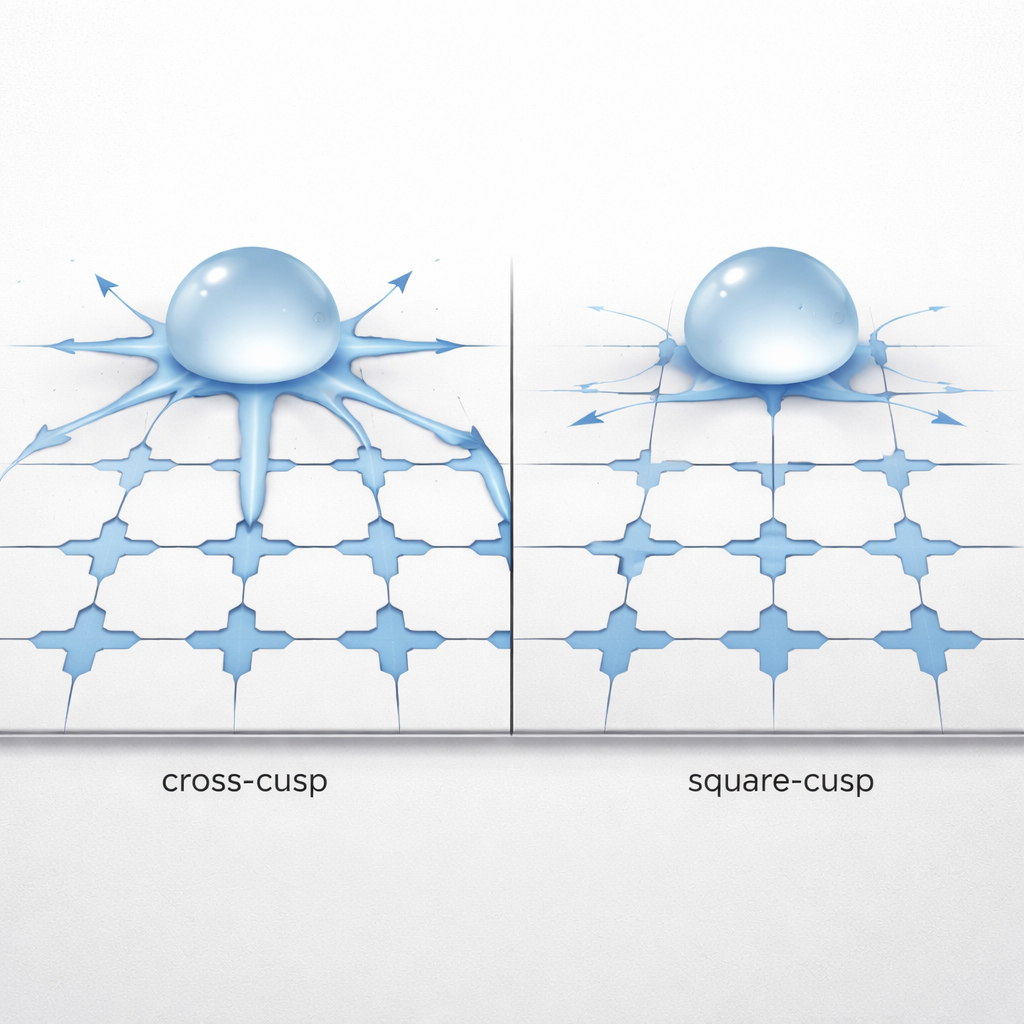
The researchers designed a new microscopic landscape, called a bulk-cusp microstructure, etched into a silicon wafer. At first glance it looks like a repeating pattern of tiny crosses or squares, each surrounded by sharp, tooth-like tips (the “cusps”). When a water droplet lands on this surface, it does not simply spread out into a circle. Instead, it can be made to stretch in one, two, three, or four chosen directions—or stay put—depending on how these crosses or squares are arranged. Crucially, all of this happens without any external power: the liquid is pulled along by capillary forces, the same effect that draws water up a paper towel.
Two Hidden Players: The Main Droplet and Its Thin Film
To understand this behavior, the team distinguishes between the visible “body” of the droplet and an ultrathin “precursor film” that creeps ahead of it like a microscopic scout. On cross-shaped patterns, the open channels between cusps are wide and well connected, so this thin film can cover a large area. As it advances, it lowers the local contact angle of the liquid, tugging the main droplet body forward along selected directions. On square-shaped patterns, the open area is smaller and more fragmented, so the film still moves but has less ability to drag the bulk of the droplet. As a result, on square-cusp surfaces the thin film can be guided, while the main droplet remains almost pinned in place.
How Geometry Turns Surface Tension Into Directional Force
High-speed microscopy and computer simulations reveal that the key lies in how the cusps shape the liquid’s internal pressure. Narrow gaps between neighboring tips act like tiny funnels: surface tension pulls the precursor film from the narrow end toward the wider opening, creating a net forward force. At the same time, the sharp outer edges of the cusps pin the liquid in the opposite direction, preventing it from slipping backward. By carefully choosing the angles and spacing of these tips, the authors derive simple design rules that tell when the film will move forward and when it will be held in place. They also test water–alcohol mixtures and various oils to show that surface tension mainly controls how far the liquid can be guided, while viscosity mainly controls how fast it moves.
From Slippery Bearings to Cooler Chips
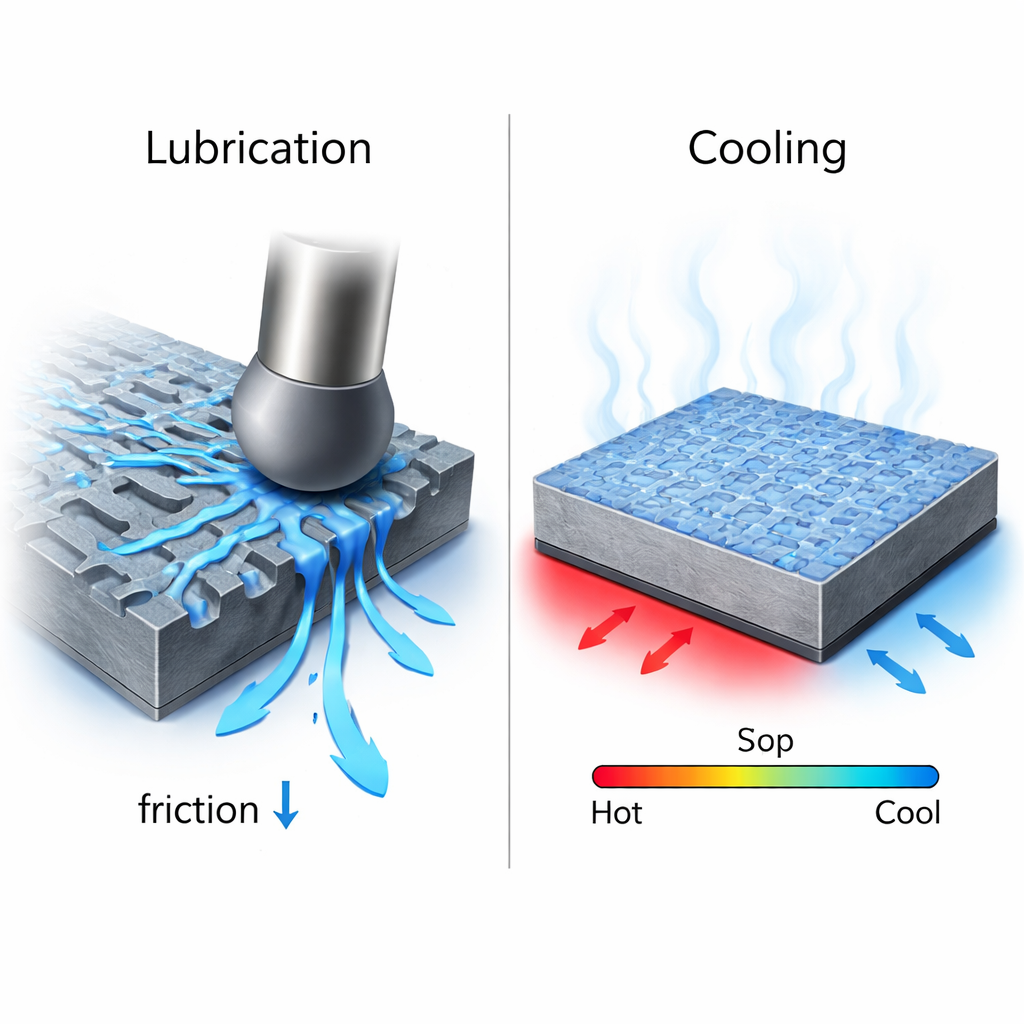
The team demonstrates two practical uses. First, they place cross-cusp patterns around, but not directly under, a sliding metal contact. When water is added as a lubricant, the pattern continuously pulls liquid from the outer region into the contact zone, cutting friction by up to about 35% compared with a smooth surface and even outperforming many advanced coatings and additives. Second, they use square-cusp patterns on a heated plate. A single tiny droplet spreads as a thin film over the entire patterned area and then evaporates, drawing away heat. Infrared imaging shows that this surface cools faster, more uniformly, and to a lower temperature than either a bare plate or one patterned without cusps, even under repeated droplet addition.
Simple Patterns for Smarter Liquid Control
In everyday terms, this work shows how cleverly shaped microscopic “roads” can steer droplets and thin liquid films without pumps, electricity, or moving parts. By tuning only the pattern—cross versus square shapes and the orientation of their tips—the same surface concept can either push lubricant into a hard-to-reach contact or spread coolant evenly over a hot spot. Because the design is flat and compatible with standard chip-making processes, it offers a practical route toward smarter, energy-free control of liquids in future cooling systems, microfluidic devices, and low-wear mechanical components.
Citation: Dai, S., Zhang, H., Liu, Y. et al. Bulk-cusp microstructure for controllable multi-directional liquid spreading. Nat Commun 17, 1519 (2026). https://doi.org/10.1038/s41467-025-68237-8
Keywords: liquid spreading, microstructured surfaces, capillary forces, lubrication, evaporation cooling