Clear Sky Science · en
Observation of partonic flow in proton—proton and proton—nucleus collisions
Why tiny particle crashes matter
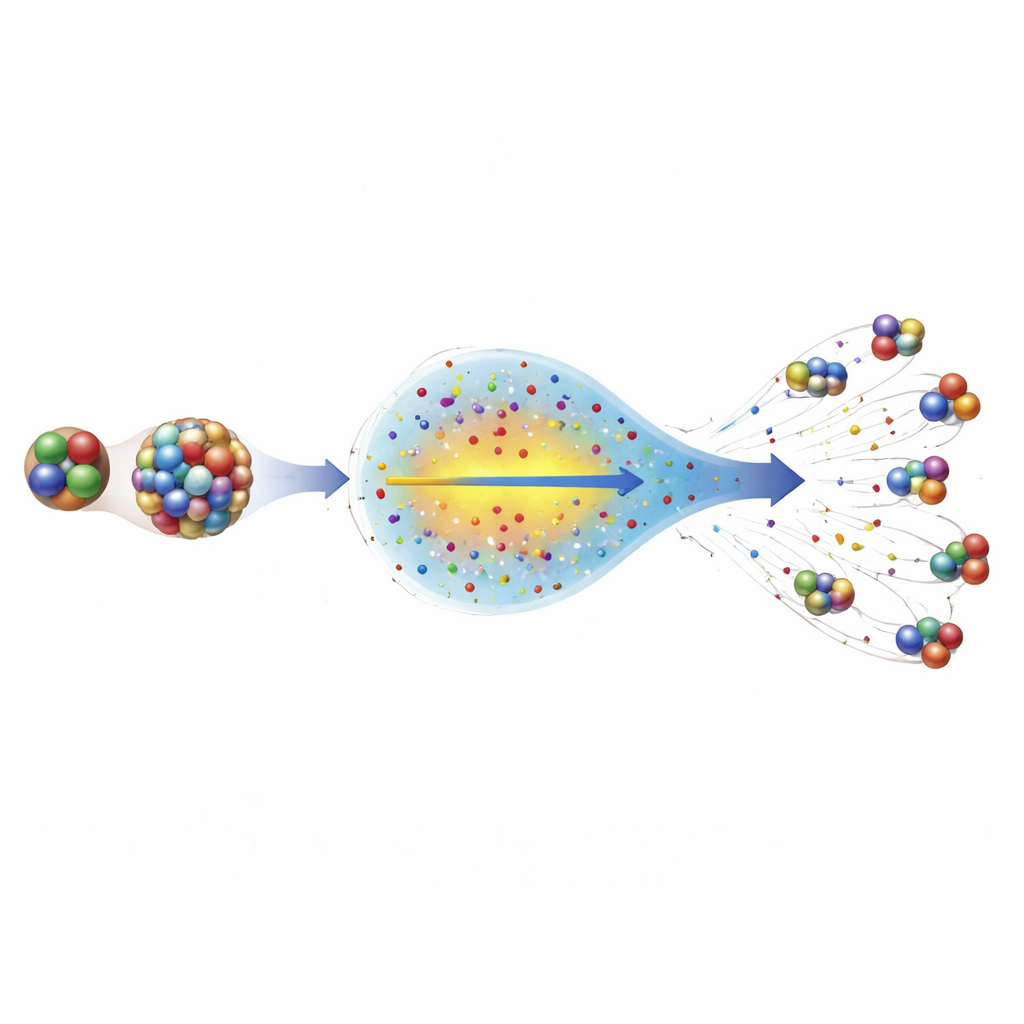
Moments after the Big Bang, the universe was filled with a hot, dense soup where quarks and gluons roamed freely instead of being locked inside protons and neutrons. Physicists can briefly recreate this exotic “quark–gluon plasma” by smashing heavy atomic nuclei together at nearly the speed of light. The new study from the ALICE experiment at CERN’s Large Hadron Collider asks a surprising question with big implications: can this same ultra-hot, flowing state of matter also form in far smaller collisions, when just protons slam into one another or into a single heavy nucleus?
From big fireballs to tiny droplets
In collisions of large nuclei such as lead–lead, the overlapping region where they hit is not perfectly round. That lopsided shape creates unequal pressure inside the fireball, so the matter created in the crash tends to flow more strongly along one direction in the plane of the collision. This uneven “collective push” shows up as more particles emerging along certain angles rather than uniformly in all directions. Over the past two decades, detailed measurements of these angular patterns have painted a consistent picture: the quark–gluon plasma formed in big collisions behaves like an almost perfect liquid, with extremely low friction.
A puzzling flow in small systems
Proton–proton and proton–nucleus collisions were long thought to be too small and too short-lived to form such a liquid-like state. They were used mainly as a clean reference to help interpret the more complex heavy-ion data. Yet experiments at the LHC and at RHIC began to reveal hints of collective behavior even in these small systems: long, ridge-like streaks of correlated particles spanning large ranges in angle, and mass-dependent flow patterns that looked eerily similar to those in large nuclei. This sparked an intense debate. Do tiny collisions also create a miniature liquid of quarks and gluons, or can these patterns be explained purely by the way gluons are arranged in the incoming protons before they collide?
Following the flow from quarks to hadrons
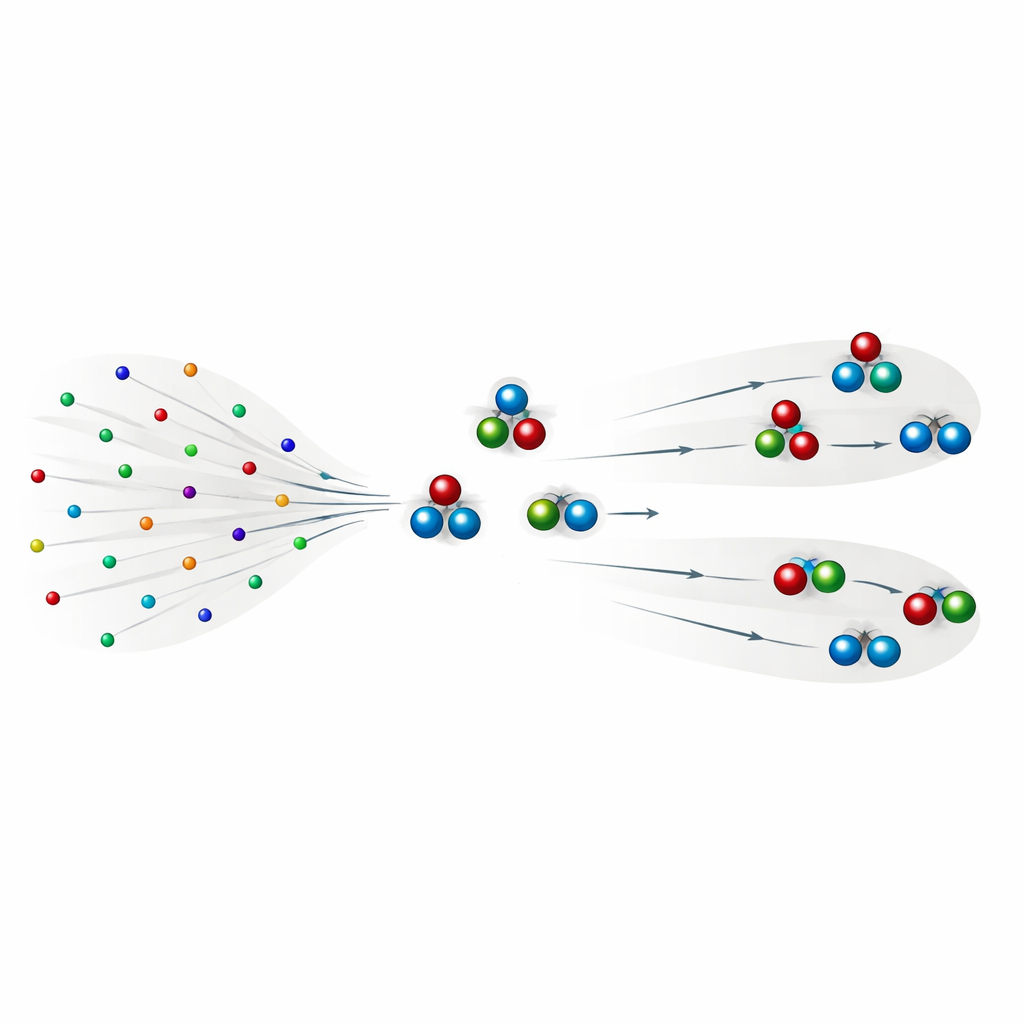
The new ALICE study tackles this puzzle by focusing on a particularly telling signature: how the flow differs between two broad families of particles, baryons and mesons. Baryons (such as protons and lambdas) are made of three quarks, while mesons (such as pions and kaons) contain a quark and an antiquark. In large heavy-ion collisions, an unmistakable pattern appears at intermediate transverse momentum: all baryons tend to share one flow curve, and all mesons another, with baryons flowing more strongly. This “baryon–meson grouping” is naturally explained if, just before ordinary particles form, quarks that are already moving collectively in the liquid simply join up—two at a time to make mesons, three at a time to make baryons. The new work measures this effect in great detail for many identified particle types in high-multiplicity proton–proton and proton–lead collisions.
What the measurements reveal
Using the ALICE detector’s capability to tell different particle species apart, the team extracted precise flow values as a function of momentum for pions, kaons, protons, neutral kaons and lambdas. They paid special attention to eliminating “non-flow” effects—short-range correlations from particle decays and jets that can mimic collective behavior—by correlating particles far apart in angle and by using sophisticated template fits. The resulting data show three key features that mirror those in large heavy-ion collisions: at low momentum, heavier particles flow less than lighter ones (a hallmark of an expanding fluid); around a few billion electron volts of transverse momentum, the different particle curves cross; and at higher values, baryons consistently exhibit a stronger flow than mesons, with the separation clearly standing out beyond statistical and systematic uncertainties.
Testing theoretical pictures
To interpret these patterns, the authors compare the data with advanced computer models. A hybrid model that combines fluid-like evolution of a quark–gluon medium with hadron formation through quark coalescence—and includes additional contributions from high-energy jets—reproduces both the overall size of the flow and the distinct grouping of baryons and mesons in small systems. In contrast, versions of the model that lack quark coalescence, or that rely only on hadronic rescattering or initial gluon correlations, fail to capture the observed baryon–meson separation. Other popular approaches succeed in mimicking some aspects, like low-momentum mass ordering, but still cannot generate the full flow pattern seen in the data.
What it means for our picture of matter
Taken together, the measurements and model comparisons point strongly to the presence of a genuine flowing quark–gluon stage even in the smallest, most violent proton–proton and proton–nucleus collisions—albeit for a fleeting instant and in a tiny volume. In everyday terms, the results suggest that under extreme conditions, matter made from quarks and gluons prefers to behave like a liquid, regardless of whether it starts from two huge nuclei or just a handful of protons. This pushes the frontier of how small a droplet of this primordial fluid can be, and deepens our understanding of how the fundamental building blocks of matter move and interact in the most extreme environments the laboratory can create.
Citation: The ALICE Collaboration. Observation of partonic flow in proton—proton and proton—nucleus collisions. Nat Commun 17, 2585 (2026). https://doi.org/10.1038/s41467-025-67795-1
Keywords: quark–gluon plasma, small collision systems, collective flow, quark coalescence, ALICE experiment