Clear Sky Science · en
Learning from nature: phytochemical strategies to protect against UV-B damage
Why sunlight can be both friend and foe
Sunlight powers nearly all life on Earth, but one slice of it—UV-B radiation—can damage the DNA, proteins, and membranes of plants we rely on for food. This review article explores how plants have evolved their own “natural sunscreens” and protective chemistries, and how scientists are now learning to harness these tricks of nature to breed crops that can better withstand a changing climate, while also improving their nutritional value for humans.
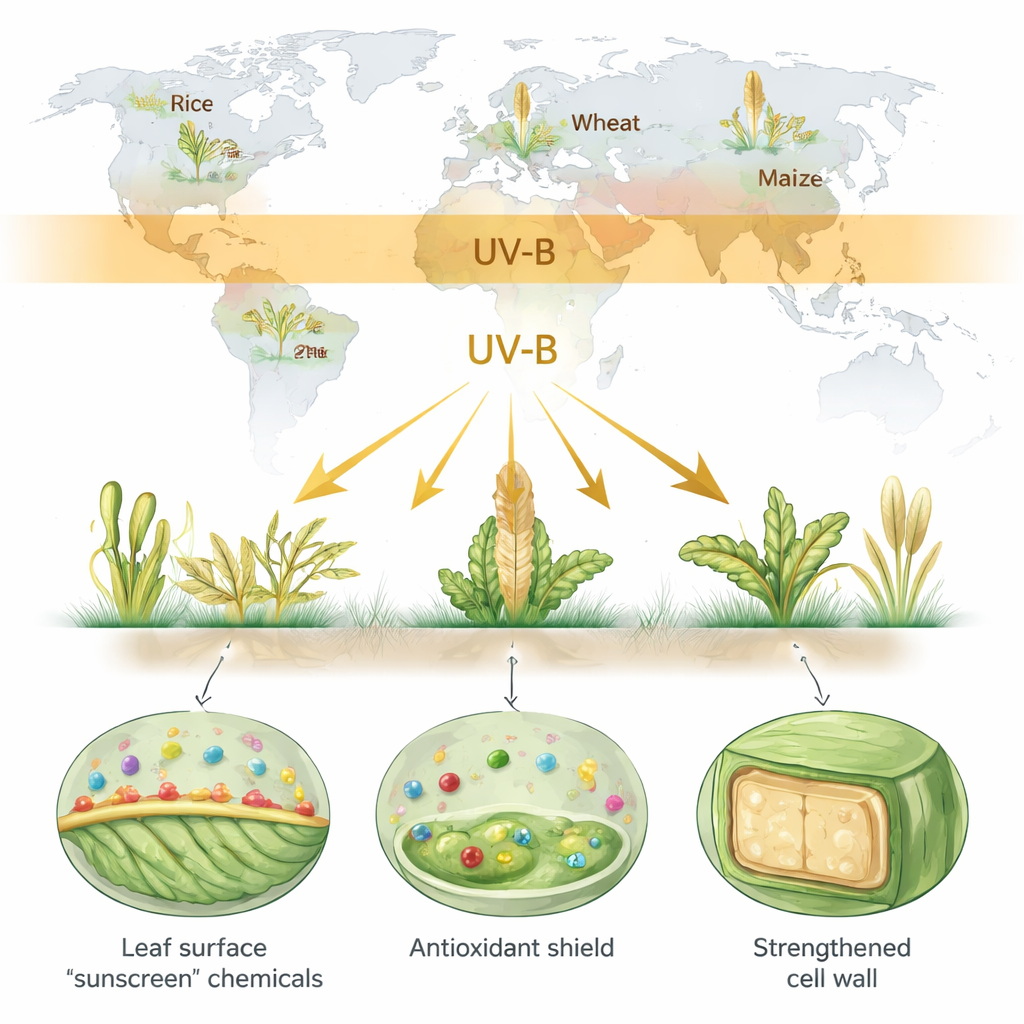
How UV light shapes life on land
When plants first colonized land, they left behind the shielding effect of water and suddenly faced much stronger UV-B radiation. Today, UV-B levels are highest around the equator and can fluctuate with altitude, cloud cover, and changes in the ozone layer. Even though global agreements have slowed ozone loss, climate change and air pollution still alter how much harmful UV-B reaches crops. Too much UV-B can stunt growth and reduce yields, but at moderate doses it can also boost disease resistance. This delicate balance means that understanding and managing UV-B exposure is increasingly important for global food security.
Plants’ chemical sunscreen toolkit
To survive under harsh sunlight, plants manufacture a wide range of small molecules that act as built‑in sunscreens and antioxidants. Many of these are colorful or aromatic compounds, such as flavonoids, phenylpropanoids, and vitamins like C and E. Packed in outer leaf layers, they soak up UV-B before it reaches sensitive tissues and neutralize the reactive oxygen by‑products that would otherwise damage cells. Some lineages have evolved especially powerful molecules, such as mycosporine‑like amino acids in algae or sinapate esters in the mustard family, that are finely tuned to absorb the wavelengths most harmful to living cells.
Genes, diversity, and natural experiments in sunlight
Different plant species—and even different varieties within a species—do not all respond to UV-B in the same way. By comparing many natural varieties of Arabidopsis, rice, barley, maize, buckwheat, and other crops, researchers have found genetic variants that control how much of each protective compound a plant makes. For example, specific genes in rice fine‑tune the production of flavonoids and tryptamine‑derived molecules, while high‑altitude barley and buckwheat varieties have been shaped by generations of strong UV exposure to stockpile potent UV‑absorbing pigments. These natural “sun‑lab” experiments show that boosting certain pathways can improve both UV tolerance and the content of health‑promoting antioxidants in our food.
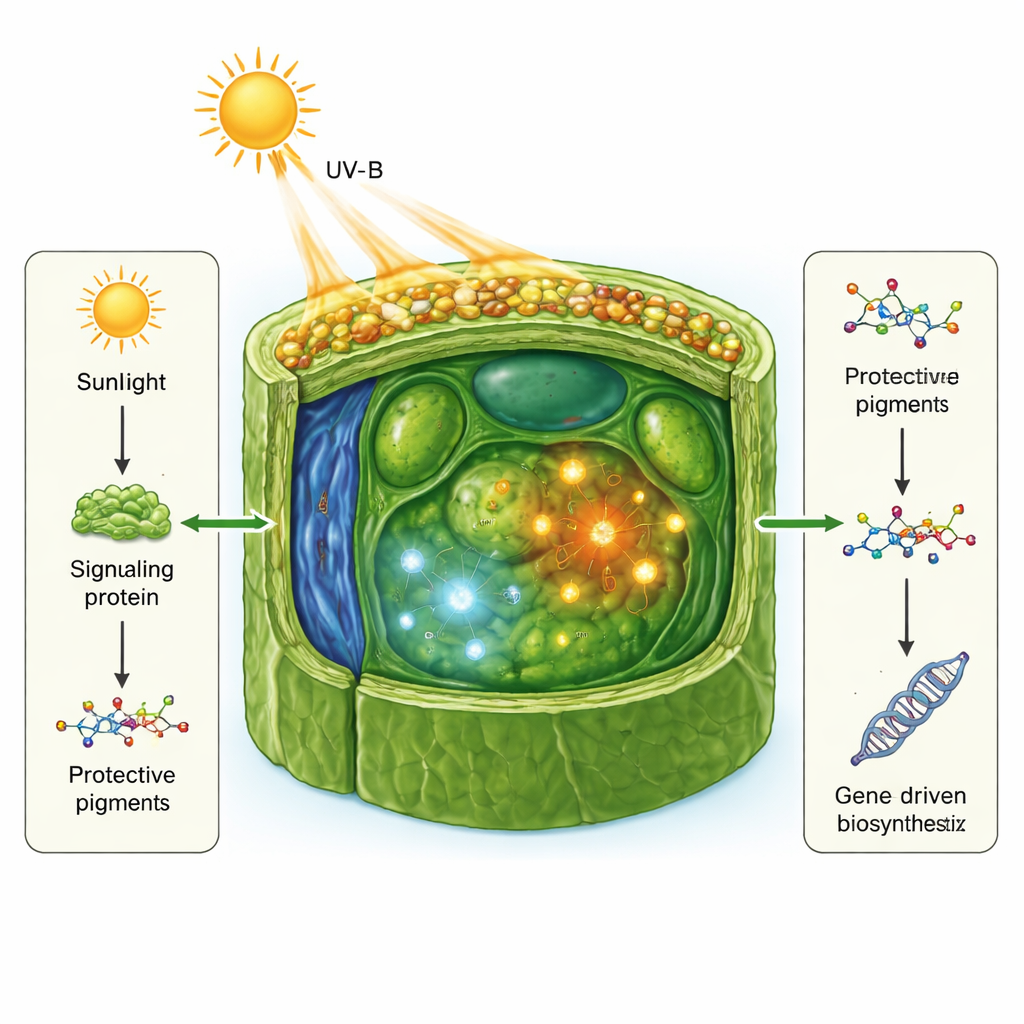
New tools: from cell maps to artificial intelligence
Modern technologies are allowing scientists to look more closely at where and when these protective molecules appear inside plants. Advanced imaging methods can map metabolites at the scale of individual cells, revealing how compounds are positioned in leaf skins, cell walls, or internal compartments to best block UV-B or quench damaging chemicals. At the same time, powerful data‑driven tools and machine‑learning models are being used to mine huge genetic and chemical datasets, predict new UV‑absorbing structures, and suggest the most promising gene targets for breeding or engineering more resilient, nutrient‑rich crops.
Stronger shields for future crops
Overall, the article concludes that plants already possess a remarkably sophisticated set of natural defenses against UV-B, built from a diverse mix of “sunscreen” pigments, antioxidants, and structural barriers in the cell wall. By understanding the genes and pathways behind these traits—and how they vary among wild and cultivated plants—researchers can design crops that are better matched to their local light environment. In practical terms, this means food plants that keep yielding reliably under harsher sun while also providing more beneficial phytochemicals in our diets, turning a potential climate‑driven threat into an opportunity to improve both agriculture and human health.
Citation: Bulut, M., Tohge, T., Chen, W. et al. Learning from nature: phytochemical strategies to protect against UV-B damage. Nat Commun 16, 9927 (2025). https://doi.org/10.1038/s41467-025-66135-7
Keywords: plant sunscreen, UV-B stress, flavonoids, crop resilience, antioxidants