Clear Sky Science · en
The contribution of mycetoma grains to suboptimal disease management
A Hidden Tropical Threat Under the Skin
Most people have never heard of mycetoma, yet a simple thorn prick in the wrong place can trigger this devastating disease. Mycetoma slowly eats away at feet, legs, and sometimes other body parts, causing swelling, deformity, and disability in some of the world’s poorest communities. This review article explores a peculiar hallmark of the disease—tiny compact clumps of microbes called “grains”—and explains how these stubborn structures help the infection persist despite surgery and powerful drugs.
What Is Mycetoma and Who Does It Affect?
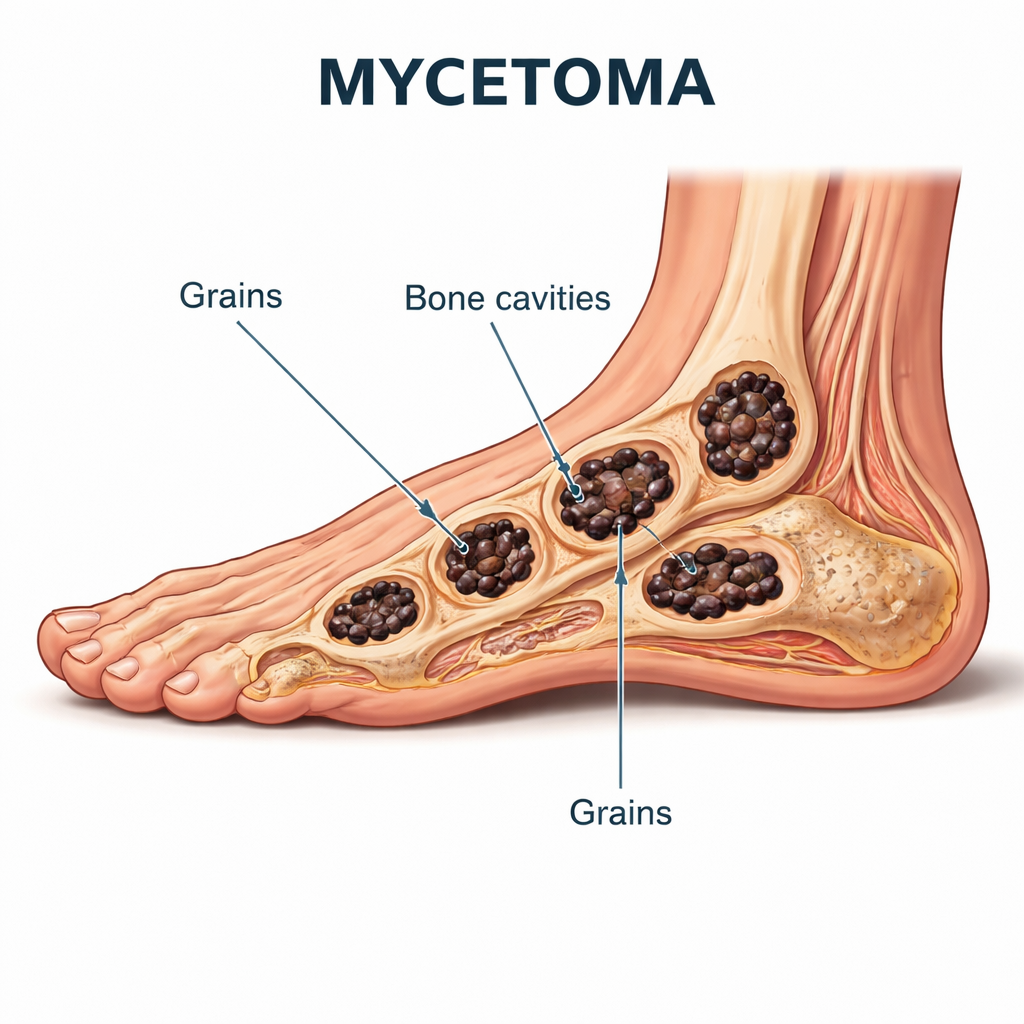
Mycetoma is a long‑lasting infection that mainly strikes people in tropical and subtropical regions who walk or work barefoot in fields and scrub. It is considered a neglected tropical disease because it causes major disability but receives little global attention. Patients usually develop a painless lump under the skin that gradually enlarges, forms draining channels, and releases small colored granules or grains. These grains can be black, white, red, or yellow depending on the microbe involved. Over time, the infection spreads along natural tissue planes into deeper structures and bone, creating multiple cavities and deformities, while tendons and nerves are often surprisingly spared.
From Soil Microbe to Chronic Infection
The microbes that cause mycetoma—certain fungi and filamentous bacteria—normally live in soil, plant material, animal dung, and even the walls of rural homes. Infection begins when a minor skin injury, such as a thorn puncture, pushes them into the tissue. The early stages are silent, and the incubation period is unknown, but eventually the microbes multiply and organize into grains surrounded by chronic inflammation and scarring. Why only some exposed people develop disease likely reflects a complex mix of microbial tricks, such as pigment production and enzyme release, and host factors like genetics and immune strength, which scientists are only beginning to unravel.
Grains: Microbial Fortresses Made with Human Material
Grains are dense micro‑fortresses in which the invading organisms are packed together and encased in a tough matrix. In fungal (eumycetoma) grains, especially those caused by Madurella mycetomatis—the leading agent in Sudan—the outer layers are dark due to melanin pigment. This pigment is made via several biochemical pathways and helps shield the fungus from immune attack, environmental stress, and antifungal drugs. Remarkably, detailed analyses show that the bulk of DNA and proteins within these grains come not from the fungus but from the patient: around 99% are human in origin. The cement‑like material also concentrates metals such as calcium, zinc, and copper, and contains lipids and proteins, all contributing to a hardened shell that drugs struggle to penetrate.
How the Body Fights Back—and Why It Often Fails
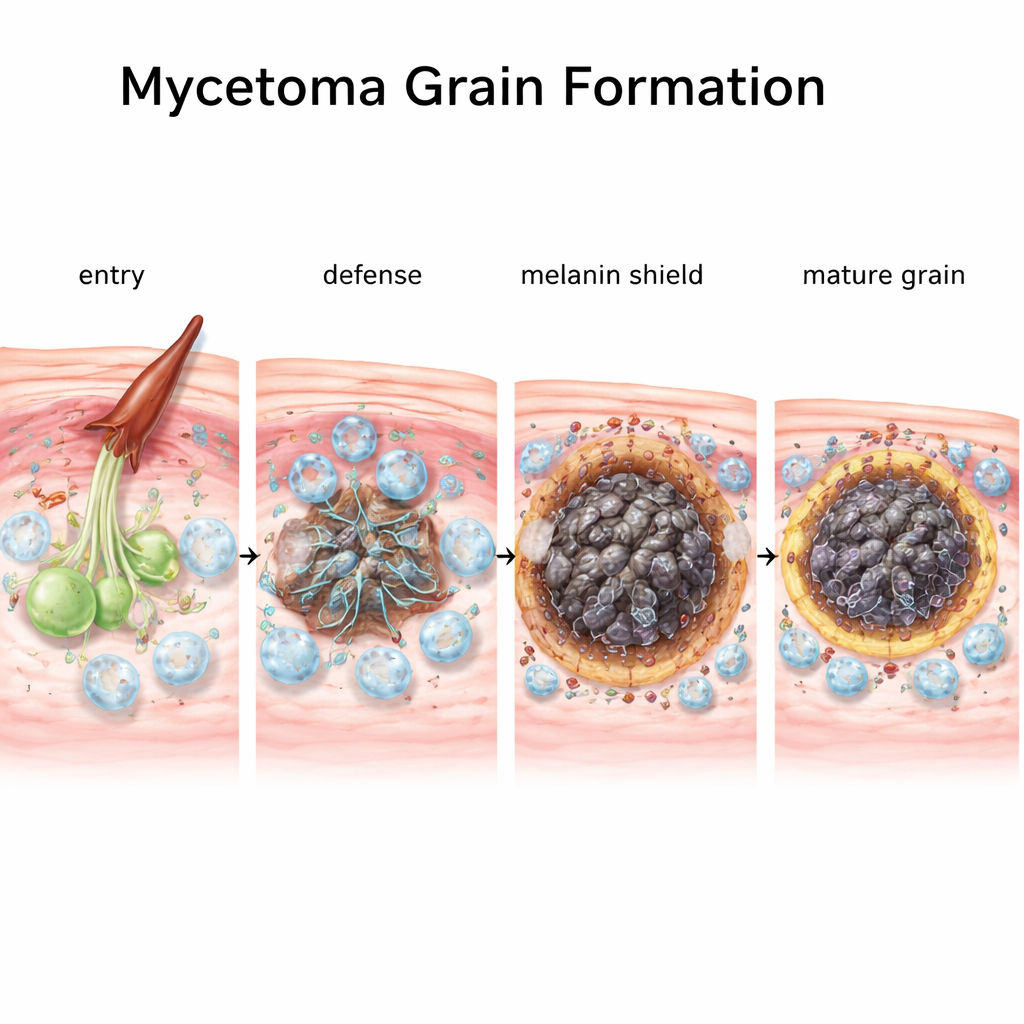
Under the microscope, grains are surrounded by shifting rings of immune cells. Early on, swarms of white blood cells called neutrophils crowd around and sometimes into the grain, releasing toxic molecules in an attempt to break it apart. Later, large scavenger cells and giant cells take over, engulfing fragments of the grain and pigment. In rare cases, the grain disappears completely, leaving behind a healed nodule, but most of the time the infection persists. Studies in animal models, including insect larvae and mammals, show that grain formation proceeds through stages: entry and recognition of the microbe, early immune attack, a burst of defensive pigment and matrix production by the pathogen, and finally a mature grain in which immune cells are largely excluded from the interior.
Different Microbes, Different Grains
When bacteria rather than fungi cause mycetoma (actinomycetoma), the grains have distinctive appearances but similar functions. Species such as Streptomyces somaliensis and Actinomadura madurae build grains from tangled bacterial filaments bound together by sugars, proteins, and strands of DNA, mixed with trapped immune cells and tissue debris. These grains can be yellow, white, or red, and range from soft to rock‑hard. Their structure not only helps doctors distinguish among causative microbes under the microscope but also influences how aggressively the disease behaves and how well it responds to treatment.
Why Understanding Grains Matters for Patients
To someone living with mycetoma, grains are not just microscopic curiosities; they are the reason infections last for years, require repeated surgeries, and may still end in amputation. By acting as armored shelters for the microbes, grains blunt the effects of both the immune system and medicines. The authors argue that truly effective control of mycetoma will depend on decoding how grains form, what makes their protective matrix so tough, and how host and microbe signals interact during this process. They call for modern tools—from genetics and molecular biology to bioinformatics and artificial intelligence—to design better diagnostics, track disease early, and develop treatments that can finally crack open these tiny fortresses and improve outcomes for affected communities.
Citation: Hassan Fahal, A., Ahmed, A.O., El Hassan, L. et al. The contribution of mycetoma grains to suboptimal disease management. Nat Commun 16, 9855 (2025). https://doi.org/10.1038/s41467-025-64908-8
Keywords: mycetoma, neglected tropical disease, fungal infection, granuloma, chronic wound