Clear Sky Science · en
The geroprotective potential of chalcones
Why plant molecules that slow aging matter
Most of us would like to grow old while staying healthy, mobile, and mentally sharp. Scientists now know that aging itself is a major risk factor for heart disease, diabetes, cancer, and brain disorders such as Alzheimer’s and Parkinson’s disease. This review explores an intriguing idea: certain natural compounds from plants, called chalcones, might tap into the body’s built‑in maintenance systems to slow aspects of aging and delay age‑related diseases. 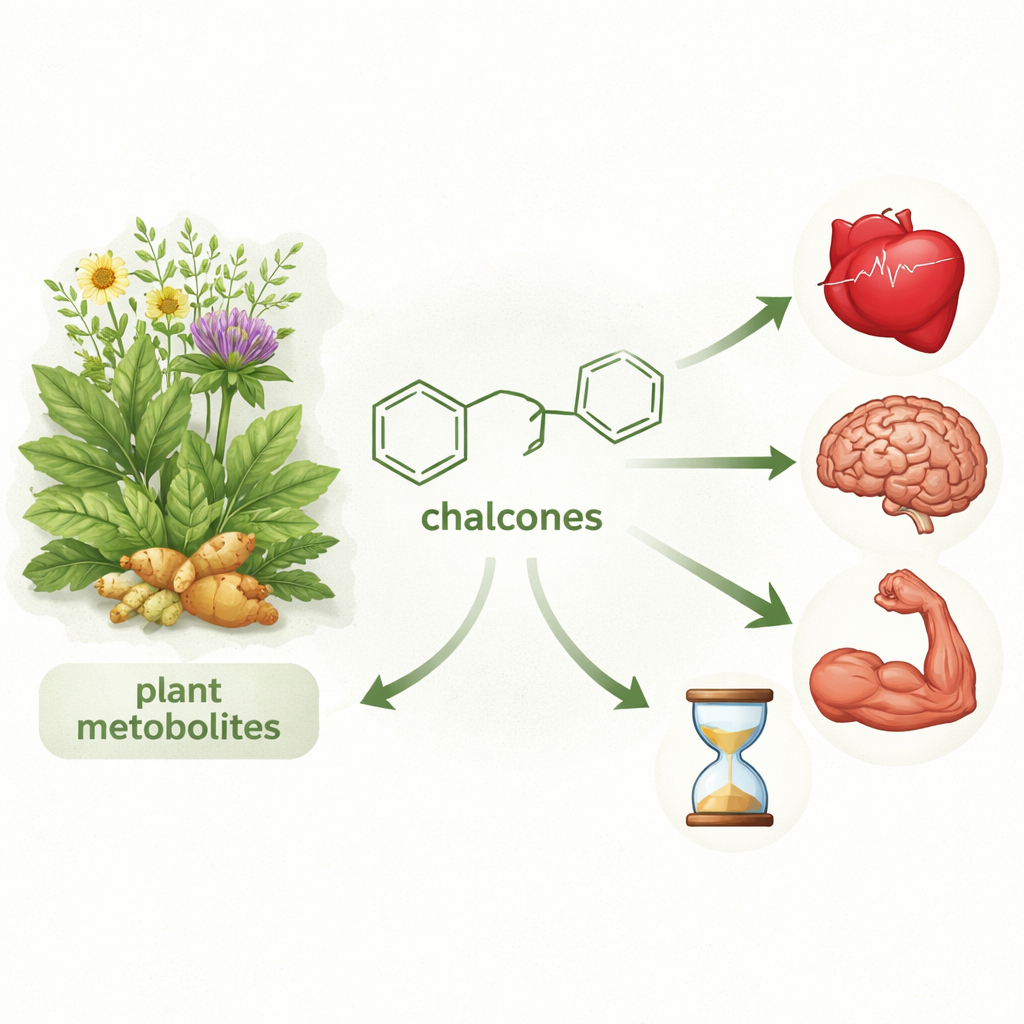
From harsh diets to “diet in a pill”
For decades, the most reliable way to extend healthy lifespan in animals has been to eat less. Caloric restriction and various forms of fasting can switch cells into a “survival and repair” mode, improving blood sugar control, heart health, and resistance to disease. A central player in this response is autophagy, the cell’s internal recycling program that breaks down worn‑out parts and harmful clutter. But strict long‑term dieting is difficult and can be unsafe for many people, so researchers have been searching for caloric restriction mimetics—drugs or natural molecules that trigger the same protective pathways without actually cutting calories.
Chalcones: colorful plant chemicals with hidden power
Chalcones belong to the large family of polyphenols found in fruits, vegetables, tea, coffee, cocoa, and herbs. Chemically, they share a simple backbone: two ring‑shaped units connected by a short chain, a structure chemists find easy to tweak and optimize. Traditional medicines have long used chalcone‑rich plants for ailments ranging from infections to high blood pressure. Modern studies now show that several well‑defined chalcones can extend life or improve health in yeast, worms, flies, mice, and human cells. They often act by boosting autophagy and by fine‑tuning the cell’s response to oxidative stress—reactive molecules that damage DNA, proteins, and fats.
Two standout molecules and how they work
One of the best‑studied chalcones is 4,4’-dimethoxychalcone, discovered in the long‑lived “tomorrow leaf” plant Angelica keiskei. This compound extends lifespan in simple organisms, helps heart tissue survive poor blood flow in mice, protects brain cells in models of Parkinson’s disease and traumatic brain injury, and even improves the quality of aging egg cells used in fertility treatments. It appears to act mainly by turning on autophagy through blocking specific gene switches called GATA transcription factors, by adjusting iron handling in cells, and by strengthening antioxidant defenses. Strikingly, it can also act as a senolytic, selectively killing old, dysfunctional “senescent” cells that drive chronic inflammation and many age‑related conditions. Another chalcone, 3,4‑dimethoxychalcone, activates a different pair of master switches, TFEB and TFE3, which ramp up the cell’s recycling centers (lysosomes). This leads to better recovery after heart and limb injuries, improved responses to cancer chemotherapy, and protection in models of spinal cord damage, artery clogging, and skin photoaging—again strongly linked to enhanced autophagy. 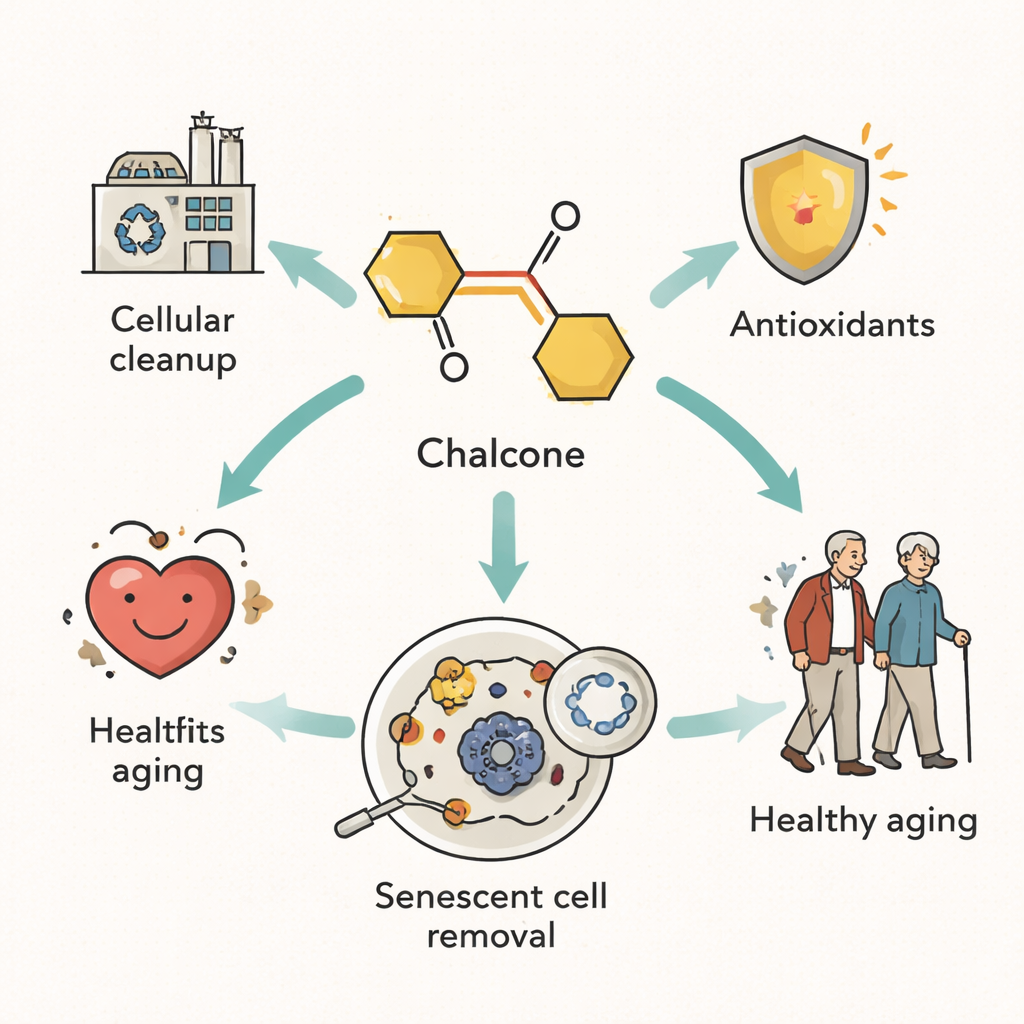
A wide toolkit against age‑related diseases
Beyond these two molecules, many other natural and synthetic chalcones show promise against specific age‑related problems. Some reduce inflammation and protect brain cells in models of Parkinson’s disease, stroke, and dementia. Others guard the heart and liver during stress, help clear toxic proteins, or combat obesity and fatty liver disease, sometimes by activating energy‑sensing enzymes that also promote autophagy. A few chalcones lengthen lifespan in tiny worms, and some activate the NRF2 pathway, a central regulator of the body’s antioxidant and detoxification genes. At the same time, chalcones can interact with estrogen and androgen hormones and the enzymes that make them, which may lead to sex‑specific benefits and risks that future studies must carefully map out.
From lab bench to real‑world aging
Despite their promise, chalcones are not yet proven anti‑aging drugs for humans. Most evidence comes from cells, worms, flies, and a limited number of mouse studies, so their long‑term safety, ideal doses, and true impact on human lifespan and healthspan remain unknown. Like many plant compounds, some chalcones may be poorly absorbed or rapidly broken down, requiring clever formulations or combinations to work well. Researchers also need to understand precisely which molecular targets each chalcone hits, and how to avoid unwanted effects on hormone balance. Still, because chalcones are relatively easy to synthesize and modify, they offer a flexible platform for designing next‑generation molecules that better engage the body’s recycling, antioxidant, and damage‑clearing systems. In the long run, optimized chalcone‑based treatments could become part of a broader toolbox—alongside lifestyle changes—to help more people enjoy longer, healthier lives.
Citation: Carmona-Gutierrez, D., Zimmermann, A., Kroemer, G. et al. The geroprotective potential of chalcones. Nat Commun 16, 9152 (2025). https://doi.org/10.1038/s41467-025-64167-7
Keywords: aging, chalcones, autophagy, plant compounds, healthy lifespan