Clear Sky Science · en
Neurodevelopmental commonalities in cognitive control networks for mathematics and reading in meta-analysis of 3308 participants
Why this research matters for everyday life
How well children learn to read and work with numbers shapes their school success, job prospects, and even long-term health. These skills often rise and fall together: kids who are strong readers are frequently strong in math, and those who struggle in one area often struggle in the other. This article asks a deceptively simple question with big practical implications: does the brain rely on a shared “control system” that helps us both read and do math, and does this system develop differently from childhood to adulthood?
Two school skills, one shared brain toolkit
Reading and mathematics look very different on the surface—letters versus digits, stories versus sums—but earlier work showed that scores in the two areas are strongly linked. The authors pulled together results from 179 brain imaging experiments, covering 3,308 people, to see whether this behavioral connection reflects common brain machinery. They focused on studies that compared easier versus harder tasks within each subject, such as simple versus complex arithmetic or word versus sentence reading. This allowed them to separate brain areas that handle basic perception from those that step in when mental effort, planning, and attention are required. 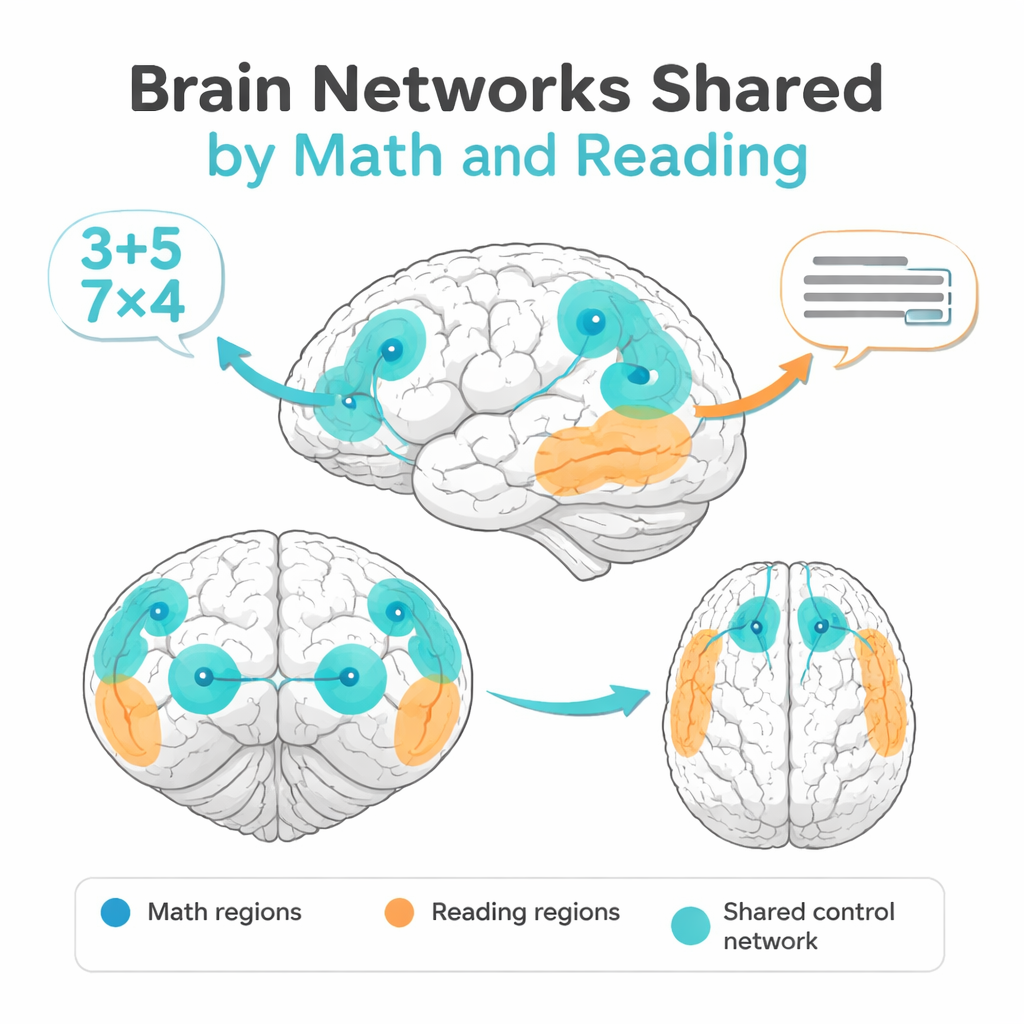
Math and reading have their own “home bases”
The meta-analysis confirmed that math and reading each rely on distinct sets of specialized regions. Number and arithmetic tasks mainly lit up parietal and frontal areas involved in processing quantity, spatial attention, and working memory. Reading tasks, in contrast, consistently engaged a left-sided network in the temporal and occipital lobes, including regions that decode written word forms and link them to sounds and meanings. These findings fit decades of research showing that arithmetic leans on brain systems that handle magnitude and stepwise problem solving, whereas reading leans on systems tuned to language and visual word recognition.
A common control hub for effortful thinking
Beyond these subject-specific “home bases,” the study found a striking overlap: both math and reading, especially when tasks were more demanding, repeatedly activated a shared set of control regions known as the salience network. Key hubs here include the anterior insula and the dorsomedial prefrontal cortex, areas thought to help us focus on what matters, switch between mental routines, and decide how much effort to invest. When adults and children tackled harder problems or more complex text, these hubs turned on regardless of whether they were dealing with numbers or words. Additional analyses of thousands of other imaging results showed that these hubs are also tied to general abilities such as attention, memory, and reasoning, reinforcing the idea that they form a domain-general control system.
How children’s and adults’ brains differ
The authors also compared brain patterns between children and adults. Children showed broader and stronger engagement of control networks during both math and reading, even for relatively simple tasks. Their parietal and temporal activations were also more widespread. Adults, in contrast, relied more heavily on streamlined, posterior “expert” regions that efficiently handle familiar symbols and facts, while still recruiting prefrontal control hubs when tasks became truly challenging. This pattern suggests a developmental shift: as experience and schooling tune specialized math and reading circuits, the brain can lean less on general-purpose control for routine problems, reserving it for moments that genuinely demand extra effort. 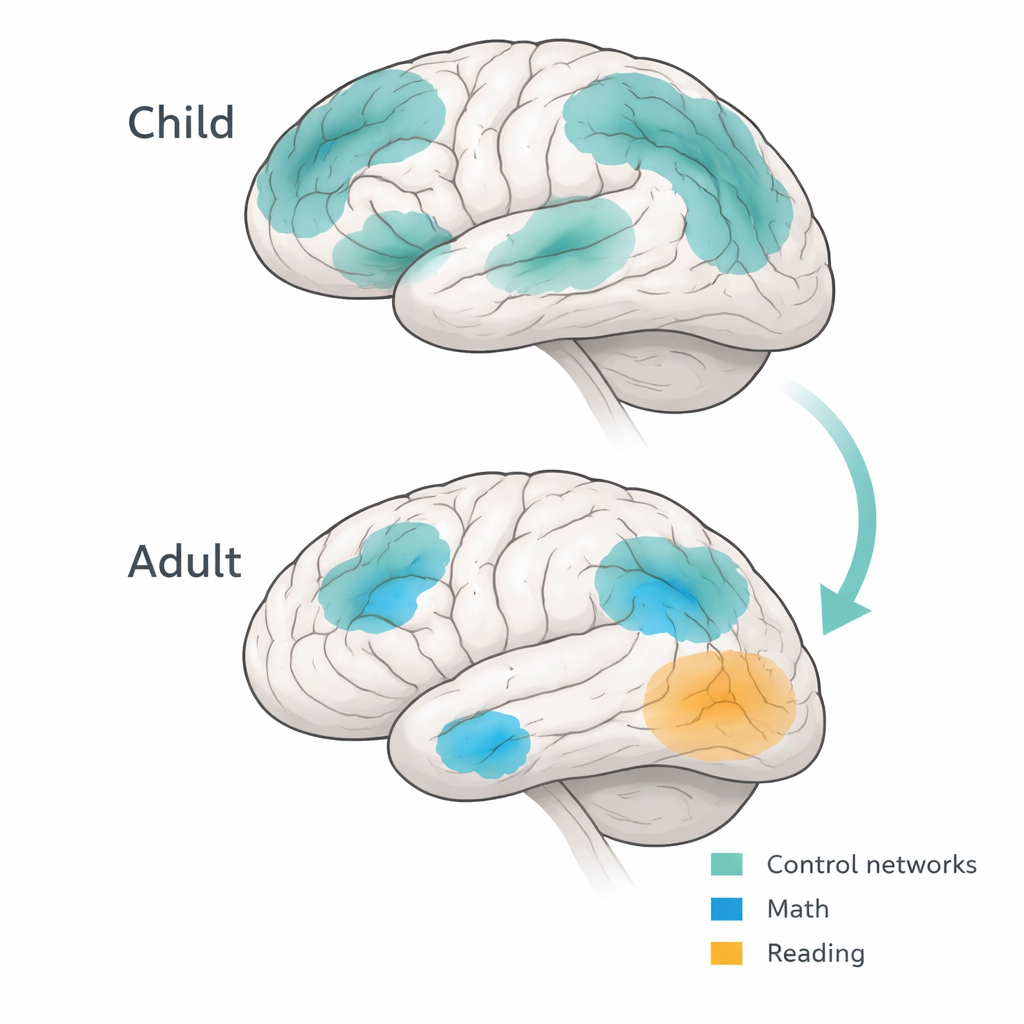
What this means for learning and difficulties
Altogether, the review supports the idea that a common cognitive control network helps drive success in both math and reading, rather than the similarities being a loose by-product of many unrelated processes. The ability to sustain focus, flexibly switch strategies, and coordinate different brain systems—functions tied to the anterior insula and dorsomedial prefrontal cortex—appears central to learning in both domains. This shared architecture may help explain why learning problems in math and reading so often occur together, and why interventions that boost attention, motivation, and strategic thinking can improve achievement across subjects. For parents, teachers, and clinicians, the message is clear: supporting children’s general cognitive control skills is not just a bonus—it is a core ingredient in helping them become confident readers and problem solvers.
Citation: Ünal, Z.E., Park, Y., Simsek, E. et al. Neurodevelopmental commonalities in cognitive control networks for mathematics and reading in meta-analysis of 3308 participants. Nat Commun 16, 8398 (2025). https://doi.org/10.1038/s41467-025-63259-8
Keywords: cognitive control, math and reading, brain development, salience network, learning difficulties