Clear Sky Science · en
Microbial consortia for the conversion of biomass into fuels and chemicals
Turning Plant Waste into Everyday Products
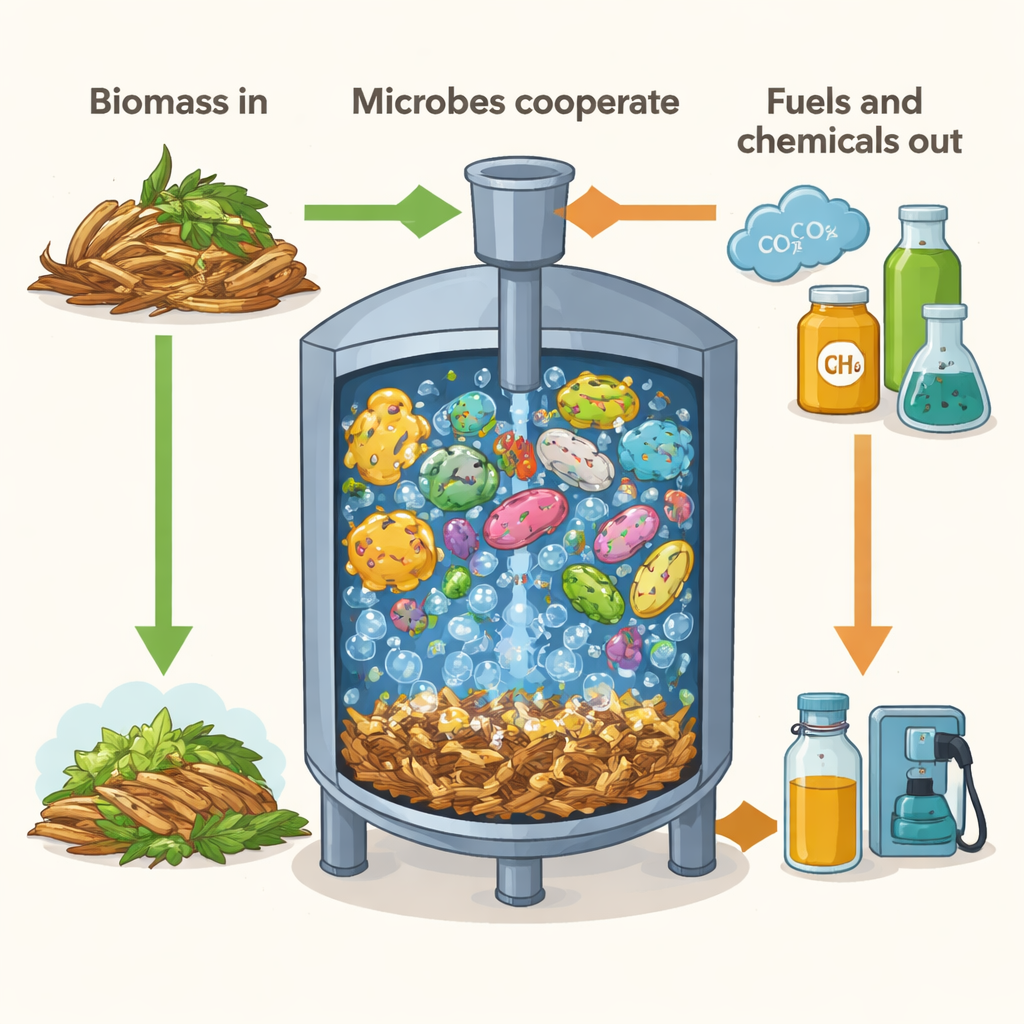
Every year, farms and forests leave behind mountains of inedible plant leftovers—stalks, straw, wood chips, and other residues. Much of this material is burned or left to rot, even though it is rich in carbon. This article explores how teams of microbes, working together in carefully designed communities, could turn this tough plant waste into fuels, plastics, and other chemicals we now get from oil. If successful, these living factories could help reduce our reliance on fossil resources while making better use of agricultural and forestry waste.
Why Tough Plant Matter Is Hard to Use
Plant stems and wood are built from a stubborn composite called lignocellulose. It is made of three intertwined parts: cellulose (chains of sugar), hemicellulose (a mix of different sugars), and lignin (a complex, glue-like aromatic material). This structure protects plants and makes them stand up—but it also makes the material hard to break down. Today’s biofuel plants mostly use easy sugars from starch or simple plant juices. Only a tiny fraction of global ethanol, for example, comes from lignocellulosic feedstocks, because the processes are expensive and leave a lot of the plant mass unused.
Microbial Teams and Division of Labor
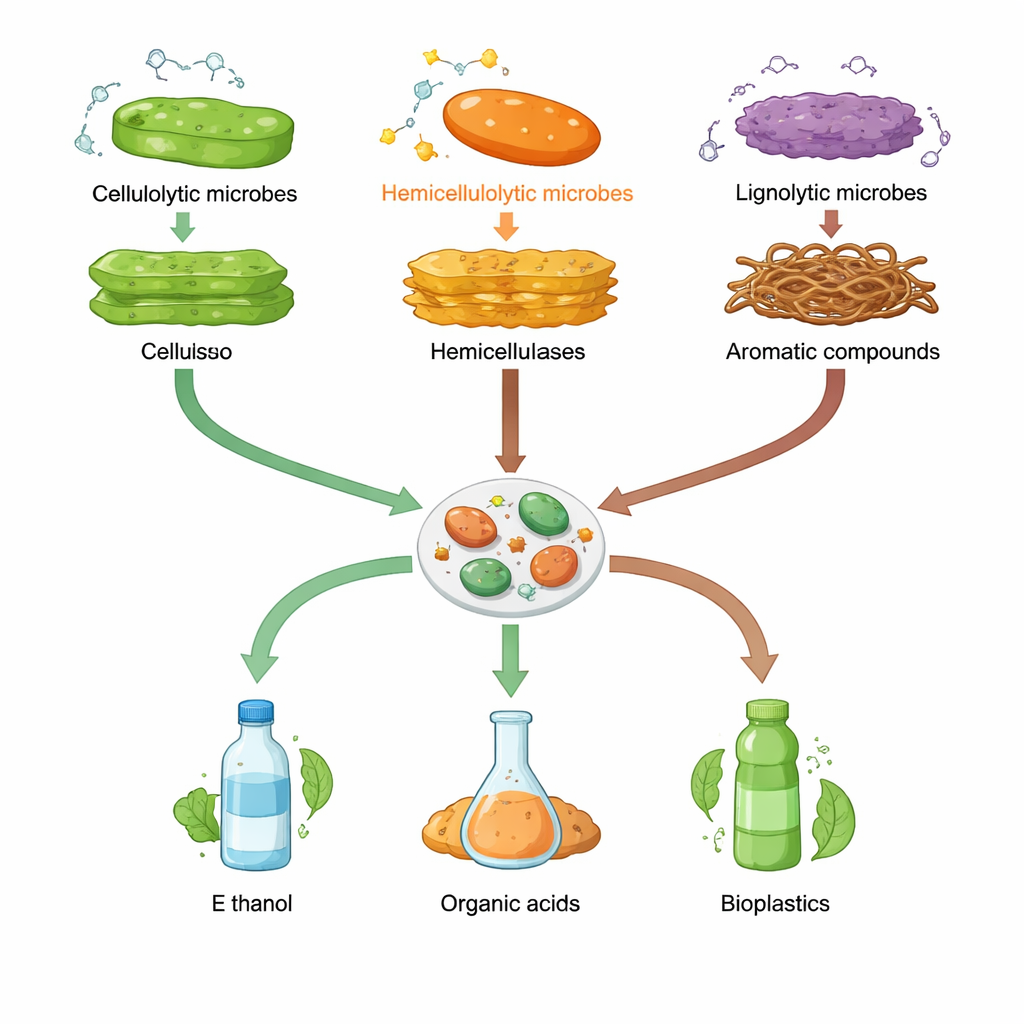
In nature, lignocellulose is routinely dismantled by diverse microbial communities in places like soil, compost heaps, and the stomachs of cows. Instead of one “super microbe” doing everything, these communities divide the work. Some microbes specialize in cutting up cellulose, others attack hemicellulose, and others still can handle the stubborn lignin. Their combined actions turn plant polymers into small molecules—sugars, acids, gases—that other microbes convert into biogas, organic acids, or other products. This division of labor reduces the burden on any single microbe and tends to produce stable, resilient ecosystems that resist disturbances.
From Natural Communities to Designer Consortia
Industry is trying to harness this natural teamwork in two main ways. One approach starts from rich natural communities, such as those in animal guts or wastewater plants, and gently “domesticates” them through selective conditions to enrich useful members. These communities are powerful but complex, making them hard to fully understand or precisely control. The other approach builds simpler, synthetic consortia from a small number of well-known species. Here, engineers choose a cellulase-producing fungus, a sugar-fermenting yeast, or a bacterium that turns plant-derived molecules into a specific product, and assemble them like parts in a machine. Synthetic consortia are easier to study and tune, but they can be fragile and unstable over time.
Keeping Microbial Communities in Balance
For these microbial teams to work in large tanks, their members must coexist without one outgrowing or poisoning the others. The review highlights several strategies to keep balance. Some rely on engineered communication systems, where microbes send chemical signals to slow growth, self-destruct, or produce toxins only when needed. Others make strains dependent on each other’s nutrients, so no one type can take over. Physical tricks also help: growing oxygen-loving fungi on membranes while oxygen-sensitive bacteria live deeper in the liquid, or encapsulating one partner in a gel that creates a protective niche. In advanced setups, light or electrical signals are used as external “dials” to nudge community composition during a process.
Watching and Guiding Living Factories
Because these communities are complex and dynamic, scientists are developing new tools to monitor and model them. Microfluidic chips and imaging methods let researchers study how microbes interact in tiny, structured environments. Spectroscopic tools and clever fluorescent tags can track which species are present and how stressed they are, even in messy mixtures that contain solid plant particles. At the same time, mathematical models are being built to predict which combinations of species and interactions will be most stable and productive, and to design control loops that automatically adjust light, nutrients, or signals to keep the community on target.
What This Could Mean for a Low‑Carbon Future
The authors conclude that microbial consortia are well matched to the difficult task of converting tough plant biomass—and even carbon dioxide—into useful products. Natural communities already show what is possible, but widespread industrial use will depend on making synthetic communities that are predictable, stable, and easy to control. As new tools for monitoring, modeling, and steering microbial behavior mature, and as processes are redesigned to use all parts of the plant and combine multiple steps in one tank, consortia-based biorefineries could move from lab demonstrations to commercial reality, turning what is now waste into a key resource for a more sustainable chemical industry.
Citation: Troiano, D.T., Studer, M.HP. Microbial consortia for the conversion of biomass into fuels and chemicals. Nat Commun 16, 6712 (2025). https://doi.org/10.1038/s41467-025-61957-x
Keywords: lignocellulosic biomass, microbial consortia, biofuels, biorefineries, synthetic ecology