Clear Sky Science · en
2D computational photodetectors enabling multidimensional optical information perception
Seeing More Than Meets the Eye
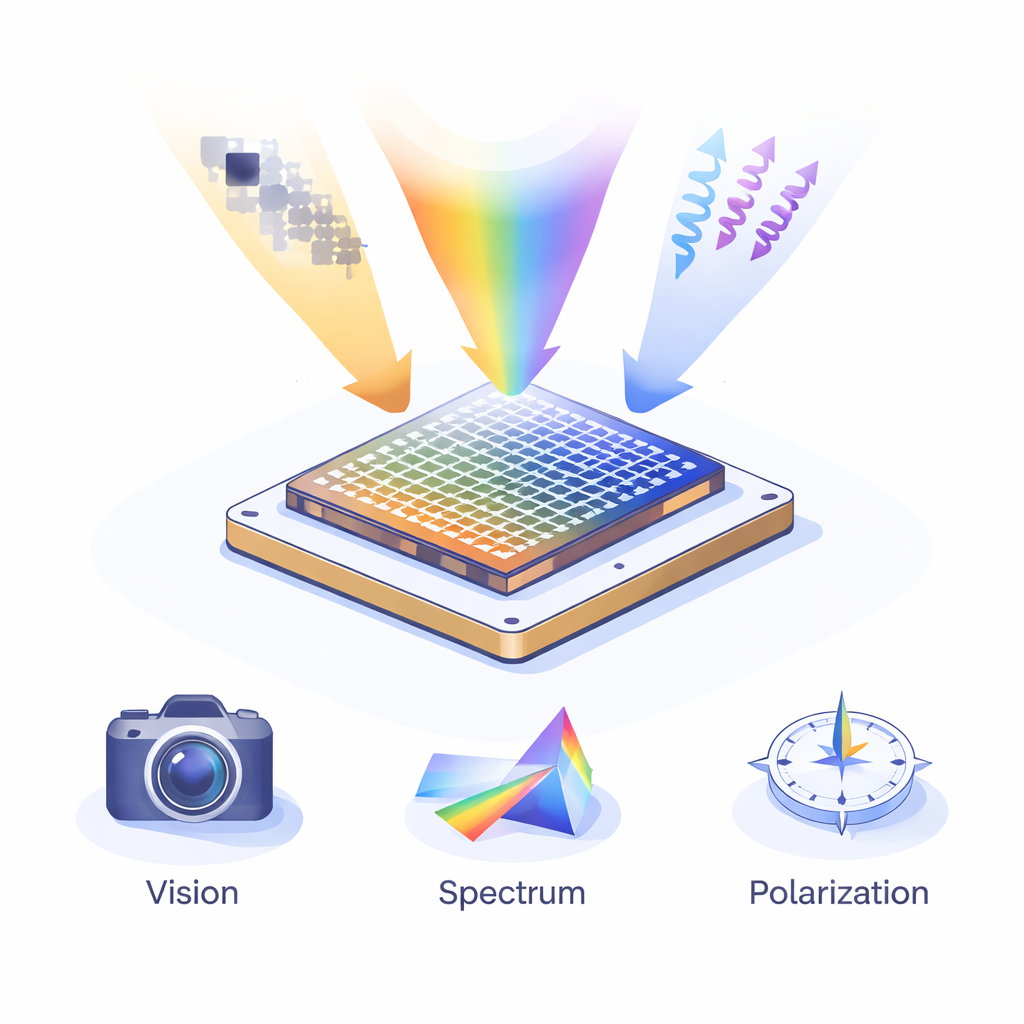
Every beam of light that reaches our eyes carries far more than just brightness and color. It also has a unique “signature” in time, wavelength, and polarization that can reveal what objects are made of, how they move, and even whether a signal has been tampered with. This article reviews a new class of ultra-thin light sensors made from two-dimensional (2D) materials that can read several of these hidden layers of information at once, while also performing some of the data processing on the chip itself. Such capabilities could transform environmental monitoring, medical imaging, and secure optical communications.
New Eyes Built from Atom-Thin Materials
The authors focus on 2D van der Waals materials—crystals only a few atoms thick whose layers are held together by weak forces. Because they are so thin and clean at the surface, these materials interact strongly with light yet generate relatively little electronic noise. Different 2D materials can be stacked like Lego bricks without worrying about crystal matching, allowing engineers to build custom “sandwiches” that respond to particular colors or polarizations of light. The review explains how these stacks can be wired so that light is not only detected but also encoded, filtered, and partially analyzed directly in the detector, reducing the need for bulky lenses, prisms, and separate processors.
Borrowing Tricks from the Retina
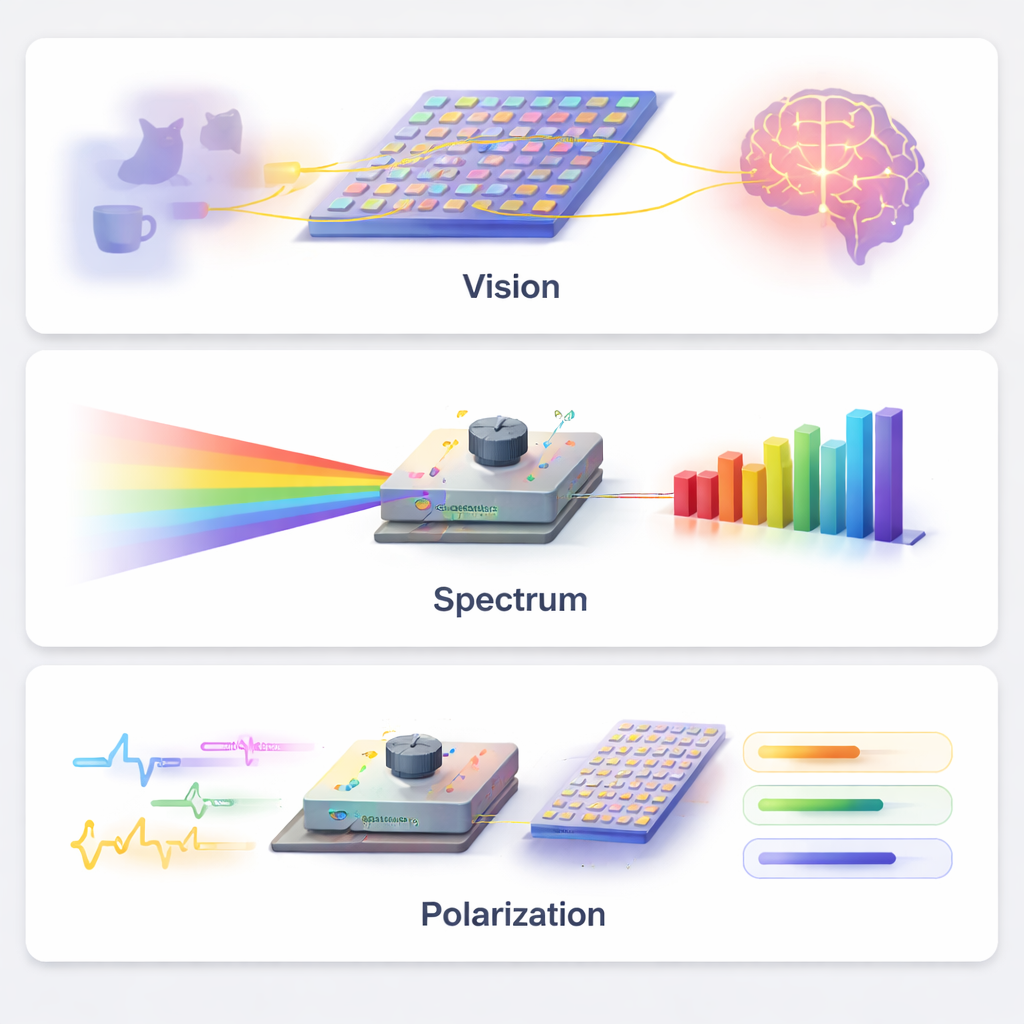
A major theme is neuromorphic vision—sensors that behave more like a retina than a traditional camera. Conventional image chips capture complete frames at fixed rates and send huge volumes of raw data to a computer. By contrast, 2D neuromorphic sensors can strengthen or weaken their response based on recent light history, mimicking how biological synapses learn. This lets them filter out noise, enhance edges, adapt to very dark or extremely bright scenes, and even encode motion as bursts of electrical spikes rather than continuous images. Different operating modes handle static scenes, moving objects, or sudden events, allowing real-time detection with lower power and less data traffic.
Shrinking the Spectrometer to a Single Pixel
Another section describes “computational spectrometers” built from a single 2D photodetector instead of the usual arrangement of gratings and detector arrays. Here, the detector’s color response is tuned electrically: by changing a voltage or bias, the same tiny pixel responds differently across wavelengths from the visible to the mid-infrared. During a calibration step, the device learns how its electrical signals relate to known input spectra. Later, when it measures an unknown light source, software reconstructs the full spectrum from a handful of current readings. In some designs, deep-learning models are trained to handle highly nonlinear responses, reaching sub-nanometer resolution in devices not much larger than a dust grain.
Reading the Twist of Light
Light is also characterized by polarization—how its electric field wiggles as it propagates—which is captured by four numbers called the Stokes parameters. The review surveys miniature polarimeters that use twisted stacks of 2D materials or 2D–metasurface combinations to extract these parameters on a chip. By carefully arranging layer orientations or nano-patterned metal structures, the devices convert different polarization states into distinct electrical signals. Some systems can recover the full polarization state with only a few output channels, and several combine these measurements with machine learning to decode intensity, color, and polarization simultaneously, in areas only tens of micrometers across.
Toward Intelligent, All-in-One Light Chips
The authors conclude that 2D computational photodetectors are poised to become the building blocks of “intelligent pixels” that not only sense light, but also remember, analyze, and classify it on the fly. Future work aims to expand their usable brightness range, push spectral coverage deeper into the ultraviolet and infrared, and add sensitivity to more exotic light structures such as vortex beams. At the same time, researchers are developing large-area growth and integration methods so that these tiny, smart detectors can be tiled into practical camera and sensor arrays. For non-specialists, the key message is that cameras, spectrometers, and polarimeters are slowly merging into compact, programmable chips that will let machines see the world in far richer detail than the human eye.
Citation: Wang, F., Fang, S., Zhang, Y. et al. 2D computational photodetectors enabling multidimensional optical information perception. Nat Commun 16, 6791 (2025). https://doi.org/10.1038/s41467-025-61924-6
Keywords: 2D photodetectors, neuromorphic vision, computational spectrometer, polarization imaging, multidimensional optics