Clear Sky Science · en
Vulnerability of mineral-organic associations in the rhizosphere
Why roots matter for hidden soil carbon
Soils store more carbon than the atmosphere and all plants combined, much of it tucked away where we cannot see it: in tiny partnerships between minerals and organic matter. For years, scientists have treated these mineral–organic associations as long‑term vaults that lock up carbon for centuries. This review challenges that simple picture. It shows that the narrow zone of soil around living roots—the rhizosphere—is not just a site where new carbon is stored, but also a hotspot where that stored carbon can be shaken loose and returned to the air.
How soil minerals hold on to carbon
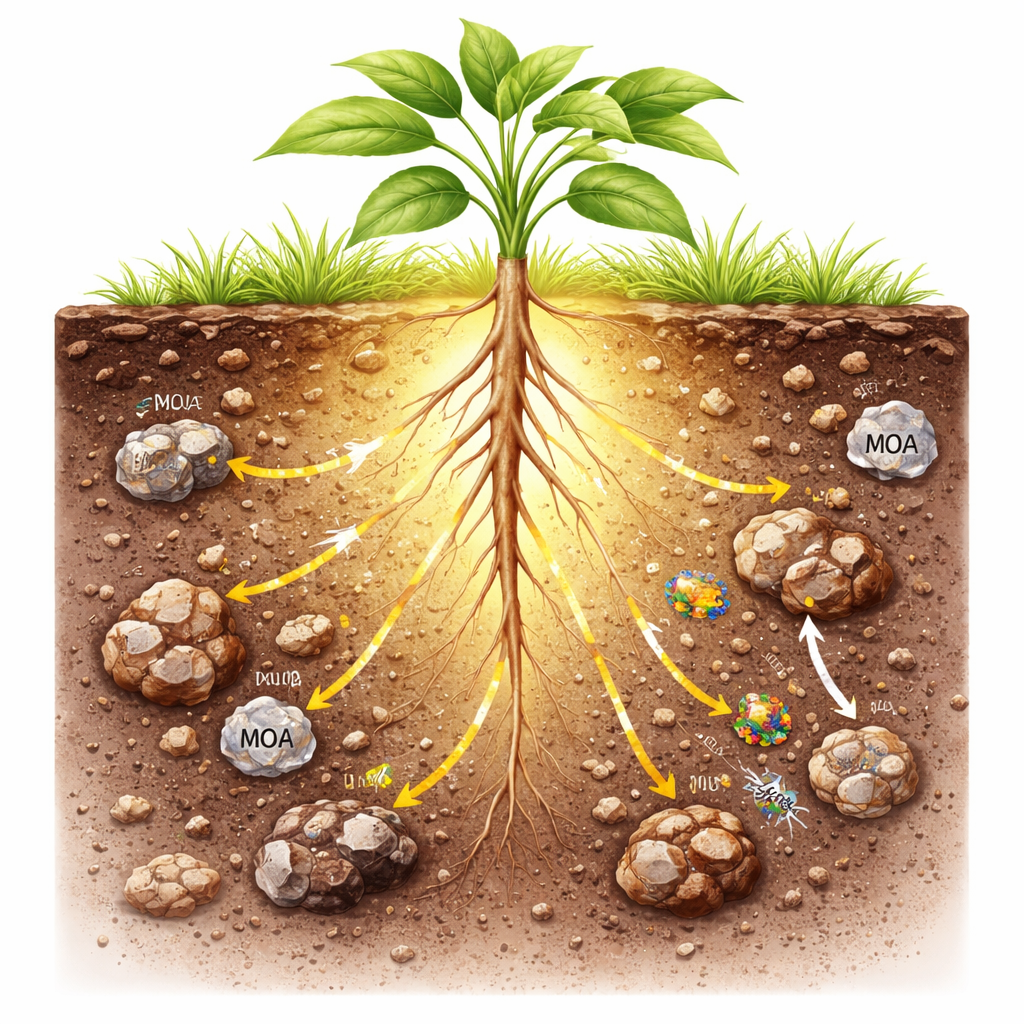
Organic matter in soil, including root exudates and dead microbial cells, sticks to reactive minerals like iron and aluminum oxides or clays, forming what scientists call mineral–organic associations. These associations slow down the access of microbes and enzymes to carbon, helping it persist. The strength of this protection depends on properties of both partners: the size and chemical groups of the organic molecules, and the type, crystallinity, charge, and porosity of the minerals. Small, simple compounds often form weaker, more easily reversed bonds, while large polymers with many contact points can be tightly anchored or even trapped inside tiny pores or newly formed mineral coatings.
Roots as both builders and breakers
Plants send 40–60 percent of their photosynthesized carbon belowground as a diverse mix of sugars, acids, mucus‑like gels, and dead root material. This input helps build mineral–organic associations and is a major reason soils are such large carbon reservoirs. Yet the same root zone is chemically restless. Roots and their microbes release organic acids, metal‑binding compounds, and enzymes; they change pH, draw down oxygen, and alter water movement and solute concentrations. The authors argue that these processes not only build new associations but can also disrupt existing ones, making once‑protected carbon mobile and available for decomposition.
Three main ways the lock can be picked
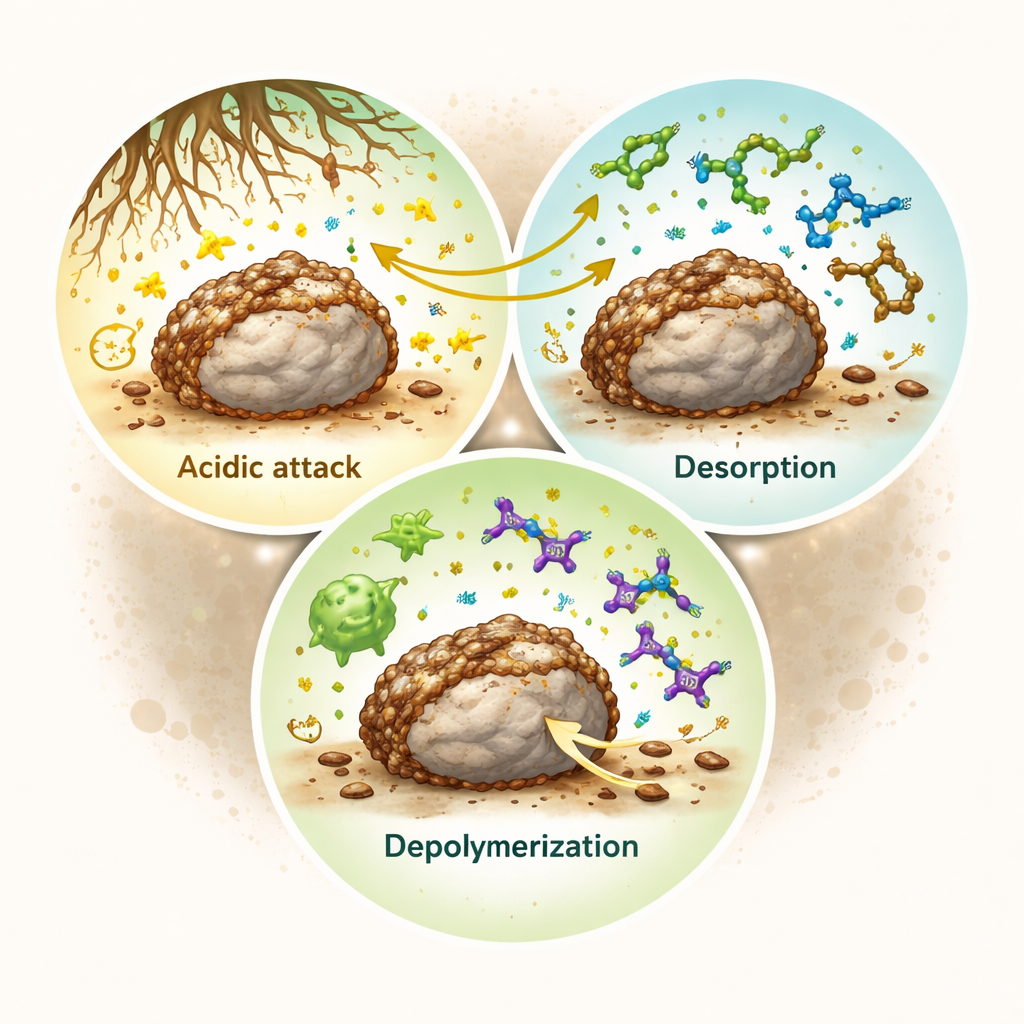
The review groups disruption into three broad mechanisms. First, dissolution: acids, strong metal‑binding molecules, or reducing agents can dissolve parts of the mineral itself, carrying attached organic matter into solution. This particularly threatens poorly ordered iron, aluminum, and manganese oxides that are otherwise strongly linked to long‑term carbon storage. Second, desorption: fresher compounds or changing concentrations in the soil water can swap places with bound organic matter or push it off mineral surfaces, especially when the original bonds are weak or involve only a few attachment points. Third, depolymerization: enzymes and reactive oxygen species can snip large, mineral‑bound molecules into smaller fragments, some of which detach and become easier for microbes to consume.
What makes some soils more at risk than others
Not all soils are equally vulnerable. The balance between formation and disruption of mineral–organic associations depends on which minerals dominate, what kinds of plants and microbial partners are present, and how roots shape their immediate environment. In humid, oxide‑rich tropical and temperate soils, root strategies that rely on strong acids and metal‑binding compounds may favor mineral dissolution and ligand exchange. In clay‑rich or calcium‑rich soils, gentler exchange reactions, dispersion of loose aggregates, and enzymatic depolymerization may be more important. Because root activity and rhizodeposition vary over millimeters in space and hours to years in time, disruption likely occurs in pulses and hotspots, not smoothly across the profile.
Why this matters for climate and land management
Many climate and soil‑health strategies assume that simply increasing root growth will lock away more carbon by feeding mineral‑organic associations. This review argues that such strategies are incomplete unless they also account for how roots and microbes can unlock those same stores. The authors propose a “vulnerability spectrum” that links specific types of mineral–organic associations to the processes most likely to disrupt them in different ecosystems. Incorporating both formation and disruption into models should improve predictions of how soil carbon responds to warming, changing rainfall, and land use. For policymakers and land managers, the message is clear: boosting root inputs can help store carbon, but only if we understand and manage the conditions that keep mineral‑bound carbon from being rapidly returned to the atmosphere.
Citation: Bölscher, T., Cardon, Z.G., Garcia Arredondo, M. et al. Vulnerability of mineral-organic associations in the rhizosphere. Nat Commun 16, 5527 (2025). https://doi.org/10.1038/s41467-025-61273-4
Keywords: soil carbon, rhizosphere, mineral–organic associations, root exudates, climate feedbacks