Clear Sky Science · en
Un(der)explored links between plant diversity and particulate and mineral-associated organic matter in soil
Why the variety of plants in a field matters
When we think about fighting climate change, forests and fields often come to mind as giant vacuum cleaners for carbon dioxide. But much of that carbon does not stay in leaves or wood; it ends up hidden in the soil. This article explores how the number and mixture of plant species growing on the surface can change how much carbon soil can lock away, and how long that carbon stays put. Understanding these links can help farmers, foresters, and land managers turn soils into stronger, more reliable carbon banks.
Two hidden carbon banks under our feet
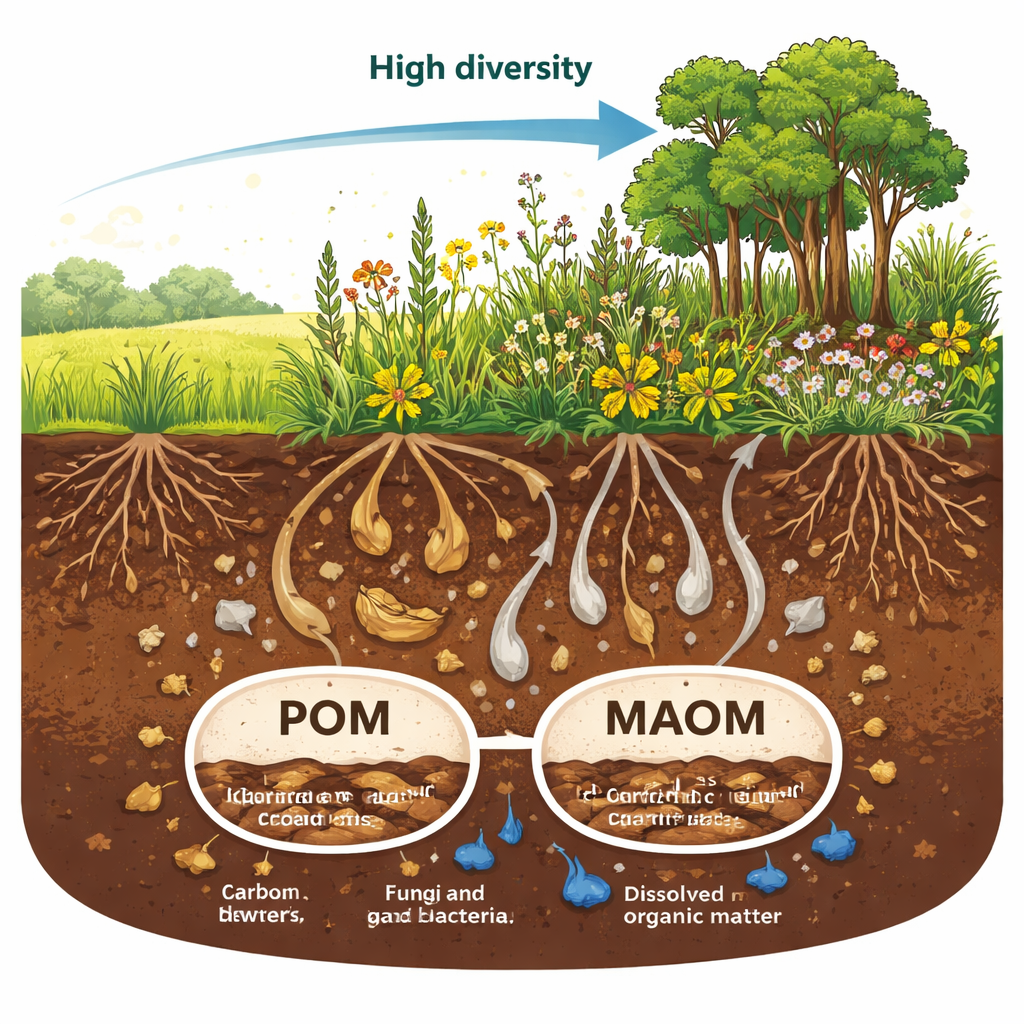
The authors focus on two main forms of soil organic matter. One is particulate organic matter (POM), made of recognizable bits of dead roots and leaves that are only partly broken down. POM is relatively "fast" carbon: it can build up quickly, but it can also be lost quickly when conditions favor rapid decay. The other form is mineral-associated organic matter (MAOM), in which tiny fragments of organic material are stuck to soil minerals or locked in very small clumps of soil. MAOM tends to hold carbon for decades to centuries. The article argues that to understand how plant diversity shapes total soil carbon, we must ask separately what it does to these two very different pools and how close a given soil is to its capacity to store MAOM.
How many plant species change soil life and carbon flows
Richer plant communities usually produce more biomass above and below ground, sending more litter and roots into the soil. Diverse mixtures can slow the breakdown of fallen leaves when chemical compounds from different species interfere with decomposers, or speed it up when they create better moisture and nutrient conditions. At the same time, a greater variety of roots and exudates (the sugary and other compounds leaked by living roots) feeds a more abundant and often more diverse community of microbes and soil animals. Earthworms and other "bioturbators" pull surface litter deeper into the soil, while microbes turn plant material into their own biomass and, when they die, leave behind residues that can become MAOM. In this way, plant diversity influences not just how much carbon enters the soil, but also how it is transformed and where it ends up.
The importance of soil type and unused storage space
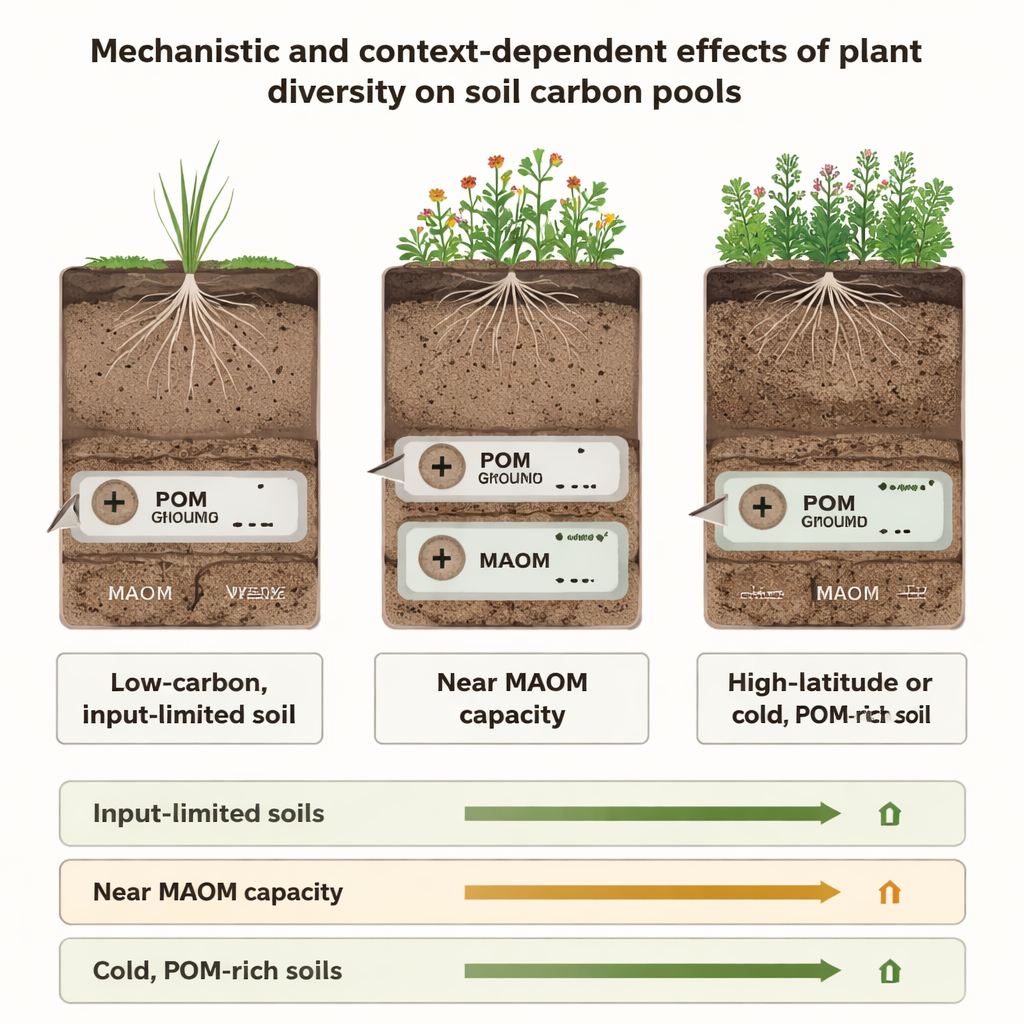
The same plant-diversity change does not have the same effect everywhere. The authors propose that plant diversity boosts soil carbon most strongly where soils are hungry for organic inputs and still have plenty of free mineral surfaces for MAOM to form, such as newly formed soils, degraded agricultural fields, or deeper layers. In these settings, more diverse vegetation can increase both POM and MAOM. In older, carbon-rich soils that are already close to their capacity to store MAOM, extra plant diversity may still add carbon, but mainly by building POM. Here, gains are smaller and easier to reverse, because POM is more vulnerable to rapid loss when conditions change.
When more diversity does not mean more carbon
Plant diversity can also set in motion processes that cancel out some of the gains. By stabilizing microclimate—keeping soils moister and temperatures more even—it can create better conditions for microbes to respire carbon dioxide back into the air. More dissolved organic matter from roots and decomposing litter can stick to minerals and build MAOM, but it can also wash off older organic matter, freeing it to decompose. In cold, POM-rich soils, such as in high-latitude or permafrost regions, warming and improved conditions for microbes may speed up the loss of POM more than they help MAOM to grow. As a result, increases in plant diversity in these contexts might lead to smaller-than-expected gains or even losses in stored soil carbon.
What this means for managing land and climate
The article concludes that plant diversity is a powerful lever for shaping how much carbon soils can store, but its effects depend strongly on soil properties, climate, and how much unused storage capacity remains. To design effective climate and soil-management strategies, scientists need more long-term experiments that track POM and MAOM separately across gradients of plant diversity, soil types, and environmental conditions. For a layperson, the main message is clear: protecting and restoring diverse plant communities can help build healthier, more carbon-rich soils—but only when matched thoughtfully to the right kinds of landscapes.
Citation: Angst, Š., Angst, G., Mueller, K.E. et al. Un(der)explored links between plant diversity and particulate and mineral-associated organic matter in soil. Nat Commun 16, 5548 (2025). https://doi.org/10.1038/s41467-025-60712-6
Keywords: soil carbon, plant diversity, biodiversity, climate change, ecosystem restoration