Clear Sky Science · en
Bio-inspired electronics: Soft, biohybrid, and “living” neural interfaces
Gentle Gadgets for the Nervous System
From brain–computer interfaces that let people move robotic arms to deep brain stimulators that ease Parkinson’s symptoms, electronics that talk to our nerves are rapidly moving from science fiction to medical reality. Yet today’s devices are still, at heart, pieces of metal and silicon pushed into tissue as soft as pudding. This review explains how scientists are redesigning these tools to be more like the body itself—softer, more biologically active, and even partly alive—in hopes of making neural implants safer, longer‑lasting, and capable of helping the brain and nerves heal.
Why Traditional Implants Fall Short
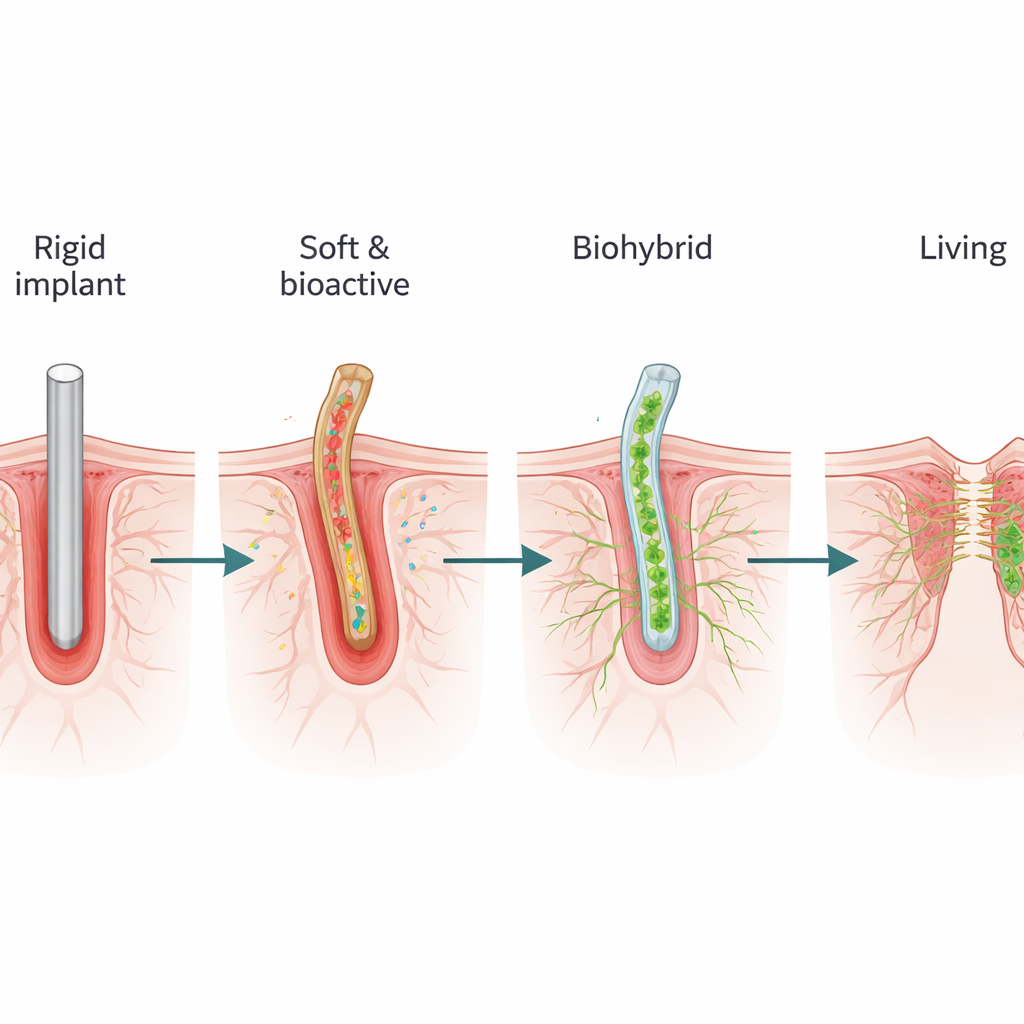
Conventional neural implants, such as Utah arrays and deep brain stimulation leads, are built from rigid metals and silicon. These materials are millions of times stiffer than brain tissue, which behaves more like jelly than glass. That mismatch makes it hard for devices to conform to the brain’s subtle movements and shapes. As the tissue shifts with every heartbeat and breath, stiff electrodes rub and tug, causing tiny injuries. The body recognizes these foreign objects and mounts an immune response, walling them off in a dense scar of support cells. Over time, this scar increases the electrical resistance between the device and nearby neurons, degrading signal quality and limiting how long an implant can function reliably.
Soft Devices That Move with the Brain
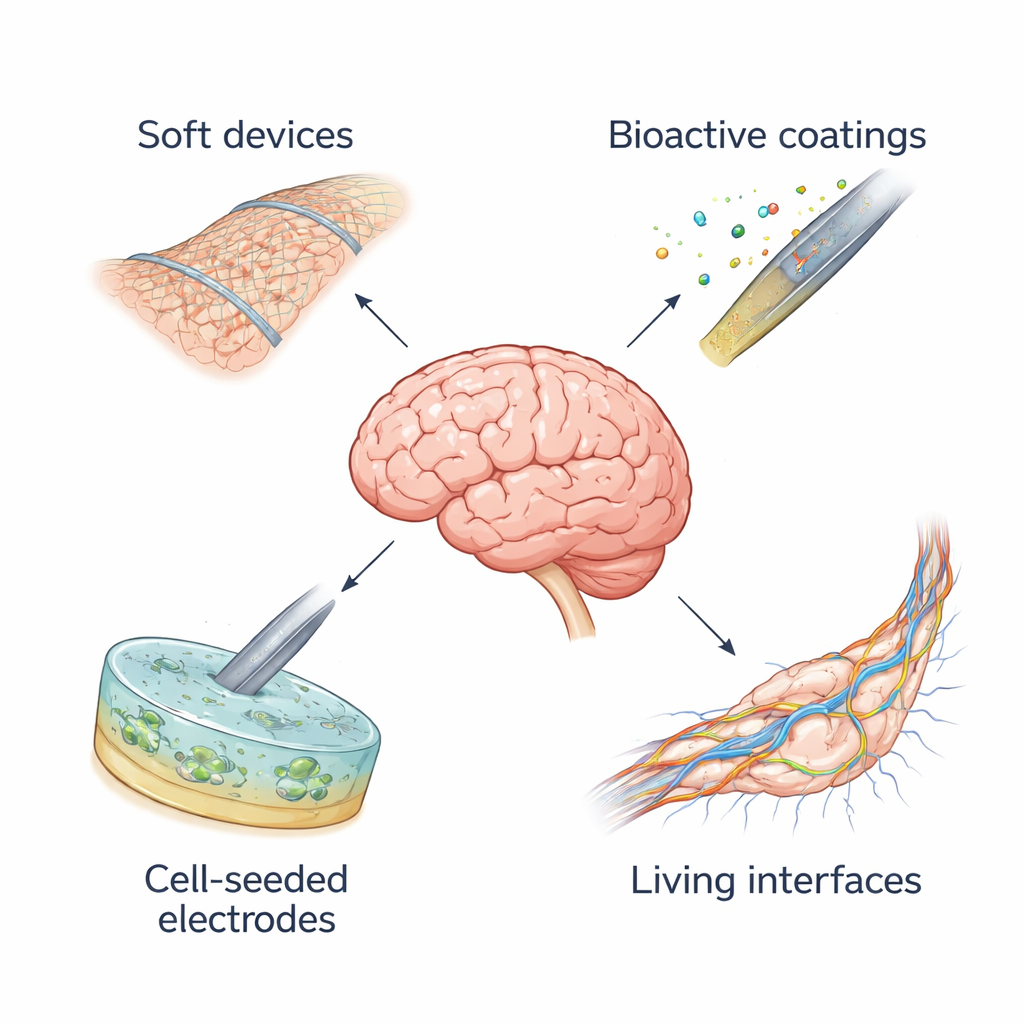
To reduce this damage, researchers are building “biomimetic” electronics—devices whose physical properties echo those of the tissue they touch. Instead of thick, rigid shanks, engineers now craft ultra‑thin films, flexible fibers, and open mesh structures that can bend and curl like living cells. Soft polymers, stretchable rubbers, and water‑rich gels help match the brain’s softness and dampen the forces that trigger inflammation. Some of these devices weave conductive plastics or nanomaterials such as graphene into flexible backbones, preserving high‑quality electrical recording while dramatically lowering stiffness. Several soft interfaces, including thread‑like brain implants and thin‑film grids that rest on the brain’s surface, are already entering human trials, showing that gentler mechanics can coexist with advanced electronics.
Surfaces That Invite Cells In, Not Push Them Away
Making devices softer is only part of the solution. The brain’s cells also respond to the chemical “feel” of an implant’s surface. Bioactive electronics take advantage of this by coating electrodes with biological ingredients the nervous system already knows and trusts, such as proteins from the natural scaffolding that surrounds cells or short molecules that promote nerve growth. These coatings can encourage neurons to grow closer to electrodes, dampen the activity of immune cells, and thin the scar that usually forms. Some coatings are designed to slowly release drugs like anti‑inflammatory compounds or growth factors right where they are needed, turning a passive wire into a smart, drug‑delivering interface. The challenge ahead is keeping these delicate layers stable and effective for years inside the body.
Blending Living Cells with Circuits
Moving further along the spectrum, “biohybrid” devices incorporate actual living cells into or onto the electronics. In one strategy, cells are grown on electrodes before implantation, sometimes within a soft hydrogel that mimics brain tissue. Once in the body, this living layer can secrete helpful molecules, attract nerve fibers, and form a biological bridge between rigid hardware and host tissue. Early versions, such as cone‑shaped electrodes that lured nerve fibers inside, have produced stable recordings for over a decade in humans. Newer approaches seed electrodes with stem cells, nerve cells, or muscle cells, aiming not only to read or stimulate activity but also to regenerate damaged pathways and restore lost functions, such as movement after nerve injury. These systems must solve tough problems of keeping cells alive, guiding their growth, and ensuring they do not wander or form unwanted connections.
Fully Living “Wires” for the Brain
At the most ambitious end are “living interfaces,” which are built entirely from biological materials and cells. Here, long bundles of nerve fibers grown in the lab act as living cables that can be implanted to reconnect brain regions or bridge gaps in injured nerves. Rather than passing current through metal, these constructs use natural synapses—the contact points between neurons—to relay signals. In the brain, such living pathways have been engineered to carry specific chemical messages, like dopamine, raising hopes for treating conditions such as Parkinson’s disease by rebuilding lost circuits instead of merely masking symptoms with electrical pulses. Because these devices are fully biological, they integrate well with host tissue, but they demand new ways to monitor and control them, often relying on light‑based imaging and stimulation instead of traditional wires.
What This Means for Future Brain and Nerve Care
Together, soft, bioactive, biohybrid, and fully living interfaces sketch a roadmap toward neural technologies that cooperate with the body rather than fight it. Softer mechanics and friendlier surfaces can reduce scarring and extend device lifetimes; adding living cells and eventually whole tissue pathways could let implants repair or replace damaged circuits, not just record from them. Many scientific, manufacturing, and regulatory hurdles remain, especially for cell‑containing and all‑living systems. But the direction is clear: tomorrow’s brain and nerve implants are likely to look and behave less like rigid gadgets and more like carefully engineered pieces of living tissue.
Citation: Boufidis, D., Garg, R., Angelopoulos, E. et al. Bio-inspired electronics: Soft, biohybrid, and “living” neural interfaces. Nat Commun 16, 1861 (2025). https://doi.org/10.1038/s41467-025-57016-0
Keywords: neural interfaces, biohybrid electronics, soft implants, brain–computer interface, tissue engineering