Clear Sky Science · en
Assessing the climate benefits of afforestation in the Canadian Northern Boreal and Southern Arctic
Why planting northern forests is not a simple fix
Planting trees in cold northern regions is often promoted as an easy climate solution: trees soak up carbon dioxide, so more trees should mean less warming. This review shows that, in the Canadian northern boreal and southern Arctic, the story is far more complicated. In these bright, snowy, permafrost-rich landscapes, new forests can both cool and warm the climate through many intertwined processes. Understanding these trade-offs is crucial before betting big climate policy—such as Canada’s Two Billion Trees program—on northern tree planting.
How northern forests shape climate in many hidden ways
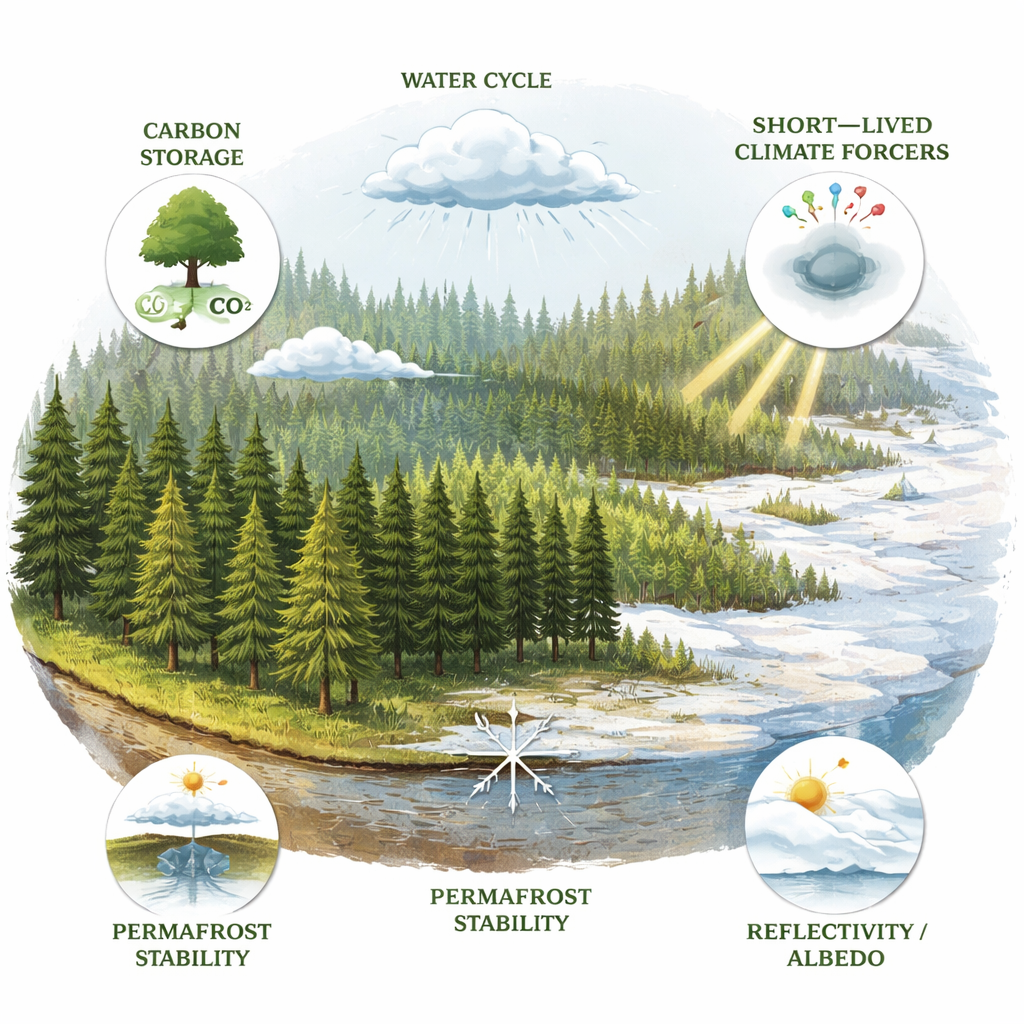
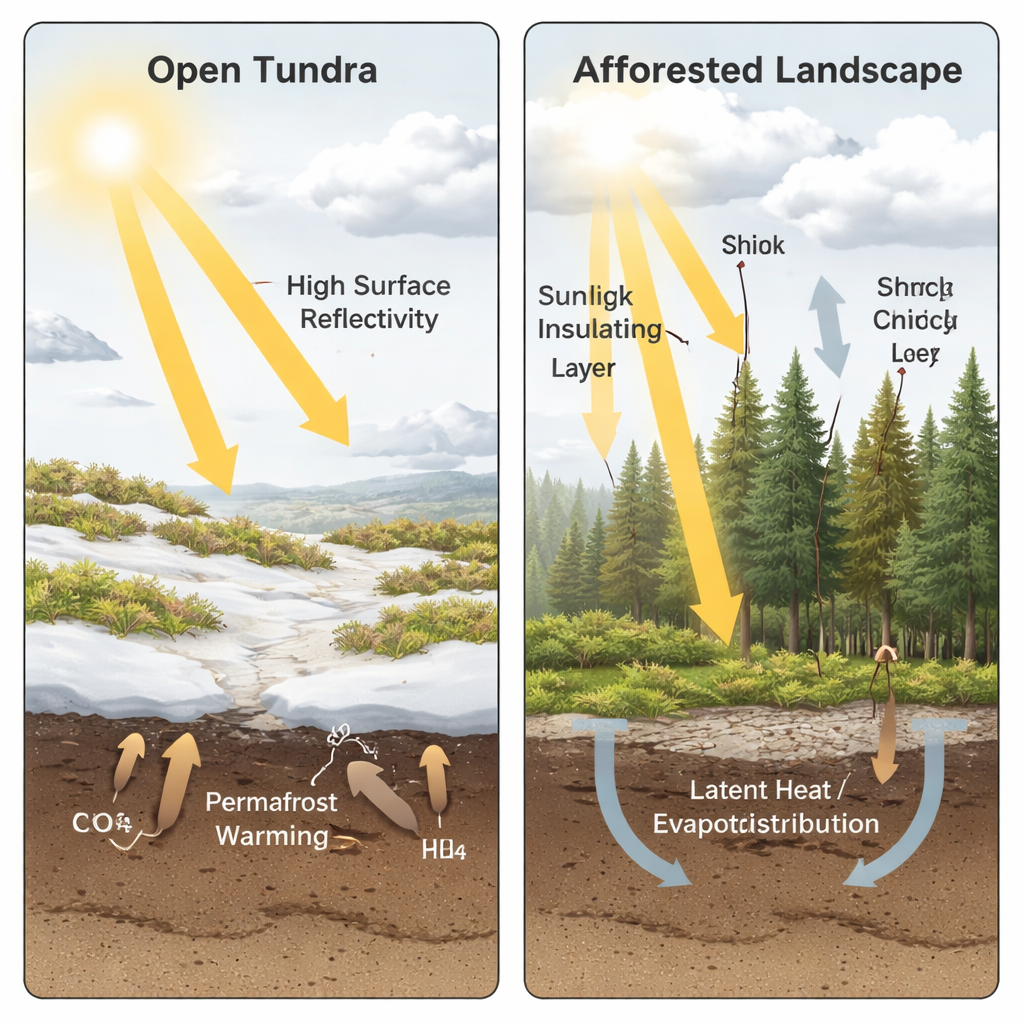
In this region, forests do much more than store carbon in wood. They darken the surface and replace highly reflective snow and tundra, meaning they absorb more sunlight and can locally warm the surface. Forests also change how energy is moved between the land and atmosphere: they pump more water vapor into the air, shift the balance between sensible heat (warming the air) and latent heat (evaporation), and influence cloud formation and rainfall. They emit reactive gases that help form particles and clouds, which in turn alter how much sunlight reaches the surface. At the same time, forest soils and roots interact with frozen ground, snow, and water in complex ways. Because all these processes pull in different directions, the net climate effect of afforestation cannot be read from carbon uptake alone.
Permafrost, snow, and the lessons of Earth’s past
Permafrost—permanently frozen ground storing vast amounts of ancient carbon and methane—is central to the climate stakes in the north. As the Arctic warms, thawing permafrost could release huge greenhouse gas emissions and further accelerate warming. Although it might seem that trees would trap more heat and speed thaw, long-term field experiments and models often show the opposite: forest cover can keep permafrost colder by shading the ground, reducing snow insulation on the forest floor, drying soils through evapotranspiration, and adding insulating moss and organic layers. Snow adds another layer of complexity. Open ground usually collects more snow that melts quickly in spring, while forests alter snow depth, distribution, and melt timing in ways that strongly affect how much sunlight is reflected and how deeply the ground thaws. Looking back to past warm periods in Earth’s history, the authors note that forest expansion did amplify warming in some eras, but that stabilizing mechanisms in the climate system usually prevented forests from marching endlessly north. This history suggests both risks and natural limits to future northern forest change.
Future climate shocks and forest disturbances
The review emphasizes that afforestation plans must be made in a world where the climate itself is rapidly changing. By 2100, northern Canada is projected to see much warmer temperatures, more rain and snow, more lightning, and far larger areas burned by wildfire. Insects, windstorms, droughts, and invasive species are expected to become more frequent or severe, sometimes turning forests from long-term carbon sinks into short-lived carbon sources. These disturbances interact and can reinforce one another—for example, fires can speed permafrost thaw, and thaw can create drier, more flammable conditions. At the same time, satellite observations already show a “greening” trend in the northern boreal and southern Arctic, hinting that vegetation is naturally shifting as the climate warms. Against this moving backdrop, the question is not simply whether to plant trees, but how such planting fits into a landscape already undergoing rapid, climate-driven change.
Limits of current studies and a more complete way to judge tree planting
Many influential studies that question the value of northern afforestation focus on just a couple of ingredients, especially carbon uptake and surface reflectivity (albedo). The authors argue that this narrow lens can be misleading. Key factors are often left out: how soil carbon responds over decades, how forests help preserve permafrost, how short-lived gases and particles from trees cool or warm the atmosphere, and how clouds and rainfall patterns are altered. Remote sensing data used to estimate albedo carry large uncertainties in snowy, cloudy high-latitude regions, and most analyses treat forest cover change as instant and uniform, ignoring how forest structure evolves with age, species choice, and planting density. As a result, firm statements that “northern tree planting is bad for the climate” rest on an incomplete and uncertain picture.
A framework for smarter, region-specific afforestation
Instead of asking “Are trees good or bad?” the authors propose an assessment framework that treats afforestation as a set of design choices whose climate effects play out over decades. Their scheme combines six components—carbon storage above and below ground, radiative effects (including both sunlight and heat radiation), non-radiative energy flows, permafrost protection, short-lived climate forcers, and cloud- and moisture-related changes—into a single time-dependent measure of net climate benefit. It explicitly includes local details such as species mix, planting density, topography, and project size, as well as future changes in temperature, precipitation, and disturbance regimes. For policymakers, the message is that northern afforestation can provide important mitigation and adaptation benefits, especially where it helps safeguard permafrost and soil carbon, but only if projects are evaluated case by case with this broader toolkit. Simplistic metrics or global averages are not enough to decide when and where planting trees in the north truly helps cool the planet.
Citation: Dsouza, K.B., Ofosu, E., Salkeld, J. et al. Assessing the climate benefits of afforestation in the Canadian Northern Boreal and Southern Arctic. Nat Commun 16, 1964 (2025). https://doi.org/10.1038/s41467-025-56699-9
Keywords: afforestation, permafrost, boreal forests, snow and albedo, climate feedbacks