Clear Sky Science · en
Artificial intelligence for modeling and understanding extreme weather and climate events
Why smarter climate tools matter to everyday life
Floods that wash away bridges, heatwaves that strain power grids, wildfires that darken skies for weeks—extreme weather is no longer rare background noise. As these events grow more frequent and intense, societies need faster, sharper ways to see them coming and to understand their impacts. This article explains how artificial intelligence (AI) is reshaping our ability to detect, predict, and make sense of extreme climate events, and why that matters for everything from insurance rates and food prices to personal safety.
Seeing patterns in a turbulent planet
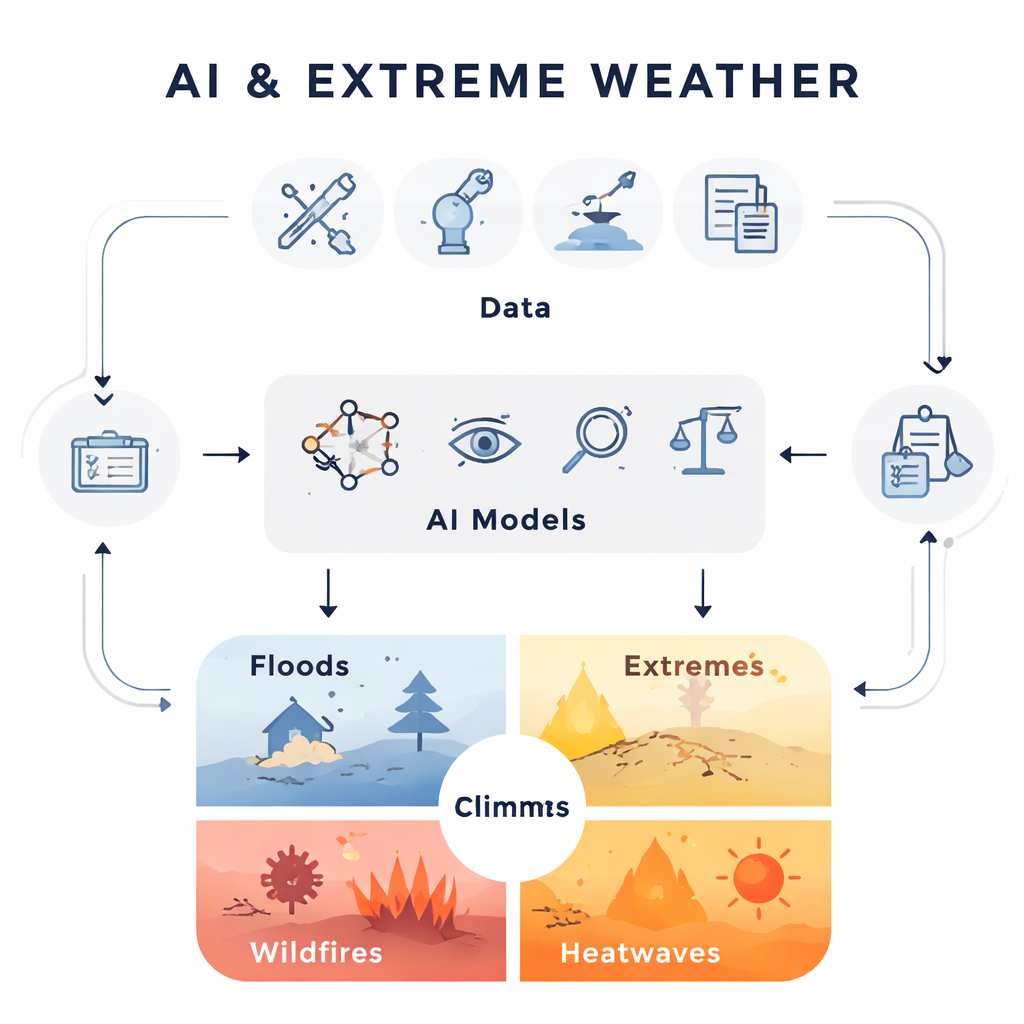
Extreme events are hard to pin down with simple definitions like “top 1 percent of temperatures” because their effects depend on where people live, how land is used, and how hazards combine. The authors describe a new AI-centered pipeline that starts with vast streams of information—weather observations, satellite images, climate model output, river gauges, news reports—and turns them into useful signals. Modern machine learning and deep learning excel at combing through these noisy, multi-layered records to spot unusual patterns: the slow build-up to a mega-drought, the atmospheric fingerprints of a looming heatwave, or the storm tracks that make catastrophic flooding more likely. Crucially, the same tools that power photo tagging and voice assistants are being tuned to Earth’s rhythms.
From early warnings to real-world impacts
The review separates AI’s role into three big jobs: detecting when and where an extreme event is unfolding, predicting what will happen next, and estimating the damage it may cause. For detection, AI goes beyond single thresholds—such as a fixed rainfall amount—and instead looks at combinations of variables over space and time to identify truly unusual situations. For prediction, neural networks and hybrid models that mix physics and data can forecast floods, wildfires, droughts, and heatwaves days to seasons ahead, often over large regions. For impact assessment, AI links climate signals to outcomes like crop failure, power demand, or human displacement, even mining newspaper archives and social media to track how communities are actually affected.
Making smart systems understandable and fair
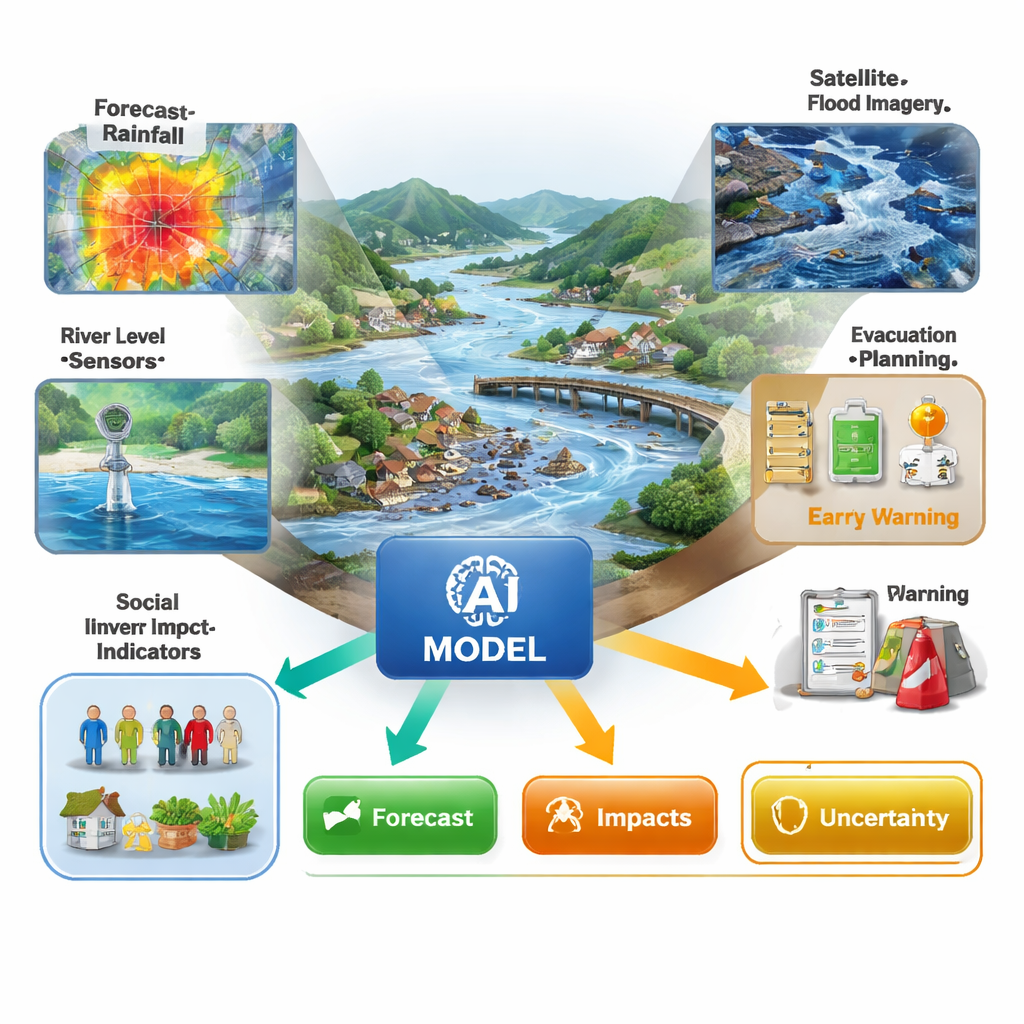
Because decisions based on AI—evacuate this valley, close that reservoir gate, target aid to this district—carry high stakes, trust is as important as accuracy. The authors highlight three key ingredients. First, explainable AI methods try to open the “black box,” showing which weather patterns, land conditions, or social factors most influenced a prediction. Second, causal analysis and event attribution ask deeper “why” and “what if” questions: Would this flood have been as severe without climate change or deforestation? What happens if we build levees or change water rules? Third, methods for quantifying uncertainty help distinguish the natural unpredictability of weather from the limits of the models themselves, so officials see not just a single forecast but a range of possibilities and their confidence.
From research labs to sirens and text alerts
The article stresses that clever algorithms alone will not save lives. Many AI models are trained on clean, curated data, yet real emergencies involve broken sensors, cloudy satellite views, and shifting local conditions. There are also ethical challenges: biased data can overlook vulnerable communities, and centralized “one-size-fits-all” systems may miss local needs. To bridge this last mile, the authors point to domain adaptation (so models stay reliable in messy conditions), partnerships with agencies that hold detailed local maps and risk data, and the use of language technologies to generate tailored warnings in clear, accessible language. Case studies on droughts, heatwaves, wildfires, and floods show how AI can both sharpen forecasts and support richer, more inclusive communication.
What this means for our climate future
In plain terms, the paper concludes that AI can become a powerful ally in living with a more volatile climate—but only if it is transparent, rigorously tested, and developed hand-in-hand with climate scientists, local experts, and decision-makers. Better benchmarks, shared datasets, and open methods are needed so results can be compared and trusted. When done well, AI can help us spot danger earlier, understand the drivers behind extremes, and design responses that protect people and ecosystems more effectively. It is not a silver bullet for climate change, but it can be a critical part of how societies prepare for and manage the extremes that are already here and those yet to come.
Citation: Camps-Valls, G., Fernández-Torres, MÁ., Cohrs, KH. et al. Artificial intelligence for modeling and understanding extreme weather and climate events. Nat Commun 16, 1919 (2025). https://doi.org/10.1038/s41467-025-56573-8
Keywords: artificial intelligence, extreme weather, climate risk, early warning systems, disaster preparedness