Clear Sky Science · en
A guidance to intelligent metamaterials and metamaterials intelligence
Why smart materials matter
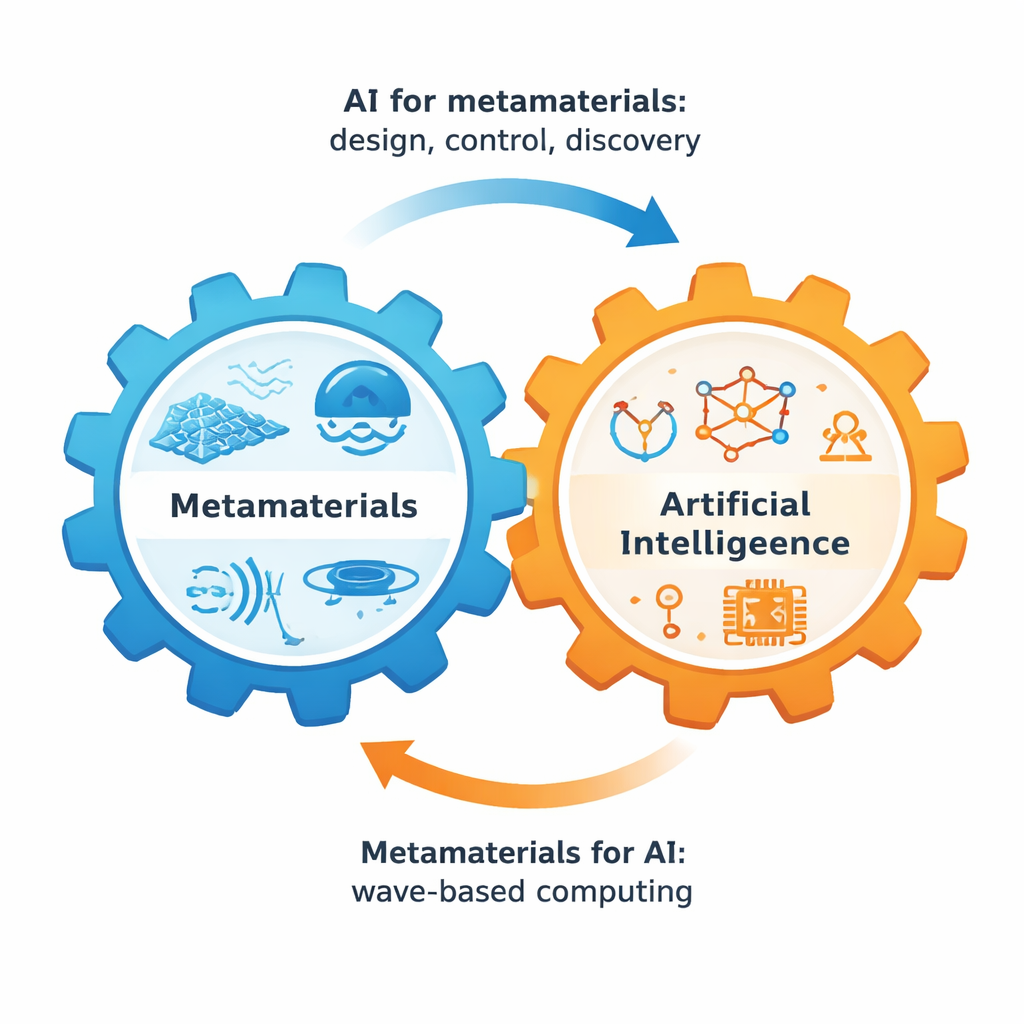
Imagine walls that can boost your Wi‑Fi, car surfaces that make vehicles vanish from radar, or paper‑thin chips that do AI calculations at the speed of light. This review article explores how two fast‑moving fields—metamaterials (engineered structures that sculpt waves) and artificial intelligence (AI)—are starting to power each other. Together they promise devices that can sense, decide, and act on their own, and new kinds of computers that use waves instead of electrons.
Building materials that outsmart nature
Metamaterials are human‑made structures built from tiny repeating units, smaller than the wavelength of light or radio waves they control. By carefully shaping these “meta‑atoms,” researchers can bend, focus, or hide electromagnetic waves in ways ordinary materials cannot—enabling negative refraction, super‑resolution imaging, and even invisibility cloaks. Early designs were bulky and fixed in function, but ultrathin versions called metasurfaces have made these ideas more practical, extending control from microwaves to visible light and even to sound and heat. Still, designing such structures is hard: each pattern tweak normally demands heavy numerical simulations and expert intuition, and most finished devices work only for a single task in ideal lab conditions.
AI as the designer and co‑pilot
Deep learning, the branch of AI that excels at finding patterns in complex data, is transforming how metamaterials are conceived and used. Instead of running thousands of physics simulations by hand, engineers train neural networks to act as ultra‑fast “surrogate” simulators. One direction, called forward prediction, feeds a proposed structure into a network and instantly predicts its optical or radio‑wave response. The harder direction, inverse design, asks the AI to propose structures that produce a desired behavior—such as a specific color, a beam that bends at a certain angle, or an efficient optical circuit. Advanced models, including generative networks and knowledge‑“inheriting” schemes, can handle situations where many different designs work equally well, offering designers whole families of candidate solutions instead of a single answer.
Metamaterials that sense, decide, and react
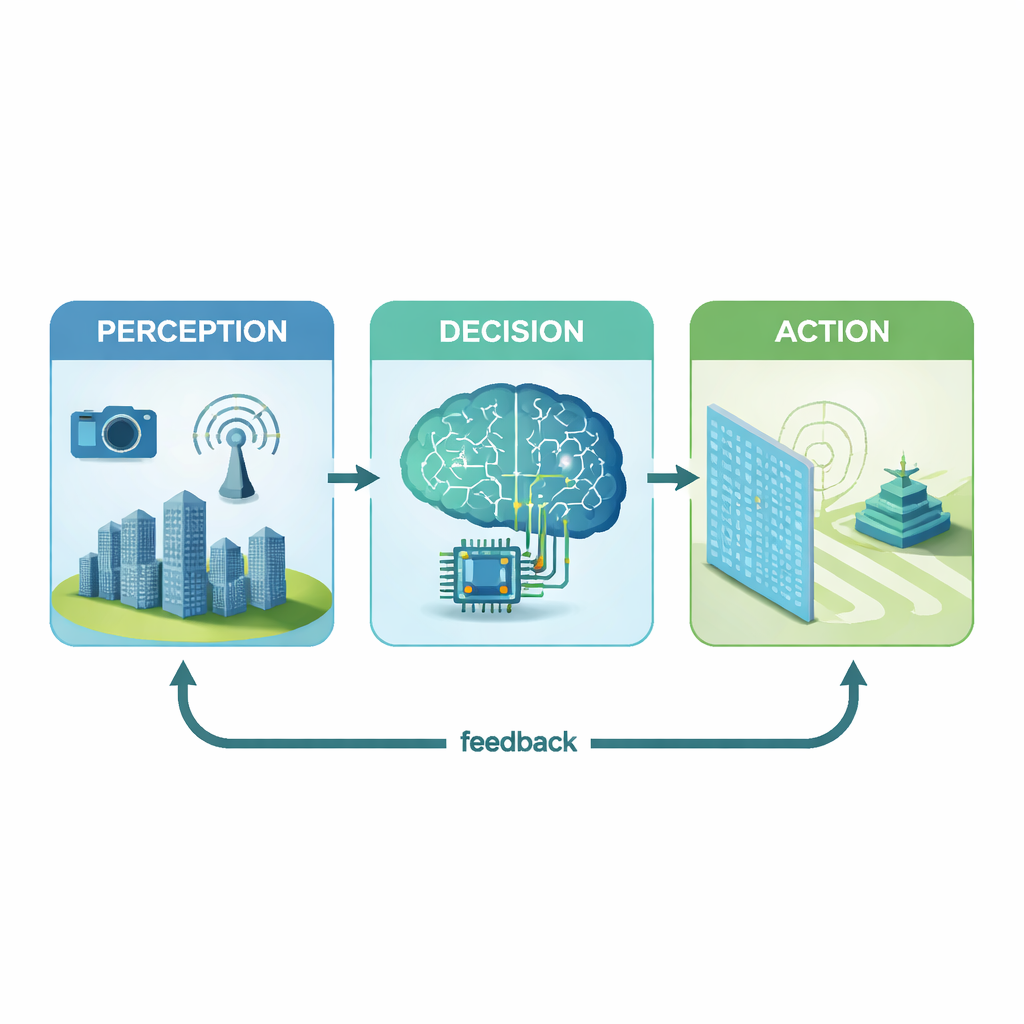
Beyond design automation, the authors describe “intelligent meta‑devices” that operate more like living systems than static components. These devices are organized around three modules: perception, decision, and action. Perception uses sensors or the waves themselves to monitor the environment—for example, tracking moving objects, changing backgrounds, or wireless traffic. A decision module, often powered by AI, learns how the overall pattern of a metasurface should change to meet a goal, such as hiding a target or improving a wireless link. The action module is a tunable metasurface made from elements that can be reprogrammed electrically, mechanically, or optically in real time. Demonstrations already include a “chameleon‑like” microwave cloak that automatically adapts to new backgrounds, and smart reflecting walls that manage wireless channels on the fly, saving energy and reducing interference.
Using waves themselves to compute
The influence also flows the other way: metamaterials give AI a new kind of hardware. Instead of representing numbers as voltages in a chip, wave‑based computing lets light or radio waves carry and process information directly as they scatter, diffract, and interfere. Carefully designed metamaterials can behave like physical neural networks, matrix multipliers, or even equation solvers. Light passing through stacked patterned layers can perform the same operations as a deep neural network, but in a single leap at the speed of light. Other structures act as instant edge detectors for images, integrators, or logic gates, offering ultra‑fast, low‑power processing that could complement conventional electronics in tasks like real‑time sensing, autonomous driving, or scientific imaging.
Challenges and the road ahead
The authors emphasize that this emerging “metamaterials intelligence” is still in its early days. Major challenges include gathering enough high‑quality data to train robust models, reducing the need to relearn from scratch for every new device, and pushing hardware to handle nonlinear effects and large‑scale systems. There are also open scientific questions: Can AI reliably reveal hidden physical relationships rather than just fitting curves? How should we quantify uncertainty when designs face real‑world fabrication errors? Despite these hurdles, the review paints a vivid picture of a future where AI‑designed, wave‑based structures quietly manage electromagnetic space—steering signals, enhancing communication, and performing specialized computations in the background, much like an invisible nervous system for our technological environment.
Citation: Qian, C., Kaminer, I. & Chen, H. A guidance to intelligent metamaterials and metamaterials intelligence. Nat Commun 16, 1154 (2025). https://doi.org/10.1038/s41467-025-56122-3
Keywords: metamaterials, metasurfaces, artificial intelligence, optical computing, intelligent devices