Clear Sky Science · en
Embracing plant plasticity or robustness as a means of ensuring food security
Why flexible plants matter for our dinner plates
As the global population grows and the climate becomes less predictable, one of humanity’s biggest questions is simple: can we keep producing enough food? This article explores how plants cope with shifting conditions like heat, drought, and poor soils, and how breeders can harness two contrasting features—flexibility and stability—to safeguard harvests. Understanding these ideas helps explain why some crops thrive in wild weather while others fail, and how future farming might adapt to a warming, less stable world.
From wild grasses to global staples
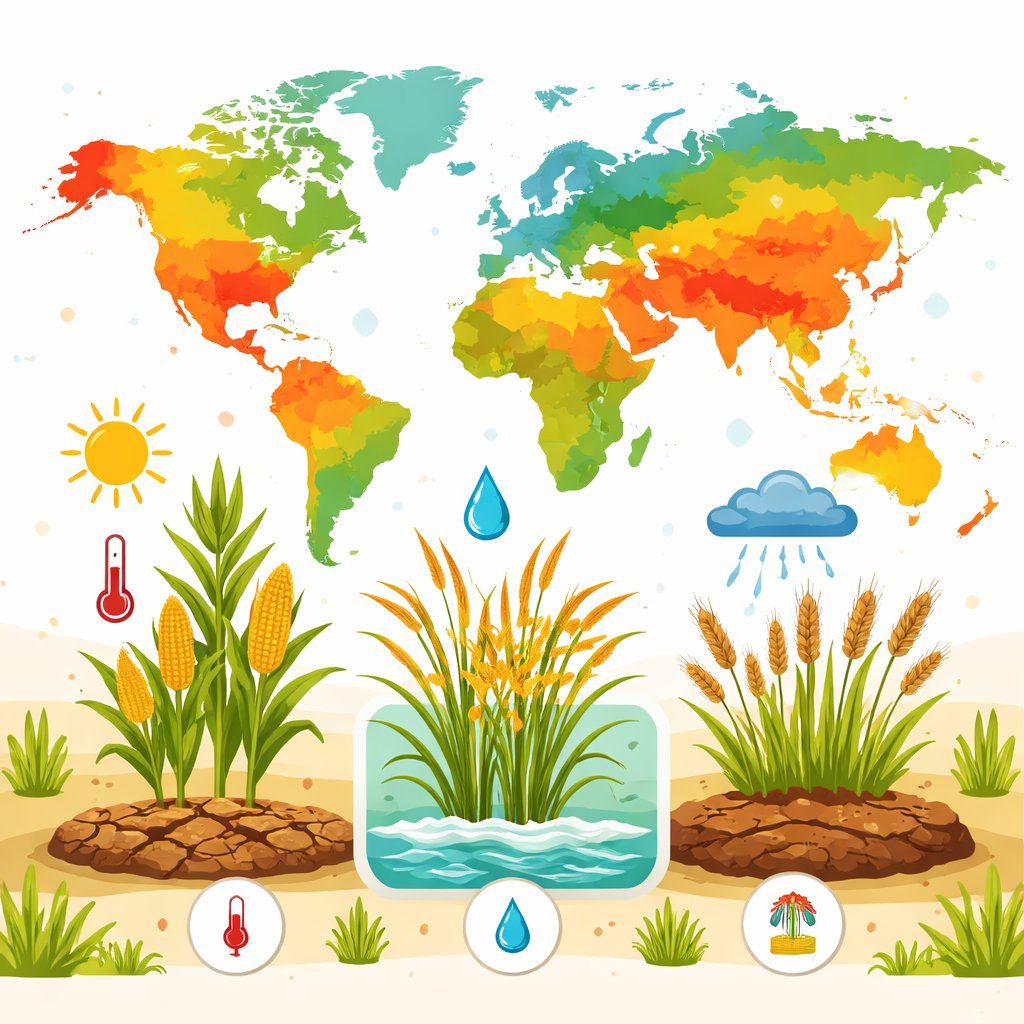
Most of today’s major crops were domesticated from wild ancestors over the past 10,000 years. Early farmers unconsciously selected plants with traits that suited their needs: bigger kernels in maize, more seeds in rice and wheat, or larger fruits in tomato and eggplant. Often, only a handful of genes drove dramatic changes, turning scruffy wild plants into high-yielding crops. Today, just 15 species provide about 70 percent of humanity’s calories, with a few—rice, wheat, corn, sugarcane, and barley—doing most of the work. Yet these crops are now grown far from their original homes and are exposed to highly varied climates, seasons, and soils, forcing them to respond to environmental pressures they never encountered during early domestication.
Flexibility: plants that change with the weather
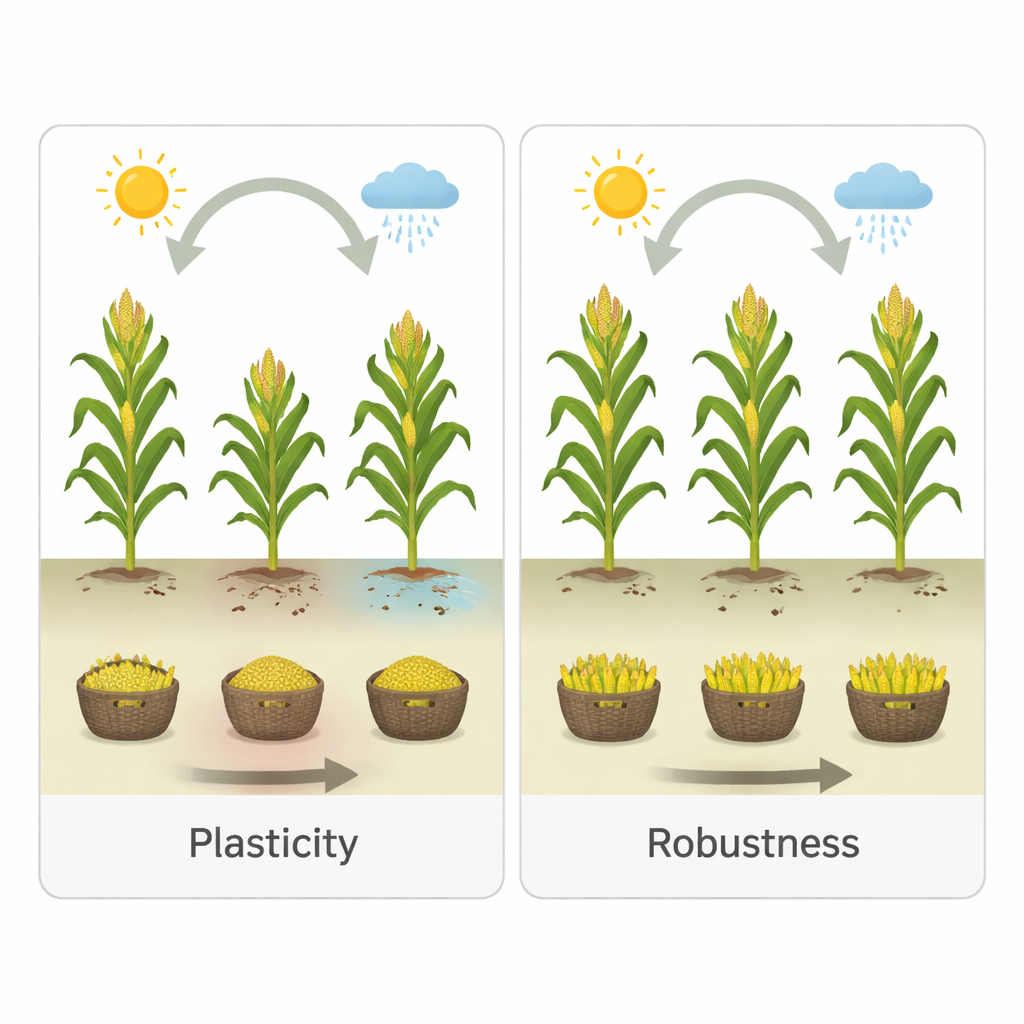
The authors use the term “phenotypic plasticity” for a plant’s ability to change its appearance or behavior when conditions shift. A single genetic type might grow tall in cool, moist fields but stay small and early-flowering in hot, dry ones. Plasticity can involve everything from the pattern of roots in the soil to flowering time and the chemistry of leaves and fruits. Modern tools—such as genome-wide studies, large field experiments, and detailed environmental monitoring—now let scientists track how thousands of plant varieties respond to differences in temperature, water, nutrients, and day length. These studies show that plasticity is often controlled by specific genes, can be inherited, and can help crops adjust to local climates, sometimes at the cost of doing poorly elsewhere.
Stability: plants that stay the course
At the other end of the spectrum lies “canalization” or robustness: the tendency of a plant to produce nearly the same outcome—even under different conditions or minor genetic changes. Robust plants act like well-engineered machines that keep running smoothly despite bumps in the road. Researchers have found genes that help buffer key traits, such as the daily internal clock, chemical defenses, or yield, so they remain steady across fields and years. In crops like tomato and soybean, certain genetic regions are linked to yield stability rather than to high average yield. These “buffering” genes do not necessarily increase performance in good years, but they reduce the risk of catastrophic failures in bad years—an appealing feature where weather is harsh or unpredictable.
Choosing between high gain and safety net
For breeders, plastic and robust crops resemble different investment strategies. Highly plastic varieties can deliver exceptional yields when conditions are favorable, but their performance can swing widely when weather turns extreme, much like a risky stock. Robust varieties behave more like conservative investments: they rarely hit record-breaking yields but provide more reliable harvests under stress. The review argues that relying entirely on either strategy is risky. Climate change brings both gradual shifts and sudden extremes, and no single approach can cover all future scenarios. Instead, breeders are combining detailed genetic data, environmental measurements, and machine learning models to predict how different varieties will fare across many possible futures.
Balancing flexibility and stability for future food
To a non-specialist, the article’s main conclusion is that there is no single “best” crop type for the coming century. In regions with well-managed, more predictable conditions, it may pay to cultivate flexible varieties that can exploit good years and push yields higher. In areas facing frequent droughts, heat waves, or storms, sturdy, robust lines that hold their yield steady may be more valuable. The authors recommend a “bet-hedging” strategy: develop and maintain both flexible and robust crops, broaden the range of species we rely on, and test plants in conditions that mimic future climates. By combining these approaches, agriculture can both protect a reliable food supply and retain the capacity to adapt as the planet continues to change.
Citation: Alseekh, S., Klemmer, A., Yan, J. et al. Embracing plant plasticity or robustness as a means of ensuring food security. Nat Commun 16, 461 (2025). https://doi.org/10.1038/s41467-025-55872-4
Keywords: food security, crop breeding, phenotypic plasticity, climate change, plant resilience