Clear Sky Science · en
Genomic divergence of leopards in the Cape Floristic Region of South Africa: potential drivers for local adaptation
Why these leopards are so surprisingly small
Along the dramatic mountains of South Africa’s Cape Floristic Region lives a little-known population of leopards that look much like their famous spotted cousins, but weigh almost half as much. This study asks a deceptively simple question with big conservation implications: are these Cape leopards small because they are inbred remnants of a once-larger population, or because they have actively adapted to survive in a harsh, food‑poor landscape?
A unique corner of Africa
The Cape Floristic Region, including the fynbos biome, is globally renowned for its rich plant life but is a tough place to be a big carnivore. Historic records and modern surveys show that hoofed prey have long been sparser here than in the game‑rich savannas farther north. Today, farming and expanding towns have pushed leopards into rugged mountain refuges, where they roam huge territories to find enough food. The researchers focused on leopards from this Western Cape population and compared them to “savanna leopards” from Mpumalanga in northern South Africa, as well as to other African leopard populations. 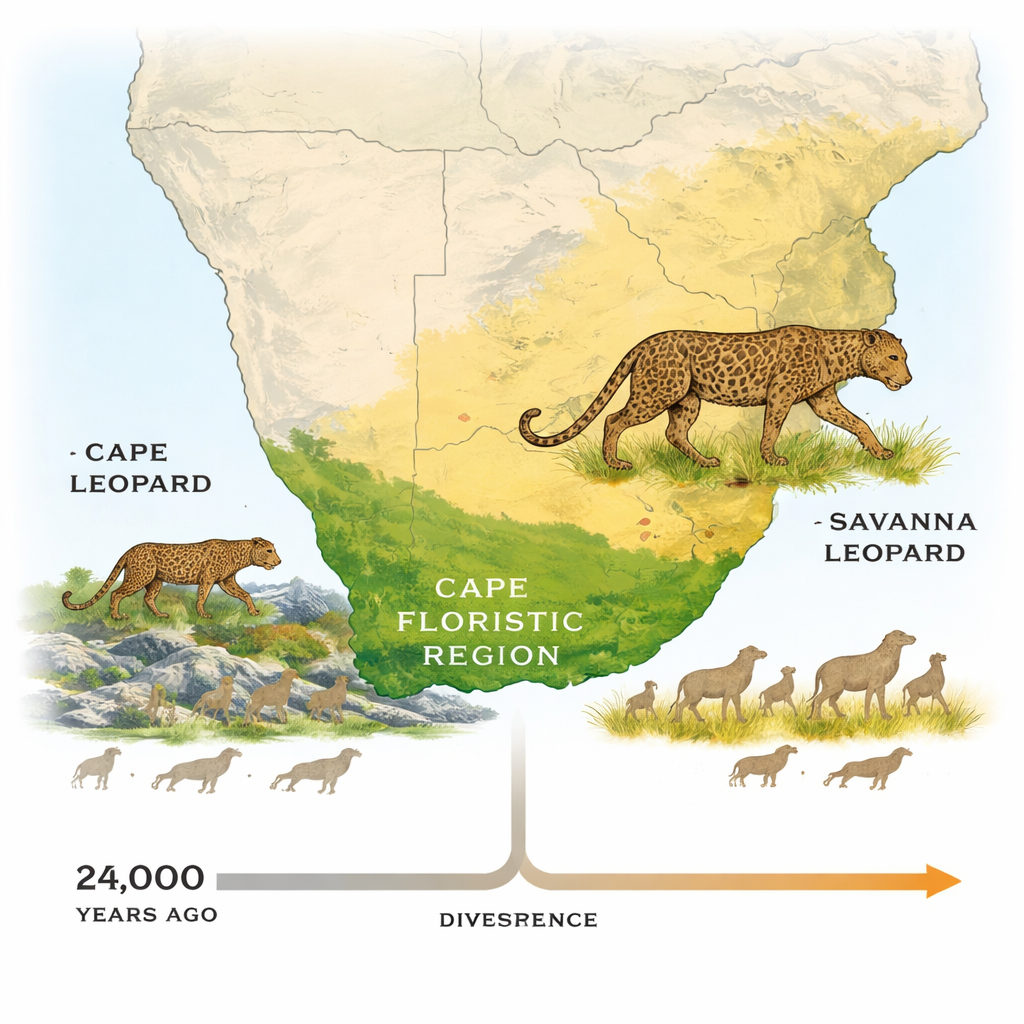
Reading the story in leopard genomes
Using whole‑genome sequencing of 43 leopards, the team examined how Cape leopards are related to other populations and how much genetic diversity they retain. Statistical analyses that group individuals by DNA patterns showed that Western Cape leopards form a distinct cluster, separate even from other South African leopards, and with little sign of mixing. By modelling changes in population size over time, the authors estimate that Cape and savanna leopards began to diverge about 20,000–24,000 years ago, during a cold, dry climatic phase when habitats were shifting and populations were likely isolated in ecological refuges.
Small, but not genetically doomed
One concern for any small and isolated animal population is inbreeding, which can unmask harmful mutations, reduce fertility and make populations more vulnerable to disease and environmental shocks. The study therefore looked for signs of long stretches of identical DNA and for the build‑up of damaging mutations. Despite their modest numbers today, Cape leopards still carry substantial genetic diversity. They show slightly more evidence of ancient inbreeding but no clear signal of a recent, severe genetic collapse. In fact, the northern savanna leopards in this study carried a somewhat higher burden of potentially harmful mutations, suggesting that recent local pressures there may have reduced the efficiency of natural selection more than in the Cape.
Genes that fit a lean life
To probe whether the leopards’ small size and lifestyle might be rooted in adaptation, the researchers searched for genes showing strong differences between Cape and savanna leopards. They identified around 90 genes under positive selection in the Cape population. Many are linked, in other mammals, to skeletal growth, body size, fat storage and metabolism. Examples include genes involved in how fat is stored or burned during fasting, how limbs and skulls develop, and how the body copes with low levels of key nutrients like zinc and vitamin A—both of which are relatively scarce in the sandy soils and food webs of the Western Cape. Together, these genetic signatures point to a shift toward smaller, energy‑efficient bodies and careful rationing of internal reserves in a landscape with limited, often small prey. 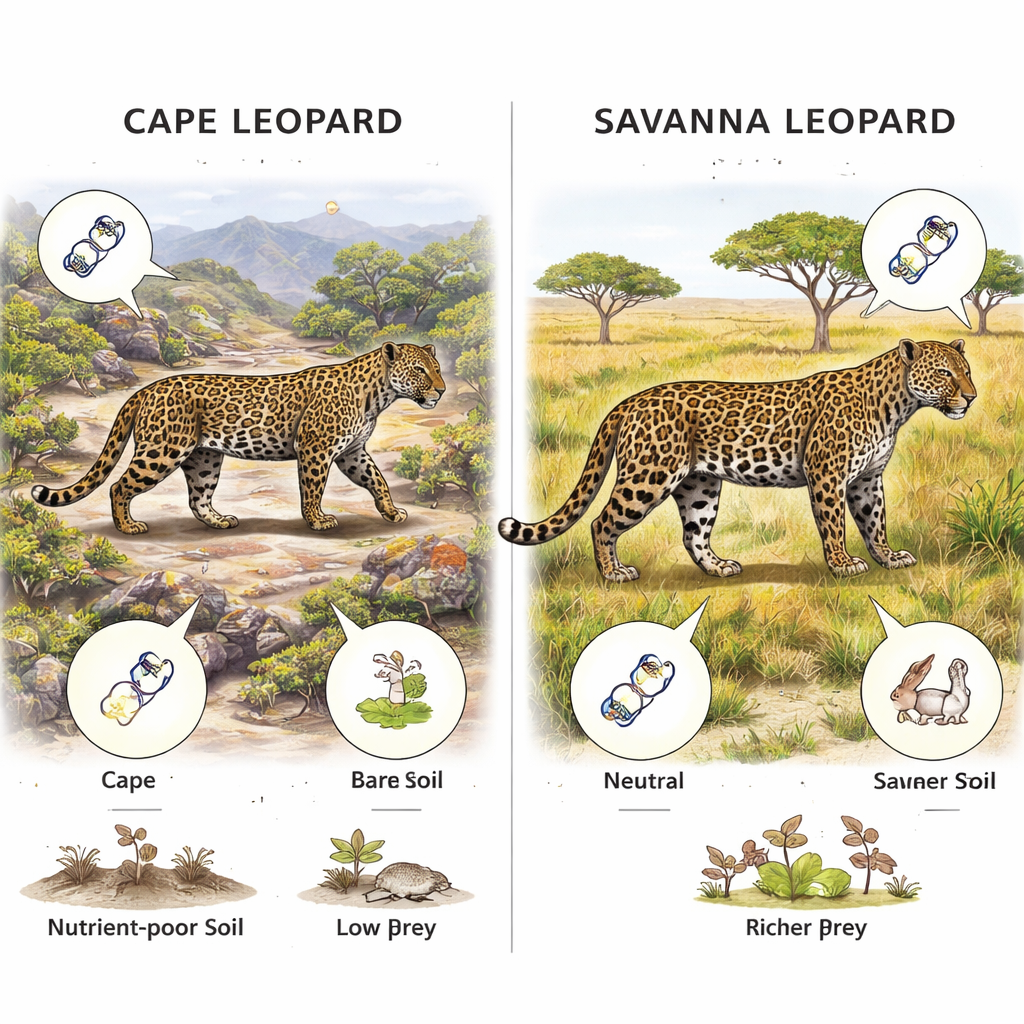
What this means for saving Cape leopards
For non‑specialists, the key message is that Cape leopards are not simply stunted or inbred versions of other African leopards. Their genomes bear the hallmarks of a long, independent history and of fine‑tuned adaptation to a nutrient‑poor, human‑dominated mountain environment. This makes them an “evolutionarily significant unit” in conservation terms—an irreplaceable store of genetic solutions to life in difficult conditions. The authors argue that moving leopards in or out of this region should be done with great caution, and that protecting both the animals and the unique habitats they depend on is essential if this distinctive, small‑bodied apex predator is to persist.
Citation: Tensen, L., Khan, A., Sarabia, C. et al. Genomic divergence of leopards in the Cape Floristic Region of South Africa: potential drivers for local adaptation. Heredity 135, 86–98 (2026). https://doi.org/10.1038/s41437-026-00822-z
Keywords: Cape leopards, local adaptation, genomic divergence, fynbos ecosystem, carnivore conservation