Clear Sky Science · en
Maternal inheritance of primary sex ratios in the dark-winged fungus gnat Lycoriella ingenua
Why tiny flies and their families matter
In most animals, whether a baby is male or female is set in stone by the chromosomes it inherits at conception, leading to a roughly even mix of sons and daughters. Dark-winged fungus gnats, however, break this rule in spectacular fashion. These tiny flies, which can infest mushroom farms, sometimes produce broods that are almost all sons or almost all daughters. This study investigates one such species, Lycoriella ingenua, to find out why their sex ratios are so strange, whether these patterns run in families, and whether temperature can tip the balance between sons and daughters.
A strange way to decide who’s born male or female
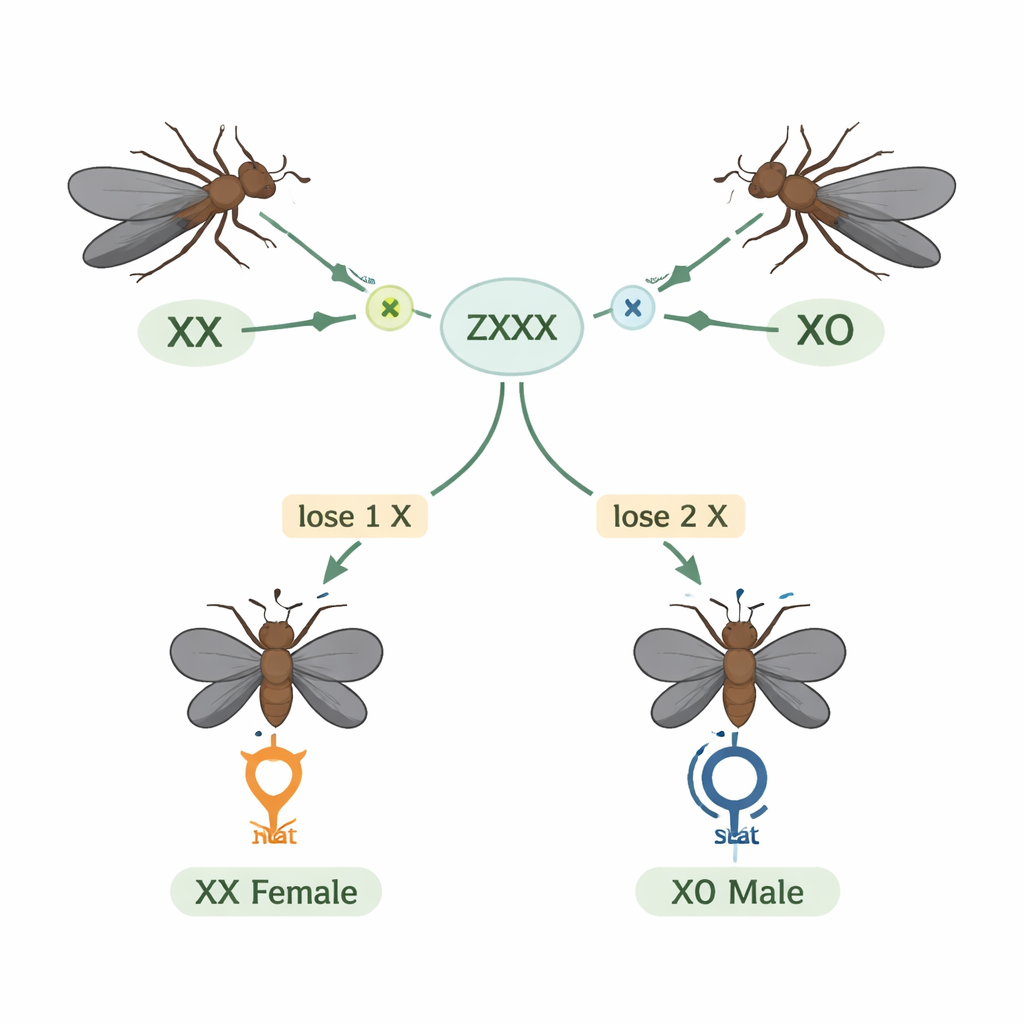
In Lycoriella ingenua, the usual rules of chromosome inheritance are turned upside down. Males carry only the chromosomes they got from their mothers, and when they make sperm, each sperm cell ends up with two copies of the X chromosome instead of just one. When these sperm fertilize an egg, the resulting embryo starts with three X chromosomes. Early in development, before the embryo switches on its own genes, it sheds either one or two of these X chromosomes. Losing one X produces a female; losing two produces a male. Because this chromosome cutting is controlled by molecules the mother loads into her eggs, mothers have the potential to influence how many sons and daughters they produce.
Families with very different mixes of sons and daughters
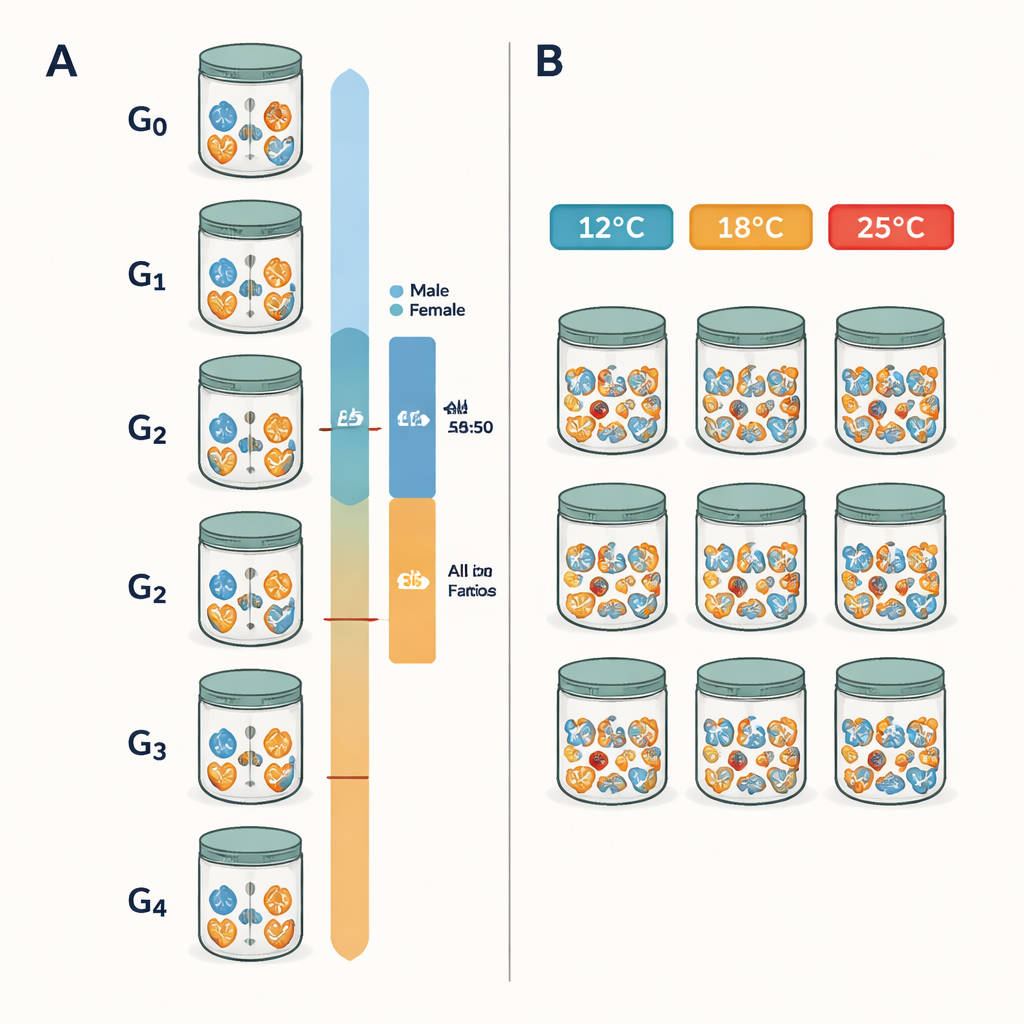
The researchers collected fungus gnats from a mushroom farm in Scotland and established dozens of “isofemale lines,” each started by a single mated pair. They then followed these family lines for up to four generations, carefully counting the number of male and female offspring in each brood. The results showed extreme variation: some broods were all male, some all female, and many fell somewhere in between. Across all broods combined, the average was only slightly male-biased, but the spread was far wider than expected if sex were decided purely by chance, suggesting underlying biological control rather than random luck.
Sex ratios that run in the family
To test whether these unusual sex ratios are inherited, the team compared mothers to their daughters, focusing on cases where daughters had been mated to their brothers so that family backgrounds were similar. Daughters of strongly male-biased mothers tended, on average, to produce more male-biased broods themselves, and daughters of more female-biased mothers tended to produce more daughters. Siblings within the same family also had more similar sex ratios than unrelated females. These patterns point to a genetic, maternally controlled component that influences what fraction of embryos are steered toward becoming sons or daughters, likely involving multiple genes acting together rather than a single on–off switch.
Testing whether temperature tilts the balance
Earlier work in related gnat species hinted that temperature during the mother’s development could sway the sex ratio of her offspring. To investigate this, the authors reared developing flies at three temperatures—12 °C, 18 °C, and 25 °C—during the pupal stage, when egg formation occurs, then returned all offspring to 18 °C and counted males and females. While extreme temperatures, especially the cold treatment, did increase overall mortality and seemed to hit males somewhat harder, the proportion of sons and daughters did not change in a consistent or statistically meaningful way across temperatures. In this species, at least in the tested range, temperature does not appear to be a major driver of the skewed sex ratios.
What this means for understanding sex and evolution
This work shows that in Lycoriella ingenua, the share of sons and daughters in a brood is a variable, inheritable trait shaped by the mother’s genes rather than a fixed 50:50 outcome. Temperature plays only a minor role, if any, in shifting this balance. For non-specialists, the key idea is that sex in these flies is not decided simply by which chromosomes an embryo starts with, but by how many X chromosomes the embryo throws away—something controlled by genetic instructions laid down by the mother. This makes the dark-winged fungus gnat a powerful model for exploring more complex, multi-gene systems of sex determination and helps biologists understand how unusual sex ratios evolve in nature, including in species that affect agriculture and ecosystems.
Citation: Shlyakonova, M., Monteith, K.M., Ross, L. et al. Maternal inheritance of primary sex ratios in the dark-winged fungus gnat Lycoriella ingenua. Heredity 135, 113–119 (2026). https://doi.org/10.1038/s41437-026-00821-0
Keywords: sex determination, fungus gnats, sex ratio, maternal effects, polygenic traits