Clear Sky Science · en
Asymmetric doping effects on the quantum critical compound CeRhIn5
Why tiny changes in a crystal can flip its behavior
Modern electronics and quantum technologies rely on materials whose electrons behave in surprising ways. One such class, called heavy-fermion compounds, can switch between magnetism and superconductivity when nudged by pressure or a dash of chemical “seasoning.” This study examines what happens when a key heavy-fermion material, CeRhIn5, is sprinkled with a small amount of mercury and squeezed, revealing how subtle changes in composition can radically reshape its quantum phases—and even remove superconductivity altogether.
A quantum metal at the brink
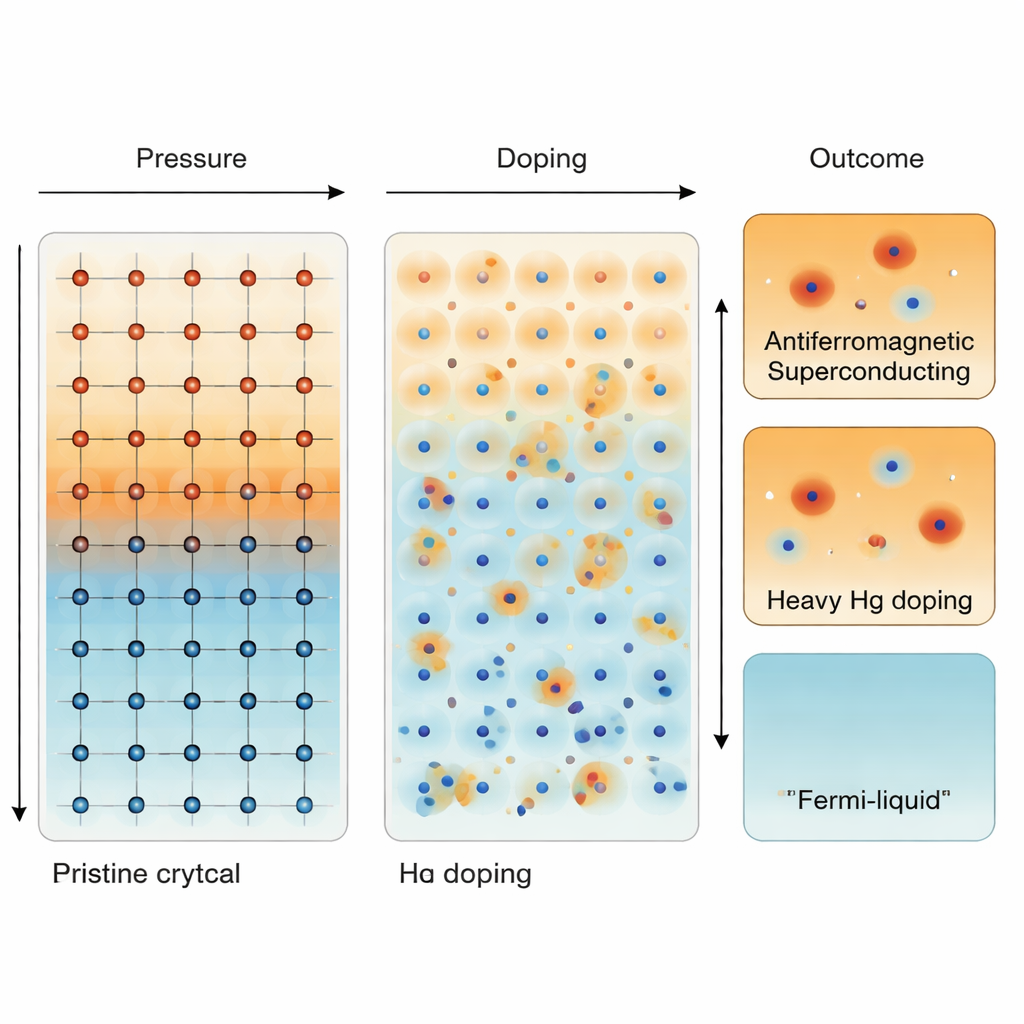
CeRhIn5 is known for living close to a quantum tipping point where its magnetic order can be wiped out by pressure, often giving way to superconductivity at extremely low temperatures. In its pure form, and in variants doped with a small amount of tin or mercury, pressure suppresses antiferromagnetic order and a dome of superconductivity appears near a special “quantum critical” pressure. This behavior has made CeRhIn5 a model system for studying how quantum fluctuations of magnetism can glue electrons into superconducting pairs.
What happens when mercury is turned up
The authors focus on a less explored case: a higher level of hole-type doping, where 5% of certain indium atoms in CeRhIn5 are replaced by mercury. Using tiny single crystals and a diamond-anvil cell, they measured how electrical resistance changes with temperature, magnetic field, and pressures up to about 24 gigapascals—over two hundred thousand times atmospheric pressure. These measurements reveal where the material orders magnetically, how that order evolves, and whether the electrons move like a conventional metal or in a more exotic, fluctuation-driven way.
Two magnetic states, but no superconductivity
Instead of smoothly losing magnetism and becoming superconducting, the heavily mercury-doped crystal passes through two distinct magnetic ground states as pressure increases. At lower pressures, an antiferromagnetic phase strengthens and then weakens. Around 8 gigapascals, a new magnetic phase with a different character emerges, persisting up to about 12 gigapascals. Only beyond this higher pressure does the material settle into a conventional “Fermi-liquid” metallic state, where resistance follows a simple temperature-squared law. Analysis of how resistance deviates from this simple behavior near each critical pressure shows strong quantum fluctuations, especially at the higher-pressure boundary, indicating a quantum critical point of a type usually associated with wave-like spin patterns.
Magnetic droplets and uneven change
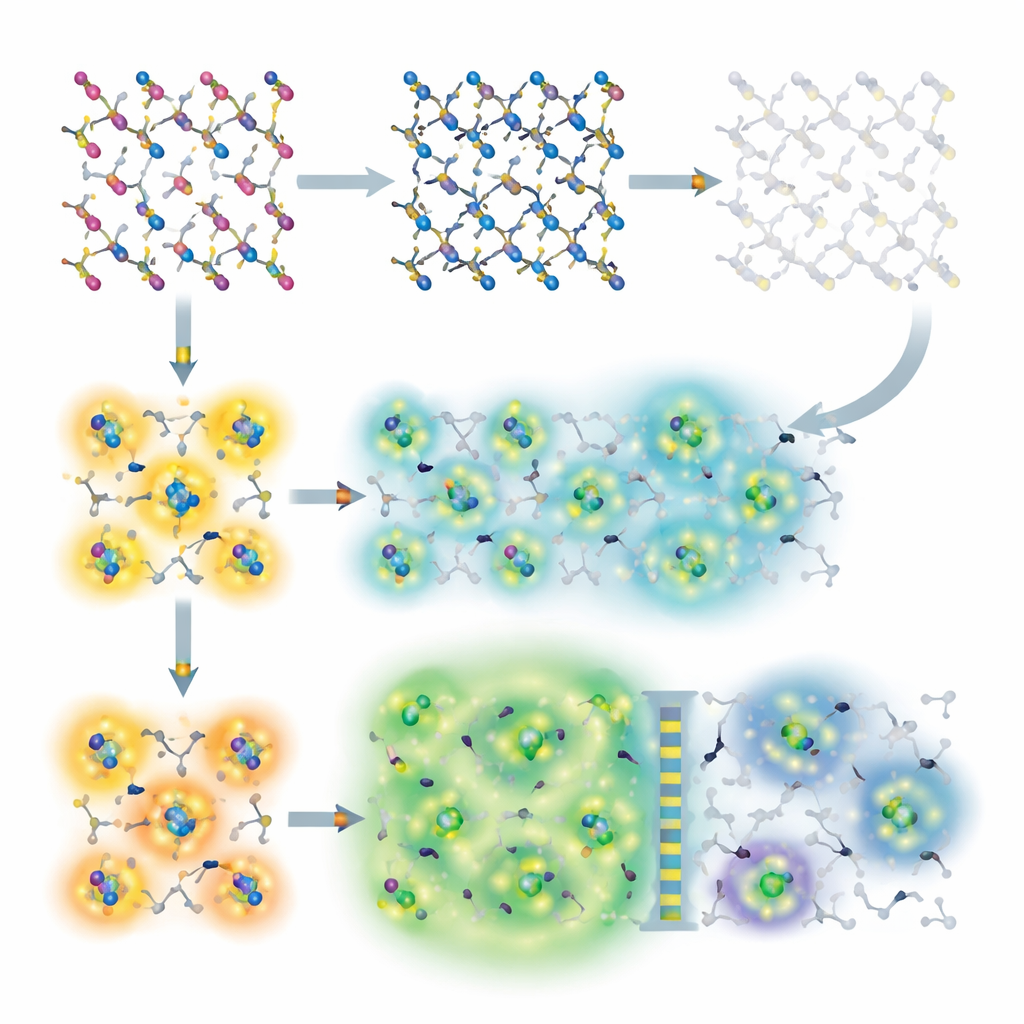
To understand why heavy mercury doping erases superconductivity while tin or light mercury doping do not, the authors compare their results with related compounds. Electron-like dopants such as tin tend to modify the electronic environment smoothly throughout the crystal, shifting the phase diagram without creating new kinds of order. In contrast, hole-like dopants such as mercury or cadmium disturb their surroundings more locally, creating tiny pockets of enhanced magnetism—“magnetic droplets”—around each impurity. At low doping, these droplets are sparse and do little more than coexist with the original magnetic state. At higher doping, they begin to overlap, stabilizing a new kind of magnetic order that competes with and ultimately suppresses superconductivity.
Frozen fluctuations and a quiet quantum point
In the 5% mercury-doped CeRhIn5, the dense network of magnetic droplets not only supports a new magnetic phase but also locally damps the magnetic jitter that usually becomes intense at a quantum critical point. As pressure suppresses long-range order, many droplets persist and “freeze” parts of the would-be critical fluctuations, leaving behind a patchwork electronic landscape. What remains of the quantum fluctuations appears too weak and spatially limited to sustain superconductivity, even though signatures of quantum criticality are still visible in the transport data.
Why this matters for future quantum materials
This work shows that not all chemical tuning is created equal: electron-type and hole-type substitutions can push a quantum material in very different ways. In CeRhIn5, electron doping acts like a gentle, uniform pressure knob, while heavy hole doping seeds islands of magnetism that grow, overlap, and ultimately change the entire phase diagram. For researchers designing next-generation superconductors and quantum devices, the message is clear: understanding whether a dopant acts locally like a magnetic “droplet maker” or globally like a smooth modifier is crucial for steering a material toward—or away from—superconductivity and other exotic quantum phases.
Citation: Wang, H., Park, T.B., Choi, S. et al. Asymmetric doping effects on the quantum critical compound CeRhIn5. NPG Asia Mater 18, 10 (2026). https://doi.org/10.1038/s41427-026-00639-6
Keywords: heavy-fermion materials, quantum criticality, antiferromagnetism, chemical doping, unconventional superconductivity