Clear Sky Science · en
Design of viologen-based 2D cationic covalent organic polymer for multi-colored electrochromic devices with tuneable redox potential
Windows That Change Color on Demand
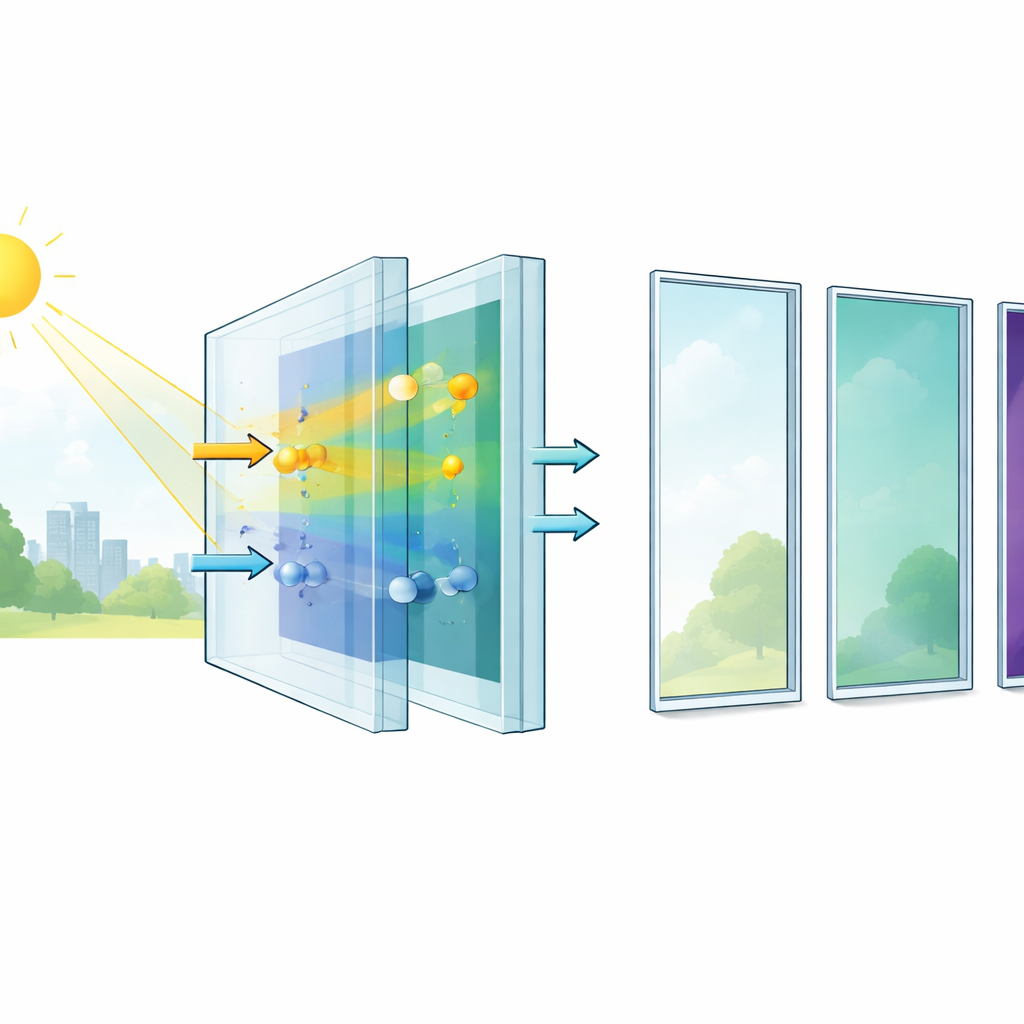
Imagine a window that can smoothly shift from nearly clear to rich hues of orange, red, green, or deep blue at the flick of a switch—saving energy, offering privacy, or displaying information, all without bulky screens. This study explores a new class of smart-color materials that make such windows more durable, efficient, and tunable, bringing electrochromic “living glass” a step closer to everyday use.
Building Color-Changing Films from Tiny Blocks
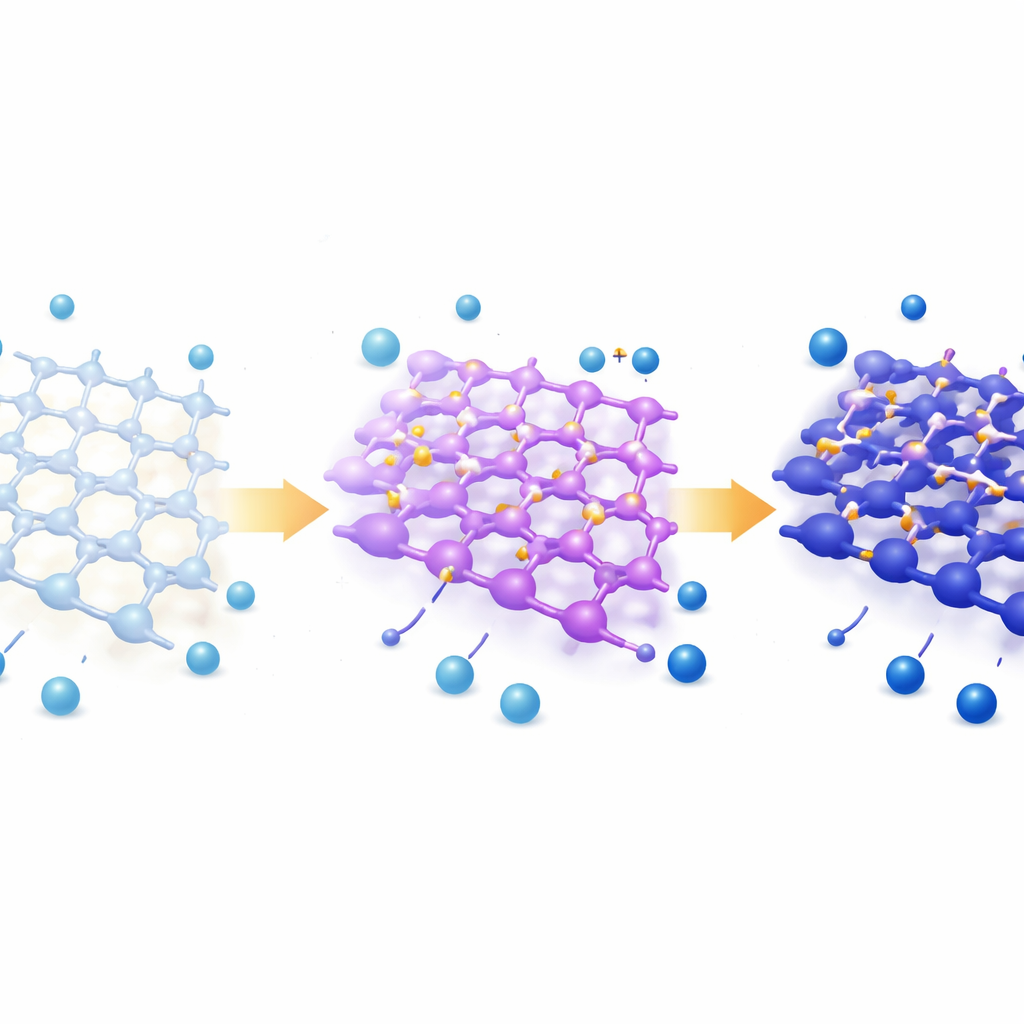
At the heart of this work are molecules called viologens, which are famous for their vivid color changes when they gain or lose electrons. Depending on their electrical state, viologens can be almost colorless, brightly colored, or deeply tinted. The researchers link many of these molecules together into thin two-dimensional polymer sheets—like a molecular mesh—forming what they call viologen-based ionic covalent organic polymers, or V-iCOPs. By choosing three different connector units (one that donates electrons, one neutral, and one that pulls electrons), they create three related films, V-iCOP1, V-iCOP2, and V-iCOP3, all grown directly on transparent conducting glass.
How Structure Shapes Color and Performance
The team carefully probed how these films are built and how that affects their behavior. Microscopy shows that the films are smooth yet overall amorphous rather than perfectly crystalline, with V-iCOP2 and V-iCOP3 forming more sheet-like, porous particles and V-iCOP1 forming denser, more featureless regions. Small pores and an overall positive charge within the films help dissolved ions move in and out, which is essential for fast color switching. Spectroscopy and electrochemical tests reveal that all three materials undergo two clean, reversible steps as electrons are added: first forming a highly colored radical state, then a neutral state with different colors. Remarkably, each film cycles through three distinct visible colors, and their exact shades and switching voltages can be “dialed in” by the choice of connector unit.
Turning Thin Films into Working Smart Devices
To turn these films into practical electrochromic devices, the researchers sandwich each V-iCOP-coated glass plate against a plain glass electrode with a soft, water-rich hydrogel in between. This hydrogel is formed in place using light-triggered polymerization and holds a salt solution plus a helper molecule that smooths out the electron flow and suppresses side reactions. The cationic films and water-based gel match well, ensuring good contact and fast ion transport. When a small voltage is applied, ions rush between film and gel, and the windows shift color within seconds. The devices show large changes in light transmission—especially for V-iCOP3, which swings from light yellow to bluish green or deep blue—and maintain strong performance over hundreds to thousands of cycles, far beyond many earlier organic electrochromic materials.
Peeking Under the Hood with Theory
To understand why these three related materials behave so differently, the authors use quantum chemical calculations on simplified fragments of each polymer. These calculations show how the chosen connector units raise or lower the key energy levels that control how easily the material accepts electrons. The electron-pulling connector in V-iCOP3 stabilizes the extra charge, allowing color changes at lower voltages and boosting color contrast. The models also reveal subtle shape changes in the molecular backbone as it switches states: more planar, sheet-like connectors (as in V-iCOP2 and V-iCOP3) favor ordered, porous structures that enable faster ion movement, while the more twisted connector in V-iCOP1 leads to denser packing and slower, less efficient switching. These insights link molecular design directly to device performance.
Toward Smarter, Longer-Lasting Color Glass
Altogether, the study shows that viologen-based 2D polymer films can deliver bright, multicolored electrochromic responses with low operating voltages, fast switching (under ten seconds), and strong durability, with the best device retaining over 90% of its contrast after 2000 cycles. The standout material, V-iCOP3, uses an electron-hungry connector to maximize color change and efficiency, hinting that “acceptor–acceptor” designs are especially promising. By pairing these films with a carefully engineered hydrogel electrolyte and guiding design choices using theory, the work outlines a clear strategy for creating next-generation smart windows and displays that are colorful, robust, and energy-efficient.
Citation: Choi, J.U., Tam, T.L.D., Park, J. et al. Design of viologen-based 2D cationic covalent organic polymer for multi-colored electrochromic devices with tuneable redox potential. NPG Asia Mater 18, 5 (2026). https://doi.org/10.1038/s41427-026-00634-x
Keywords: electrochromic windows, viologen polymers, covalent organic polymers, smart materials, color-changing devices