Clear Sky Science · en
Substrate-induced magnetism in graphene: a minireview
Why turning pencil lead into a tiny magnet matters
Graphene – a single sheet of carbon atoms like an ultra-thin slice of pencil lead – is already famous for carrying electricity extremely fast. This review explores a newer twist: how simply placing graphene on the right magnetic surface can quietly turn it into a tiny magnet without adding impurities or damaging its crystal lattice. That trick, called substrate-induced magnetism, could let engineers build future electronics that use the electron’s spin as well as its charge, enabling faster, more efficient memory, sensors, and logic devices.
From non-magnetic sheet to spin-active layer
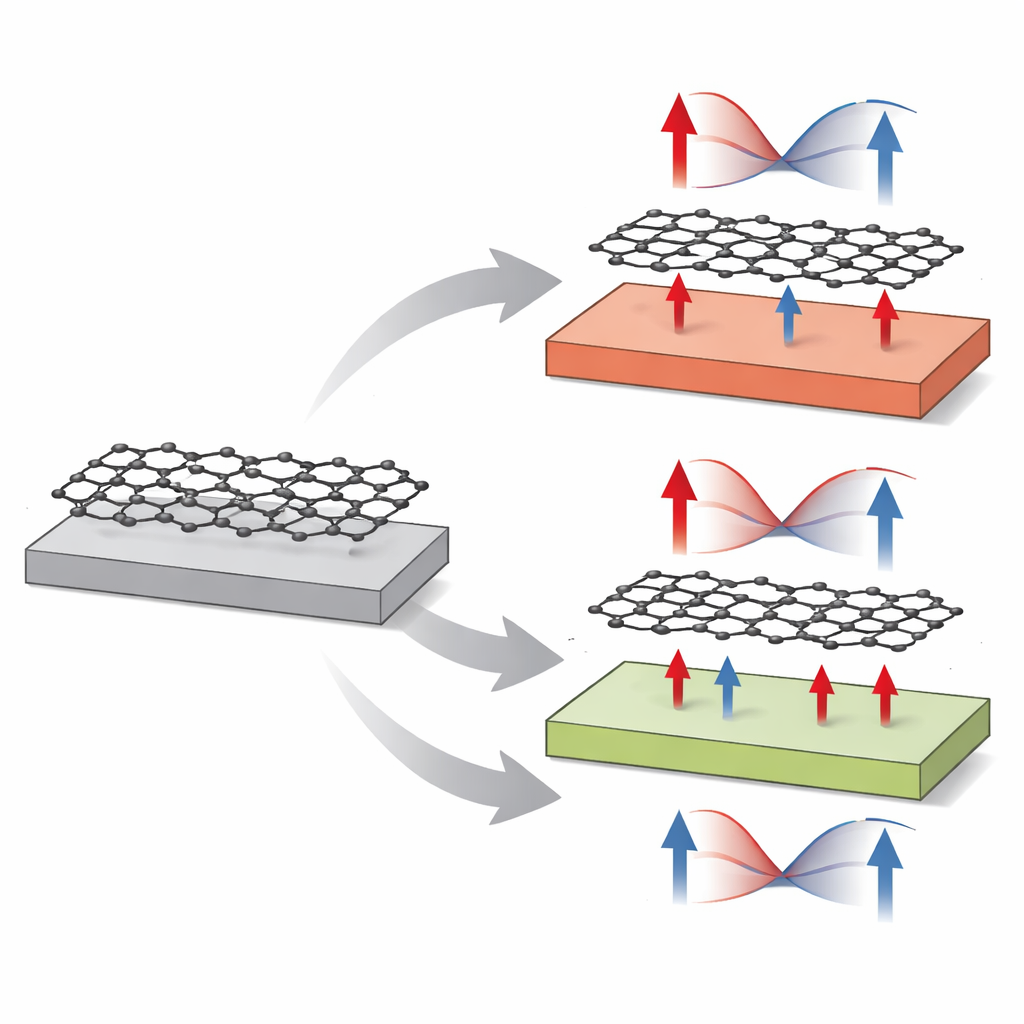
On its own, graphene is almost perfectly non-magnetic. Its light carbon atoms and balanced electronic structure do not support the kind of collective alignment of spins that gives iron or cobalt their magnetic strength. Yet experiments have shown that spins can travel long distances through graphene if they are injected from magnetic contacts, hinting that it could be a powerful medium for “spintronic” devices. The central idea of this article is that instead of trying to force magnetism into graphene by adding defects or foreign atoms, one can let a magnetic substrate do the heavy lifting: the nearby ordered spins subtly polarize the electrons in graphene, giving it a small but well-defined magnetic character.
When graphene sits on magnetic metals
The authors first survey what happens when graphene is grown directly on ferromagnetic metals such as nickel and cobalt. In these systems, the carbon layer is so close to the metal that its electrons strongly mingle with those of the underlying surface. Sophisticated calculations and spectroscopy show that graphene’s own electronic bands lose their pristine, cone-like form and instead mix with metallic states, creating new “interface states.” These hybrid states carry spin, and measurements using techniques that are sensitive to spin, such as X-ray magnetic circular dichroism and spin-resolved photoemission, reveal that the carbon atoms acquire a small magnetic moment aligned with the metal. At the same time, the graphene layer can push back: it can reduce and even reorient the metal’s magnetization and greatly enhance how strongly the system prefers magnetization to point in a particular direction, a key quantity for stable data storage.
Tuning the interface with extra layers
A second theme is how delicately this magnetic partnership can be tuned by slipping additional ultrathin layers between graphene and the metal. Adding non-magnetic spacer metals or oxides can weaken the direct contact, restoring more of graphene’s original band structure but usually reducing its induced magnetism. By contrast, inserting thin films of strongly magnetic elements such as iron or rare-earth metals can boost the magnetic signal on carbon and generate exotic effects like spin-polarized flat electronic bands or spin-dependent energy gaps. Alloy substrates such as manganese–germanium compounds provide yet another route, where theory predicts that one spin “flavor” of electrons in graphene could retain a nearly ideal, fast-moving character while the opposite spin behaves very differently – an appealing recipe for highly selective spin filters if confirmed experimentally.
Magnetism without shorting out the circuit
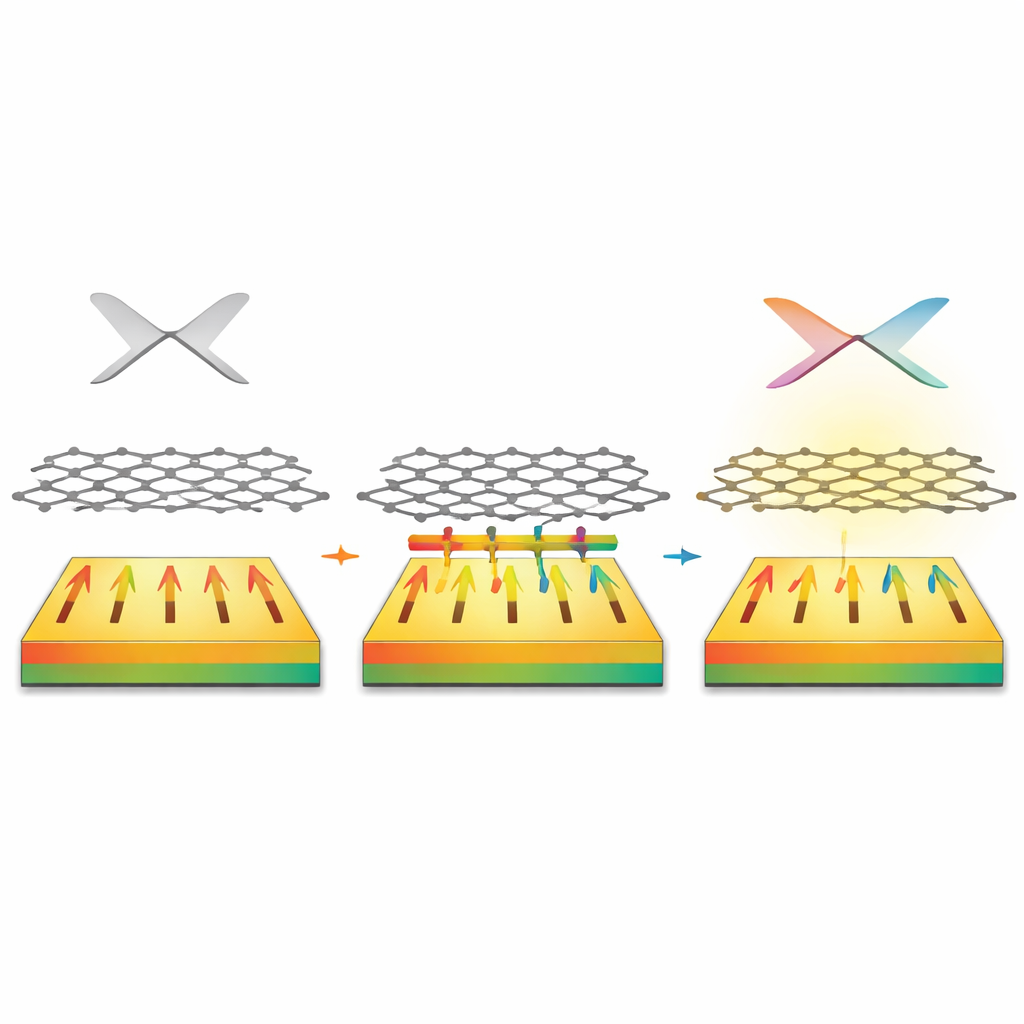
For practical devices, having graphene directly on a metal creates an electrical shortcut that undermines its special transport properties. The review therefore devotes equal attention to pairing graphene with magnetic insulators and semiconductors, such as yttrium iron garnet, europium oxides, and atomically thin crystals like Cr2Ge2Te6 or MPX3 compounds. In these hybrids, the insulating substrate provides a magnetic environment but does not carry current, so charge still flows almost entirely within graphene. Experiments that track subtle changes in the Hall resistance – a sideways voltage that reflects internal magnetization – as well as spin-sensitive X-ray measurements, have revealed clear signatures that graphene inherits a ferromagnetic character from these substrates, sometimes up to temperatures near or even above room temperature. Calculations suggest that the interfacial bonding slightly shifts graphene’s bands, opens small spin-dependent gaps, and greatly enhances its normally weak spin–orbit coupling, laying the groundwork for more complex quantum phases.
Challenges and paths to future devices
Despite substantial progress, the authors emphasize that realizing ideal spin filters and robust magnetic graphene devices remains a work in progress. Tiny changes at the interface – unwanted contamination, roughness, defects, or even a slight twist angle between the layers – can dramatically change how spins interact across the junction. As a result, many of the most exciting theoretical predictions still await definitive experimental proof. Moving forward will require cleaner growth methods, detailed microscopy and spectroscopy of each interface, and realistic computer models that include imperfections, pressure, electric fields, and light. If these hurdles can be overcome, substrate-induced magnetism could let engineers “dial in” the magnetic behavior of graphene on demand, providing a versatile platform for future spin-based electronics and perhaps even topological quantum devices.
Citation: Voloshina, E., Dedkov, Y. Substrate-induced magnetism in graphene: a minireview. NPG Asia Mater 18, 6 (2026). https://doi.org/10.1038/s41427-026-00633-y
Keywords: graphene magnetism, spintronics, magnetic proximity effect, two-dimensional materials, ferromagnetic insulators