Clear Sky Science · en
Flexible organic piezoelectric nanogenerator with high power density and excellent ferroelectric and memristor characteristics
Power from Gentle Movements
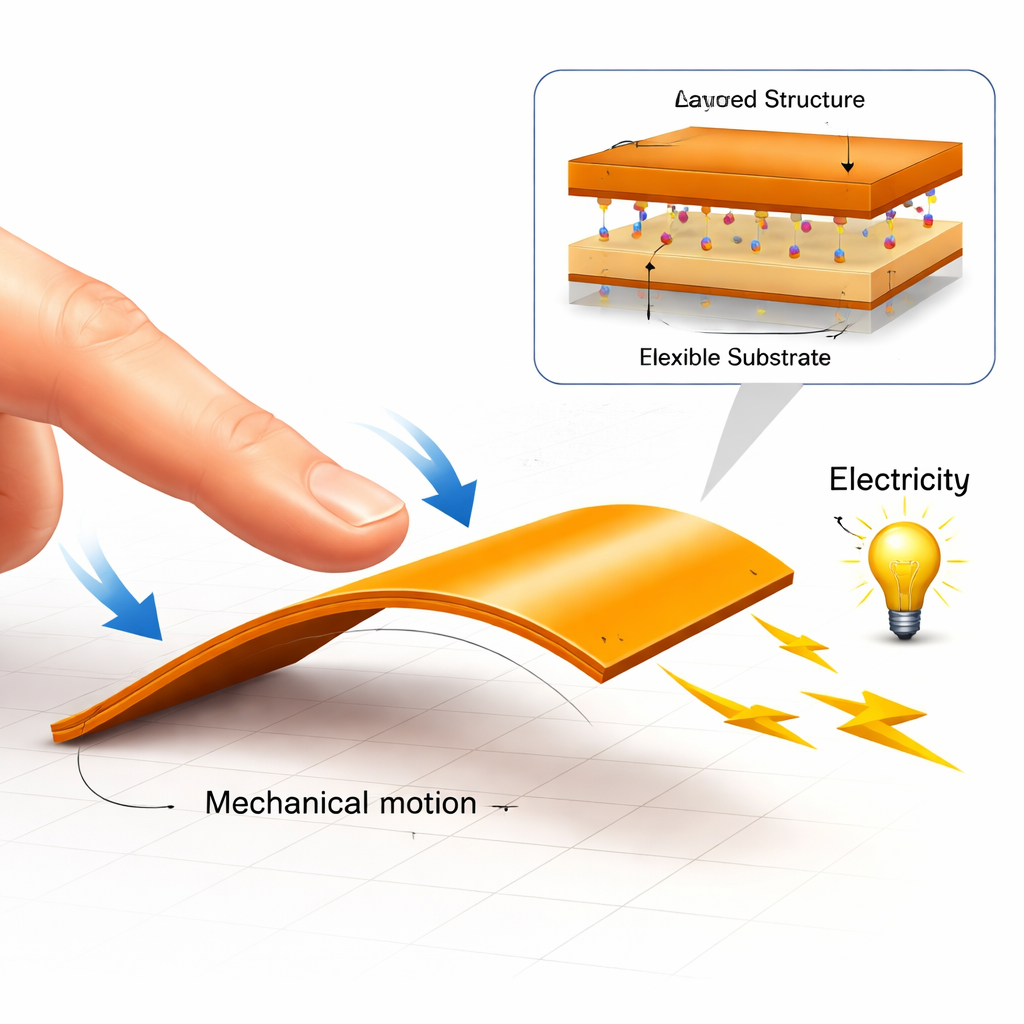
Imagine clothing, bandages, or small gadgets that power themselves simply from your everyday motions—no batteries, no charging cable. This research explores a new lightweight organic material that can do just that. It turns tiny bumps and bends into electricity, while also acting as an ultra-low-power electronic memory. That combination could help shrink, soften, and simplify the electronics inside future wearables and smart sensors.
A Tiny Crystal with Many Talents
At the heart of the study is a small organic molecule, an azobenzene derivative with one end that “pushes” electrons and another that “pulls” them. When these molecules form a crystal, they naturally line up so that many tiny electrical dipoles add together, giving the crystal a built-in electric polarization. Because this polarization can be switched by an external voltage and responds strongly to pressing and bending, the material behaves as both ferroelectric (with switchable internal charge alignment) and piezoelectric (converting mechanical motion to electricity). Unusually, this same crystal also shows “memristor” behavior, meaning its electrical resistance can be reversibly switched between high and low states and then remembered—even when power is turned off.
How the Crystal Structure Does the Work
The researchers discovered that this molecule can crystallize in two different ways, but only one arrangement is useful for energy and memory devices. In the active form, chains of strong hydrogen bonds run through the crystal, lining up the molecules so that their tiny dipoles point in the same general direction. This ordered structure leads to a relatively large built-in polarization at a low operating field, similar in strength to some more rigid inorganic materials but in a fully organic, flexible crystal. Detailed calculations show that these hydrogen-bonded chains are mainly responsible for the strong polarization, while tight stacking of the flat molecules helps stabilize the structure but prevents light-driven shape changes that are seen in some other azobenzene materials.
Memory that Remembers Without Power
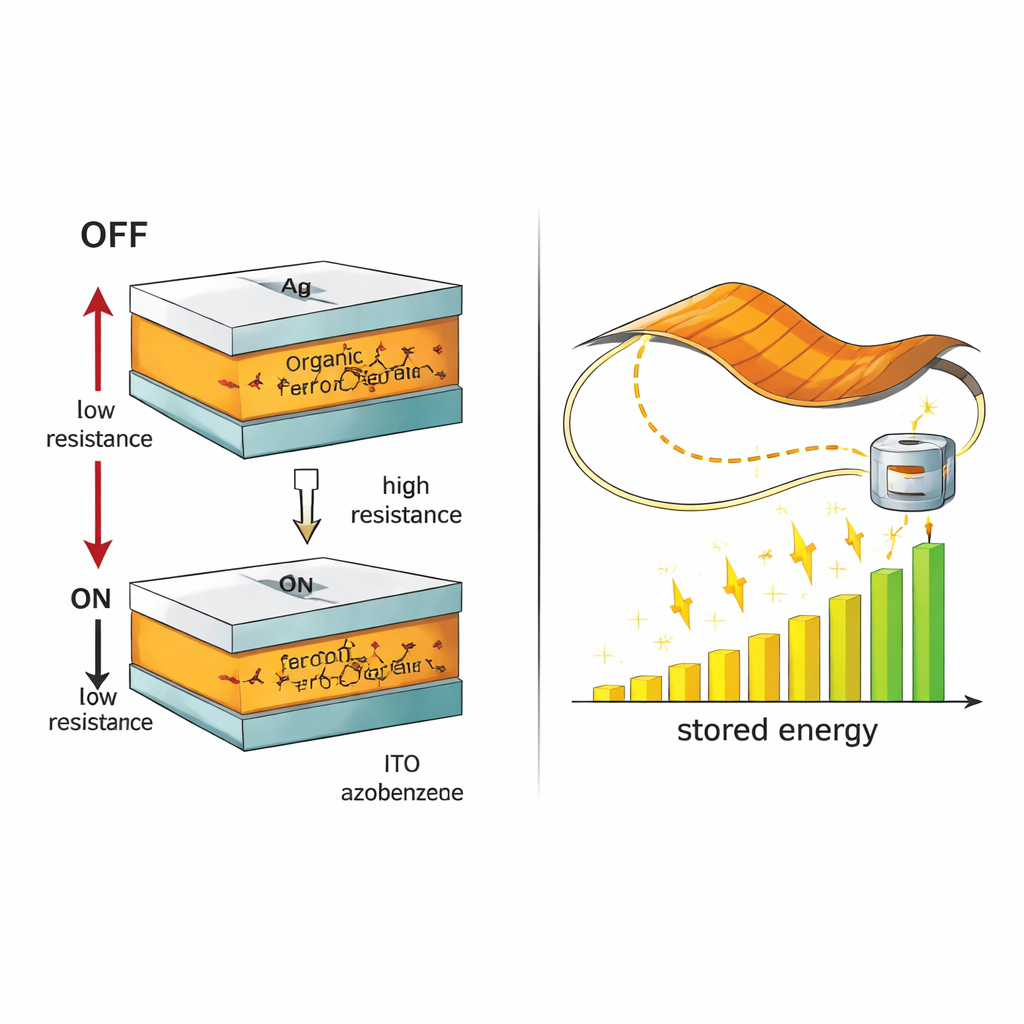
To test the crystal as a memory element, the team sandwiched a thin layer between a transparent conducting glass bottom layer and a silver top contact. When they swept a small voltage across this stack, the current jumped reproducibly between a low-conducting and a high-conducting state. These two states—often called OFF and ON—could be cycled thousands of times and held for more than an hour without fading, even though the switching voltage was below 2 volts. The researchers attribute this behavior to a blend of two effects: the formation and disruption of tiny conductive paths involving the silver electrode, and shifts in the internal polarization of the organic layer that change how easily charges can cross the interfaces. The material’s relatively low energy gap makes it easier for charges to move, supporting this low-voltage operation.
Flexible Films that Harvest Motion
Beyond memory, the team turned the material into a power source called a piezoelectric nanogenerator. They mixed microscopic crystals into a soft silicone rubber (PDMS) and cast it as thin flexible films. These orange films could be bent, rolled, and folded while keeping their structure intact. When the films were pressed rhythmically with a modest force, the best composition (about 10 percent crystal by weight) produced voltage pulses up to around 5.7 volts and a peak power density of 2.48 microwatts per square centimeter—competitive with or better than many other organic energy harvesters. At higher crystal loading, the particles began to clump, their dipoles partly cancelled each other, and the performance dropped, showing that careful mixing is crucial.
Storing Useful Energy from Everyday Motion
To demonstrate real-world usefulness, the researchers connected the flexible generator to a simple circuit that straightened the alternating output into a steady direct current and fed it into a small capacitor. In about half a minute of mechanical tapping, the capacitor charged up to roughly 1.8 volts, storing measurable charge and energy that could be used to briefly power small electronics. The device also kept working reliably over thousands of press–release cycles, indicating good durability for repetitive movements like walking or breathing.
Toward Softer, Smarter Electronics
In plain terms, this work shows that a single, lightweight organic crystal can both store digital information and harvest energy from motion, all at low voltage and with high flexibility. Instead of relying on hard, sometimes toxic inorganic ceramics, designers could someday build soft patches or thin films that sense mechanical signals, remember past events, and power themselves from the slightest movements. While further optimization and scaling are needed, this azobenzene-based material offers a promising building block for future self-powered, low-power smart devices woven into everyday life.
Citation: Ambastha, P., Kushwaha, V., Magar, A. et al. Flexible organic piezoelectric nanogenerator with high power density and excellent ferroelectric and memristor characteristics. NPG Asia Mater 18, 4 (2026). https://doi.org/10.1038/s41427-026-00632-z
Keywords: flexible electronics, piezoelectric nanogenerator, organic ferroelectric, memristor, energy harvesting