Clear Sky Science · en
Superelasticity in micro/nanostructured materials
Materials That Bounce Back
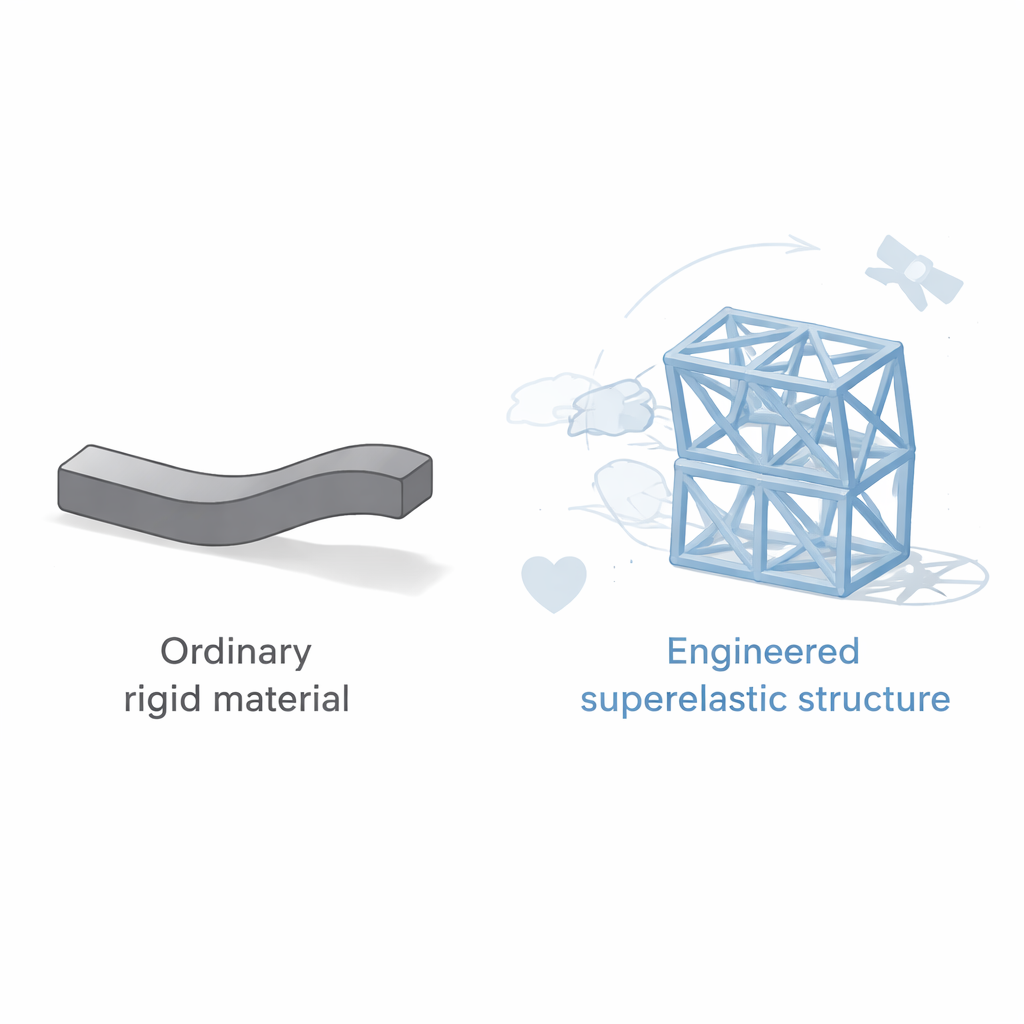
Imagine a metal bone implant, a tiny heart stent, or a phone part that can bend far without breaking or staying bent. This review article explains how scientists are learning to make hard materials—like metals, ceramics, and semiconductors—behave almost like rubber, storing and releasing large amounts of energy without permanent damage. This unusual ability to stretch and spring back, called superelasticity, could change how we build everything from medical devices and cars to flexible electronics and tiny robots.
From Stiff Solids to Super-Responders
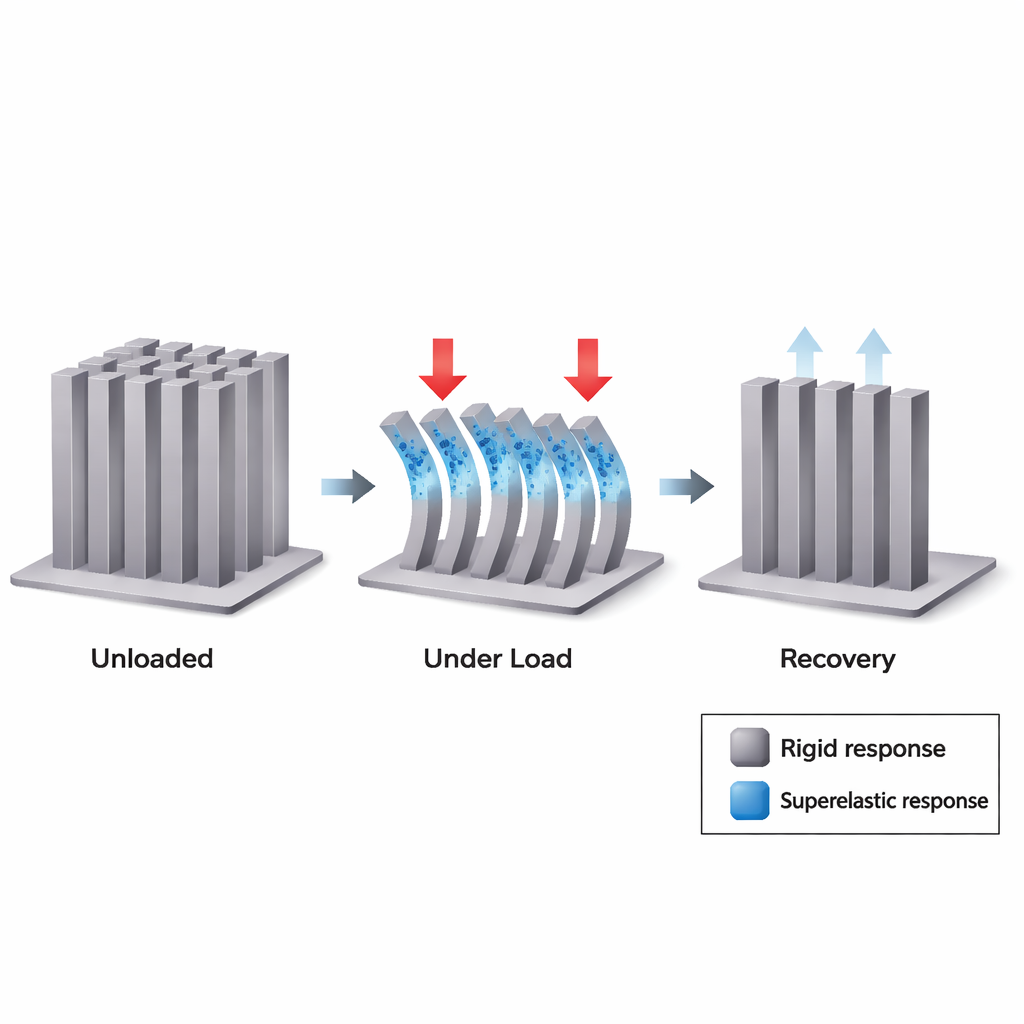
Most familiar hard materials bend only a little before they deform for good. Even though the atoms in metals and ceramics could in theory stretch much more, tiny defects and cracks cut that potential short. Researchers have discovered two main ways around this: changing the internal structure of the material, and shrinking it down to extremely small sizes. Disordered alloys and special “shape memory” metals can rearrange their internal patterns when stressed, then switch back when the load is removed. This reversible change lets them reach strains of several percent, far beyond normal metals, while new “strain glass” states—filled with nanometer‑sized domains—offer superelastic behavior over wider temperature ranges and with less energy loss.
Power of Going Small
When materials are thinned to micro- or nanoscales—think wires thousands of times thinner than a human hair—their behavior changes dramatically. Defects become rare, surfaces dominate, and the material can approach its theoretical strength. Copper and silicon nanowires, for example, have been bent or stretched to more than 10% strain and then fully recovered. Even diamond, known for being hard and brittle, can flex by nearly 10–13% in needle‑like form and snap back. Amorphous (glass-like) alloys, already more elastic than normal metals, can reach their ideal limits when thinned to tens of nanometers. In many of these tiny systems, clever control of geometry—such as allowing safe buckling instead of cracking—turns instability into an advantage, giving rise to giant, yet reversible, deformations.
Designing Tiny Springs and Smart Networks
Small building blocks are only the first step; how they are arranged also matters. The article shows how simple shapes—hollow tubes, coils, and helices—let materials bend, twist, and buckle without breaking, then recover like springs. More complex “architected” structures, such as microlattices made of hollow beams, can be both ultralight and highly recoverable, bouncing back from more than 50% compression. Patterning materials with cuts and folds (a nanoscale version of origami and kirigami) turns otherwise brittle films into stretchy, flexible sheets. Another powerful idea is to embed nano‑sized superelastic phases inside a tougher matrix. These dense micro/nanocomposites can combine high strength with large reversible strain, using percolating networks of nanowires, nanodomains, or oxides to distribute and recover deformation throughout the bulk.
From Flexible Electronics to Shape-Shifting Machines
Because these new structures can bend deeply and still recover, they are ideal for the fast-growing world of tiny devices and flexible systems. At small scales, superelastic metals and glasses are already being used in micromirrors, sensors, and actuators that must cycle millions of times without fatigue. In flexible electronics, woven networks of nanowires, nanotubes, and thin metal traces serve as stretchable conductors for electronic skin, wearable health monitors, and soft displays. Superelastic micro-architectures and composites also promise safer cars and aircraft through better energy absorption, smarter medical tools that can navigate the body, and even artificial muscles and micro-robots that move and adapt by harnessing large, reversible strains.
Why This Matters for Everyday Life
For non-specialists, the key message is simple: by shrinking and re‑architecting hard materials at the micro- and nano‑scale, scientists can make metals, ceramics, and semiconductors that flex and recover like rubber while staying strong and durable. This superelastic behavior allows devices to absorb shocks, sense tiny motions, store mechanical energy, and change shape without losing function. As fabrication methods improve, these micro/nanostructured superelastic materials could quietly appear in everything from longer‑lasting consumer electronics and safer vehicles to advanced medical implants and next‑generation robots, making everyday technologies tougher, lighter, and smarter.
Citation: Li, F., Ren, S., Xie, W. et al. Superelasticity in micro/nanostructured materials. NPG Asia Mater 18, 3 (2026). https://doi.org/10.1038/s41427-026-00631-0
Keywords: superelasticity, nanomaterials, shape memory alloys, flexible electronics, architected materials