Clear Sky Science · en
Targeting integrin beta 4 in diacetyl-induced anoikis of the airway epithelium
Why buttery flavor can hurt the lungs
Diacetyl is a small chemical that gives microwave popcorn, coffee, and some e‑cigarette liquids their buttery taste and smell. It is considered safe to eat, but workers who breathe in high levels over time can develop a serious and often irreversible lung-scarring disease called bronchiolitis obliterans, sometimes nicknamed “popcorn lung.” This study asks a simple but important question: what exactly happens to the cells lining the airways after diacetyl exposure, and can we find a weak point in that process to stop the damage before it becomes permanent?
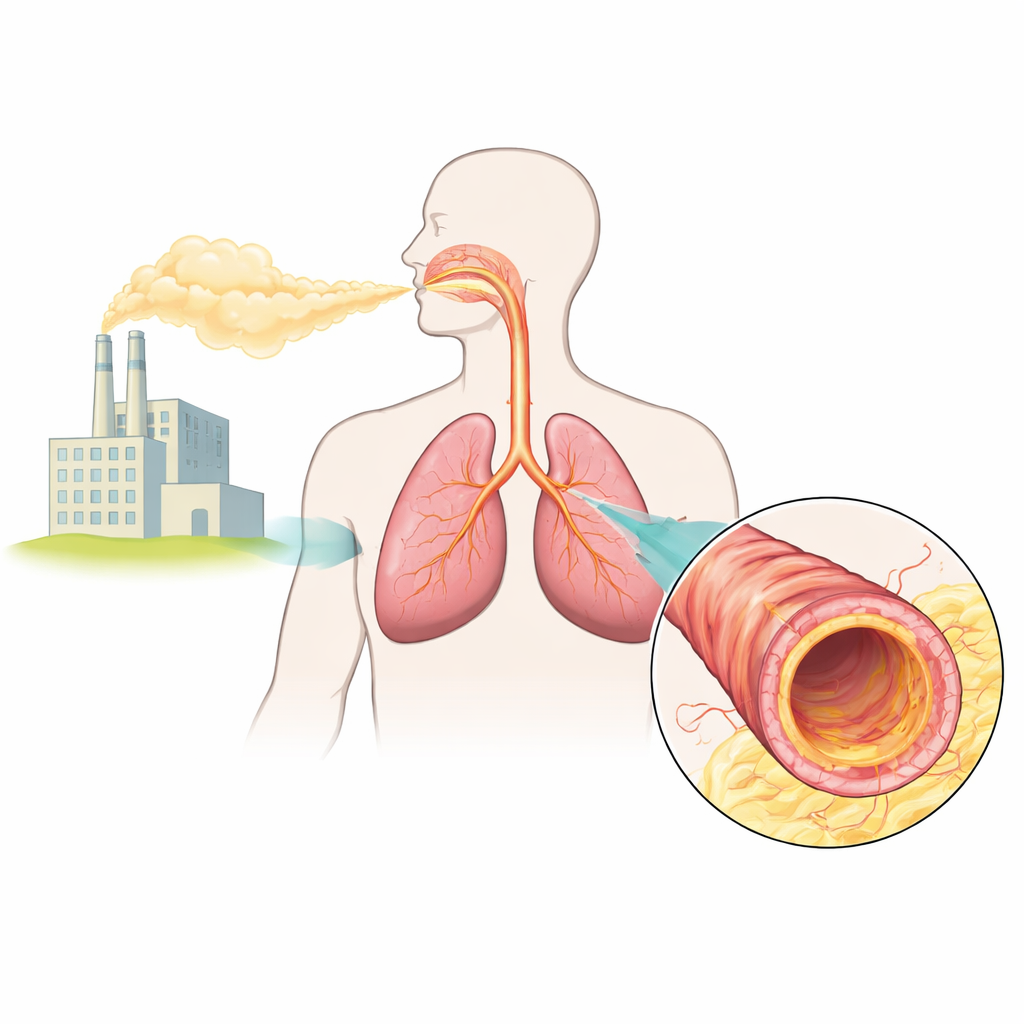
From pleasant aroma to permanent airway scars
The researchers first used rats to mimic repeated workplace exposure. Animals breathed diacetyl vapor at levels comparable to those measured in certain factories, six hours a day for five days, and were then followed for five weeks. Their lungs developed clear signs of structural remodeling: the tubes carrying air grew thicker walls packed with extra collagen, a stiff protein that forms scar tissue. Under the microscope, the airway surface that should be covered by a neat sheet of cells became distorted and overgrown, with patches of abnormal epithelium replacing healthy lining. These changes match the kind of fibrosis seen in human bronchiolitis obliterans, suggesting the model faithfully reproduces the disease process set in motion by diacetyl.
A crucial grip between cells and their foundation
A standout feature of healthy airways is the strong physical connection between the surface cells and a thin supporting sheet called the basement membrane. That grip is provided by molecular “rivets” called hemidesmosomes, which include a key protein named integrin beta 4. This protein spans the cell membrane: one end anchors inside the cell to the internal scaffolding; the other end attaches to proteins just below the cell layer. In the rat lungs, the team saw that integrin beta 4 dwindled dramatically after diacetyl exposure, especially in the larger intrapulmonary airways where scarring was most severe. At the same time, there was an expansion of cells staining for generic structural proteins (pan‑cytokeratin), signaling a shift toward a stressed, abnormal epithelial state rather than orderly repair.
Human airway cells lose their foothold and die
To see whether similar events occur in people, the researchers grew miniature three‑dimensional airway “organoids” from donated human lungs, as well as flat sheets of a human bronchial cell line. When exposed to diacetyl in the dish, organoids shrank and showed increased cell death, especially at their inner, air‑facing surface, while the number of organoids stayed about the same. Key markers of airway stem‑like basal cells, including integrin beta 4 and a protein called ΔNp63, dropped sharply, suggesting that the very cells needed for repair were being compromised. In the flat cultures, diacetyl caused cells to pull away from each other and from their base, activating enzymes (caspases) that drive programmed cell death. This pattern matches a specific form of death called anoikis, which occurs when cells lose their attachment to their foundation.
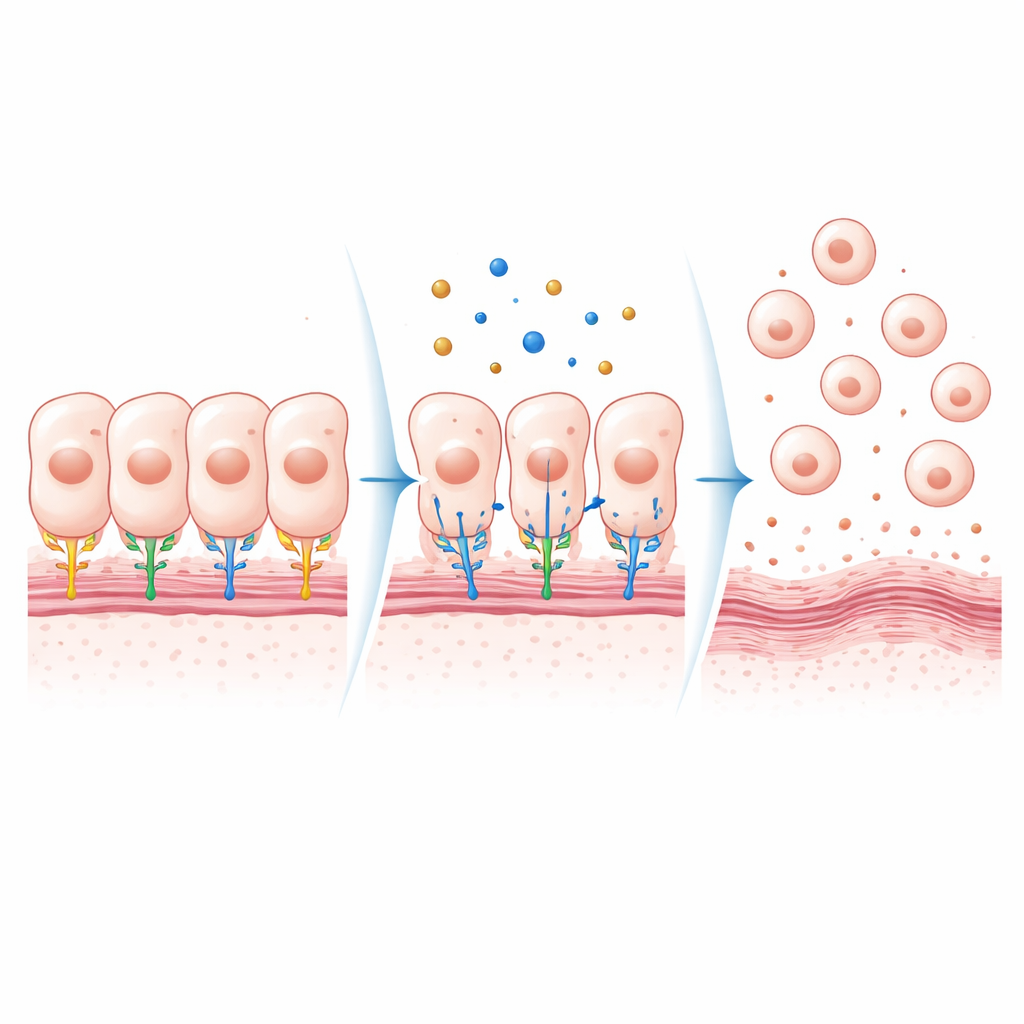
A cut link that triggers cell loss and scarring
Delving deeper, the team showed that diacetyl does not merely lower integrin beta 4 levels; it actually causes the protein to be cut into smaller fragments by caspases. Full‑length integrin beta 4 bands on protein gels diminished, while shorter pieces appeared at expected sizes for this kind of enzymatic cleavage. Under the microscope, integrin beta 4 shifted from a neat pattern at the cell surface to clumps around the cell nucleus, indicating it was no longer doing its anchoring job. Blocking caspases with a drug (Z‑VAD‑FMK) kept more integrin beta 4 at the cell surface and reduced the amount of anoikis, improving survival of airway cells after diacetyl. By contrast, forcing cells to make extra integrin beta 4 at the gene level did not rescue them: the protein was still chopped up, and a stress pathway that shuts down protein production remained active. This points to post‑translational damage—what happens to the protein after it is made—as the central problem.
What this means for protecting workers’ lungs
Put simply, this study shows that inhaled diacetyl can sever the molecular rivets that keep airway cells attached to their support, causing them to let go and die. As those cells are lost and not properly replaced, scar tissue builds up, narrowing and stiffening the small airways in a way that resembles popcorn lung. Preventing the cleavage or mis‑handling of integrin beta 4 after exposure, or calming the stress responses that follow, emerges as a promising strategy to preserve the airway lining and block the cascade toward irreversible fibrosis. While such treatments are still in the future, identifying this early “broken grip” event gives scientists a concrete target for designing interventions to better protect workers who inhale flavoring chemicals.
Citation: Kim, SY., Pitonzo, A., Huyck, H. et al. Targeting integrin beta 4 in diacetyl-induced anoikis of the airway epithelium. Cell Death Discov. 12, 115 (2026). https://doi.org/10.1038/s41420-026-02980-9
Keywords: diacetyl, bronchiolitis obliterans, airway epithelium, integrin beta 4, occupational lung disease