Clear Sky Science · en
miR-424(322)~503 impairs colon cancer progression driven by PTEN deficiency
Why this study matters for colon cancer
Colon cancer remains one of the most common and deadly cancers worldwide, and many patients still progress to advanced disease despite surgery, chemotherapy and targeted drugs. This study explores a tiny set of genetic "dimmer switches" called microRNAs that can slow or speed tumor growth. By uncovering how one specific microRNA cluster interacts with a well-known tumor suppressor gene, PTEN, the work helps explain why some colon cancers become more aggressive and points to new ways to predict risk and design therapies.
Tiny RNA switches with big impact
MicroRNAs are short RNA molecules that do not code for proteins but fine-tune how hundreds of genes are used in a cell. The miR-424(322)~503 cluster, made up of two related microRNAs, has puzzled researchers because it can act as a brake or an accelerator in different cancers. In colon cancer, its role was unclear. The authors focused on cancers driven by loss of PTEN, a gene that normally keeps growth signals under control and is frequently altered in colon tumors. They asked a simple but powerful question: what happens to colon cancer development when both PTEN and this microRNA cluster are missing?
Mouse models reveal a protective role
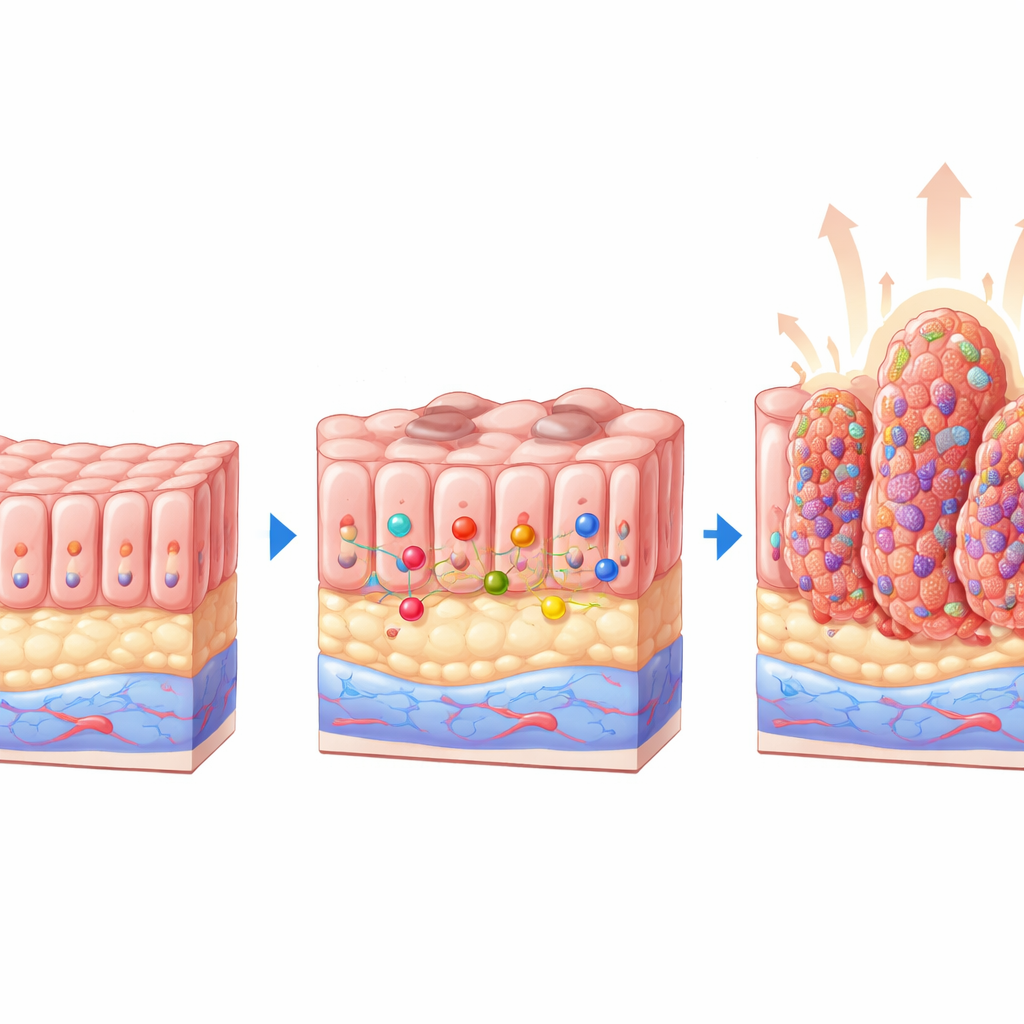
To answer this, the team used genetically engineered mice in which PTEN can be switched off in the intestinal lining, and crossed them with mice lacking the miR-424(322)~503 cluster. This created four groups: normal animals, mice missing only the microRNAs, mice missing only PTEN, and double knockout mice missing both. After triggering PTEN loss, they carefully examined the colons. Animals lacking only PTEN developed multiple small polyps, many with early-stage abnormal tissue. In striking contrast, mice missing both PTEN and the microRNA cluster had many more lesions, larger polyps and a higher proportion of advanced changes, including high-grade dysplasia and outright adenocarcinoma. The microRNA cluster alone did not cause disease, showing that its loss is particularly harmful when PTEN is already missing.
Unchanged classic pathway, shifted to new culprits
Colon cancer is often driven by overactivation of the Wnt/β-catenin pathway, a key route controlling stem cells in the gut. Because this microRNA cluster can influence that pathway in breast tissue, the authors tested whether the same was true here. Surprisingly, levels and location of β-catenin and its coreceptor LRP6 in the colon did not change when the microRNA cluster was removed, even in the double knockout animals. Instead, large-scale gene expression profiling pointed elsewhere: tumors lacking both PTEN and the microRNAs showed strong signatures of tissue remodeling, wound response and epithelial-to-mesenchymal transition, a program linked to invasion and metastasis. Signaling routes driven by MAP kinases (ERK1/2 and p38) and by the growth factor TGFβ were particularly enriched.
How growth signals spin out of control
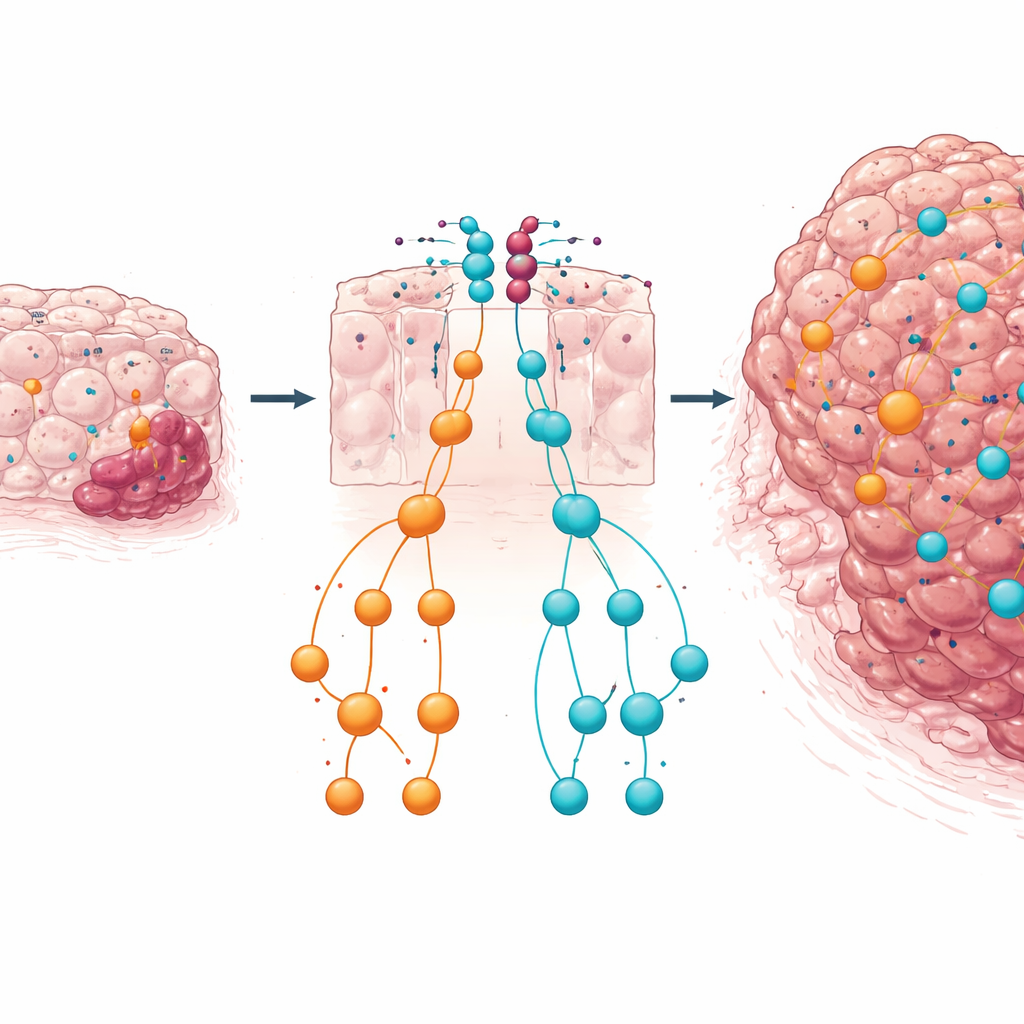
Diving deeper, the researchers examined proteins in the colon tissue. They found that while PTEN loss alone boosted the PI3K/AKT pathway, adding loss of the microRNA cluster produced a further surge in MAPK activity: more activated JNK, p38, MKK4 and especially ERK1/2. These highly active signals coincided with higher levels of cyclin D1, a key driver of cell division. At the same time, components of the TGFβ pathway that promote its activity (SMAD3 and SMAD4) rose, while an internal brake (SMAD7) fell, and cancer cells showed stronger nuclear SMAD2/3 staining, consistent with pathway activation. By comparing mouse tumor genes with predicted microRNA targets, the team identified IGF1, a potent growth factor that feeds into MAPK cascades, as a direct target of the miR-424(322)~503 cluster. When the microRNAs were absent, IGF1 escaped repression, pushing MAPK signaling even higher. Analyses of human colon cancer data sets mirrored these findings: IGF1 was higher in tumors with low miR-424 or miR-503, and the long noncoding RNA that hosts these microRNAs, MIR503HG, as well as the microRNAs themselves, were coordinately altered in patient tumors.
A double safety net and what it means for patients
Taken together, the results suggest that in PTEN-deficient colon tissue, the miR-424(322)~503 cluster acts like a second safety net. When PTEN is lost, these microRNAs are turned up, partly through signals such as TGFβ, and work to restrain powerful growth pathways like IGF1–MAPK and TGFβ–SMAD. If this microRNA brake is removed, growth and remodeling signals run unchecked, speeding the transition from benign polyps to invasive cancer. For a lay reader, the key message is that not all genetic changes in a tumor push in the same direction: some are built-in defenses. Understanding how PTEN and this microRNA cluster cooperate to keep cell growth in balance could help identify high-risk patients and inspire combination treatments that target both the PI3K/AKT and MAPK/TGFβ axes in colorectal cancer.
Citation: Vidal-Sabanés, M., Bonifaci, N., Navaridas, R. et al. miR-424(322)~503 impairs colon cancer progression driven by PTEN deficiency. Cell Death Dis 17, 254 (2026). https://doi.org/10.1038/s41419-026-08504-8
Keywords: colorectal cancer, PTEN, microRNA, MAPK signaling, TGF-beta