Clear Sky Science · en
Diploid hepatocytes resist acetaminophen-induced liver injury through suppressed JNK signaling
Why some livers weather overdoses better
Acetaminophen (paracetamol) is in countless medicine cabinets, yet taking too much is a leading cause of sudden liver failure. This study asks a deceptively simple question with big implications: do all liver cells respond to an overdose the same way? The researchers show that one particular type of liver cell, called diploid hepatocytes, is surprisingly good at surviving and repairing damage after an acetaminophen overdose, thanks to a dampened internal stress pathway.
Two kinds of liver cells, two different fates
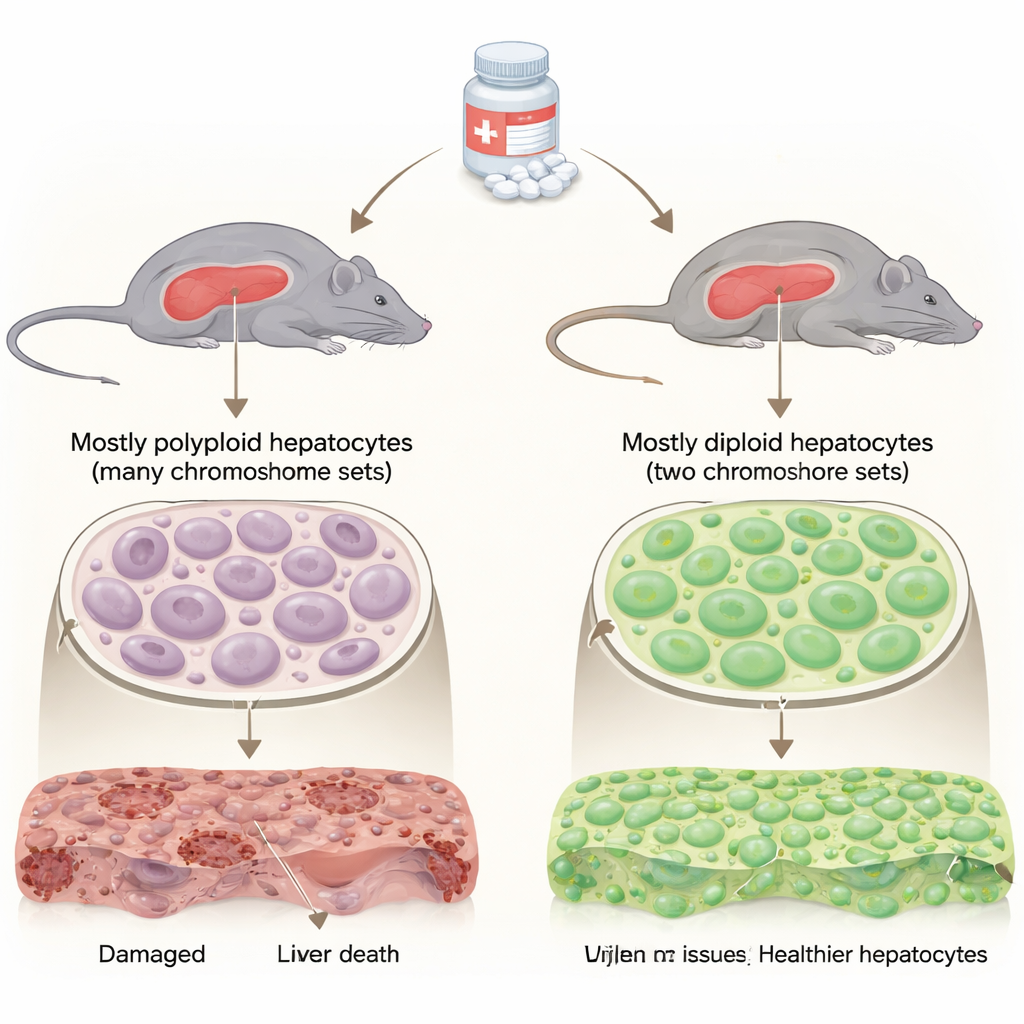
The liver is unusual because most of its working cells (hepatocytes) carry extra sets of chromosomes, making them polyploid. A smaller fraction remain diploid, with just two sets of chromosomes like most cells in the body. Scientists have known that these groups differ in how they divide and regenerate, but their roles in drug injury were unclear. The authors used specially bred mice whose livers are packed with diploid cells yet otherwise function normally, and compared them with typical mice whose livers are mostly polyploid. Both groups were given low and high overdose levels of acetaminophen to see how their livers responded over time.
Diploid-rich livers survive overdoses and bounce back faster
When mice received a “regenerating” overdose of acetaminophen, both groups showed liver damage, but the diploid-rich mice did far better. They had higher survival, lower levels of liver enzymes in the blood (a sign of less damage), and smaller regions of dead tissue and fragmented DNA under the microscope. Even at a harsher, “non-regenerating” dose—one that usually causes lasting injury and death—over half of the diploid-rich mice survived, compared with fewer than one in ten of the controls. Despite this protection, diploid-heavy livers did not sit idle: they switched on cell-division proteins earlier, suggesting they both resist injury and start rebuilding sooner.
Not the drug itself, but the stress wiring
One obvious possibility was that diploid-rich livers simply processed acetaminophen differently. The team measured key enzymes that convert the drug into its toxic by-product, levels of the protective molecule glutathione, and the amount of drug bound to liver proteins. All were similar between the two mouse types, meaning both made and handled the same amount of toxin. The crucial difference emerged later, in how cells responded to that toxin. In typical, polyploid-heavy livers, genes and proteins involved in cellular stress, DNA damage, and mitochondrial injury were strongly switched on. In diploid-rich livers, these responses were muted and resolved sooner, while genes linked to regeneration turned on earlier.
A quieter death pathway protects diploid cells
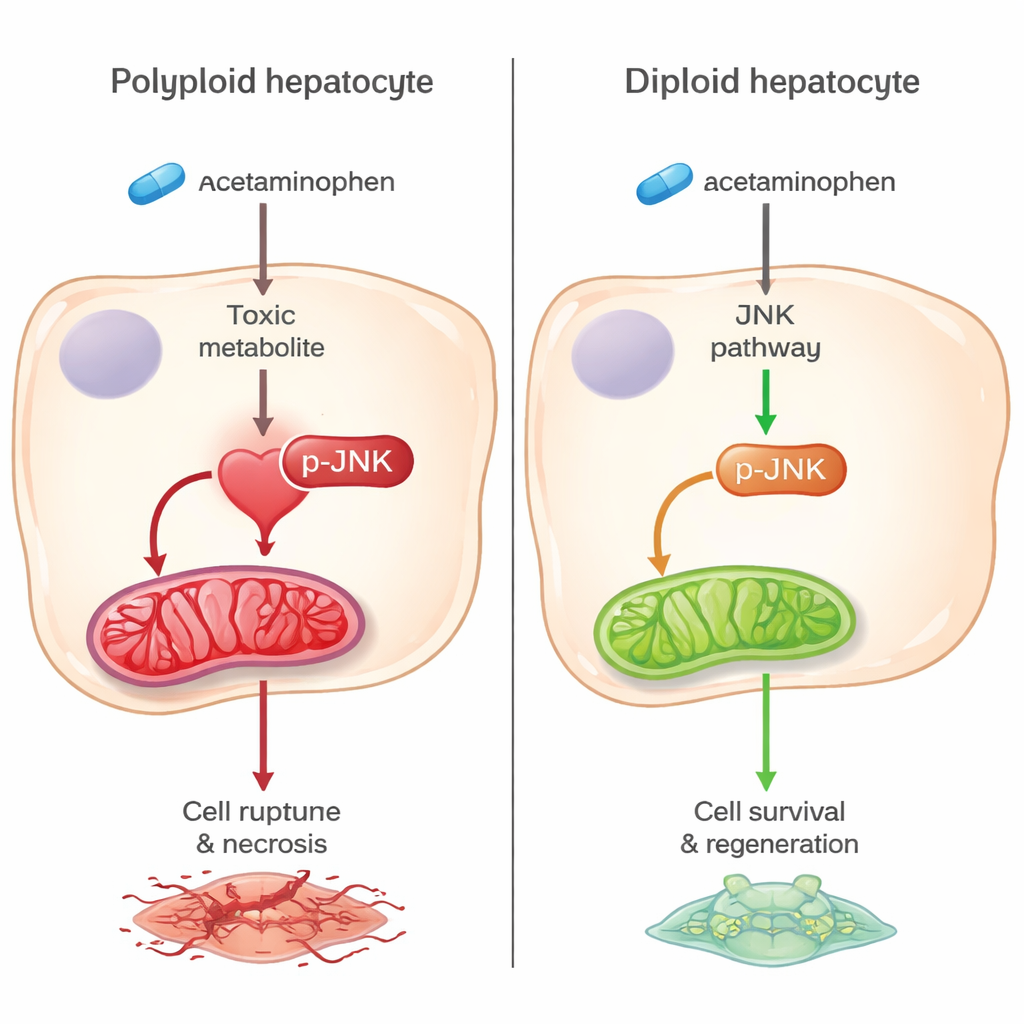
The central player in this difference is a stress-signaling route known as the JNK pathway. In standard livers, acetaminophen’s toxic by-product activates upstream enzymes that switch on JNK, which then moves into mitochondria, the cell’s powerhouses, driving oxidative damage and cell death. In diploid-rich livers, activation of these upstream enzymes and JNK itself was sharply reduced, and far less JNK reached the mitochondria. Markers of oxidative stress and mitochondrial breakdown were also lower, indicating that these powerhouses stayed more intact. Importantly, when the same genes were deleted only in adult livers without changing cell ploidy, there was no protection, pointing to the abundance of diploid cells—not the gene manipulation itself—as the key factor.
Why cell type matters for human liver injury
To see if this pattern holds more generally, the researchers exposed normal mouse liver cells grown in dishes to acetaminophen. Cells with many chromosome sets (highly polyploid) died more readily, while diploid and low-ploidy cells were more likely to survive. Together, the findings support a model in which diploid hepatocytes are the liver’s “first responders” to sudden toxic injury: they curb a major death pathway, preserve their mitochondria, and enter regeneration quickly. Polyploid cells may still be beneficial in other settings, such as guarding against cancer or adapting to long-term chronic damage. But for a one-time overdose, having more diploid hepatocytes could make the difference between recovery and liver failure.
Citation: Wilson, S.R., Delgado, E.R., Alencastro, F. et al. Diploid hepatocytes resist acetaminophen-induced liver injury through suppressed JNK signaling. Cell Death Dis 17, 203 (2026). https://doi.org/10.1038/s41419-026-08448-z
Keywords: acetaminophen overdose, liver injury, hepatocyte ploidy, JNK signaling, liver regeneration