Clear Sky Science · en
Cancer-associated fibroblasts (CAFs) derived from MFAP2 promote CRC proliferation and metastasis while suppressing CD8+ T cell-mediated antitumor immunity
Why the Tumor’s Neighborhood Matters
Colorectal cancer is one of the most common and deadly cancers worldwide, yet doctors still struggle to stop it from spreading and to predict which patients will do poorly. This study looks not just at the cancer cells themselves, but at their "neighbors"—supporting cells and immune cells that share the same space. The researchers uncover how a particular helper cell type, called cancer‑associated fibroblasts, can secretly boost tumor growth and silence the body’s own cancer‑killing T cells. Understanding this hidden conversation may open the door to new treatments that make current therapies more effective.
Hidden Helpers Inside Colon Tumors
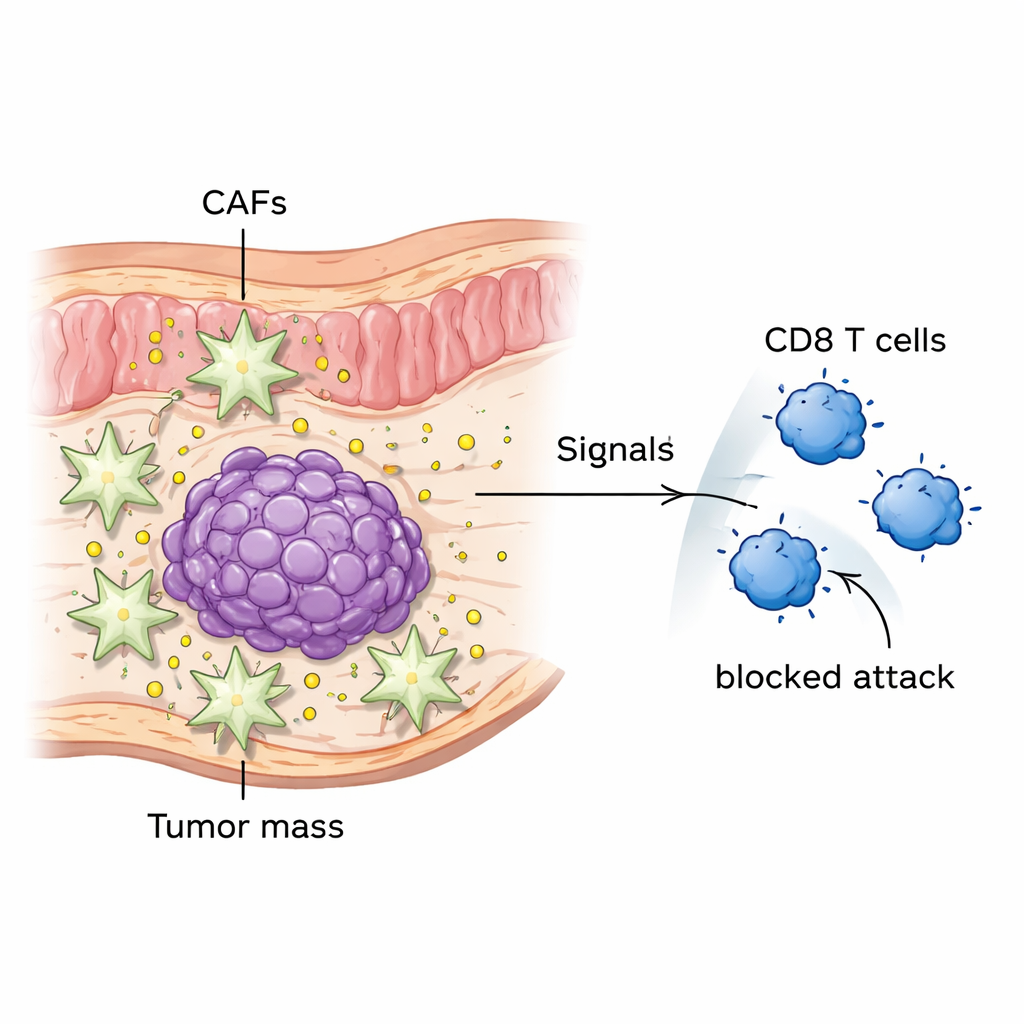
Colon tumors are not just clumps of rogue cells; they are miniature ecosystems. Among the most important inhabitants are cancer‑associated fibroblasts, or CAFs. These cells lay down connective tissue, remodel the tumor’s surroundings, and release signaling molecules. By analyzing patient samples and large gene databases, the authors found that a protein called MFAP2 is present at much higher levels in colorectal tumors than in normal colon tissue, and that patients with more MFAP2 tend to have worse survival. They showed that CAFs, rather than cancer cells themselves, are the main producers of MFAP2 in these tumors. In lab‑grown cells and in mouse models, CAFs rich in MFAP2 were closely linked to faster tumor growth and more aggressive behavior.
A Growth Switch on Cancer Cells
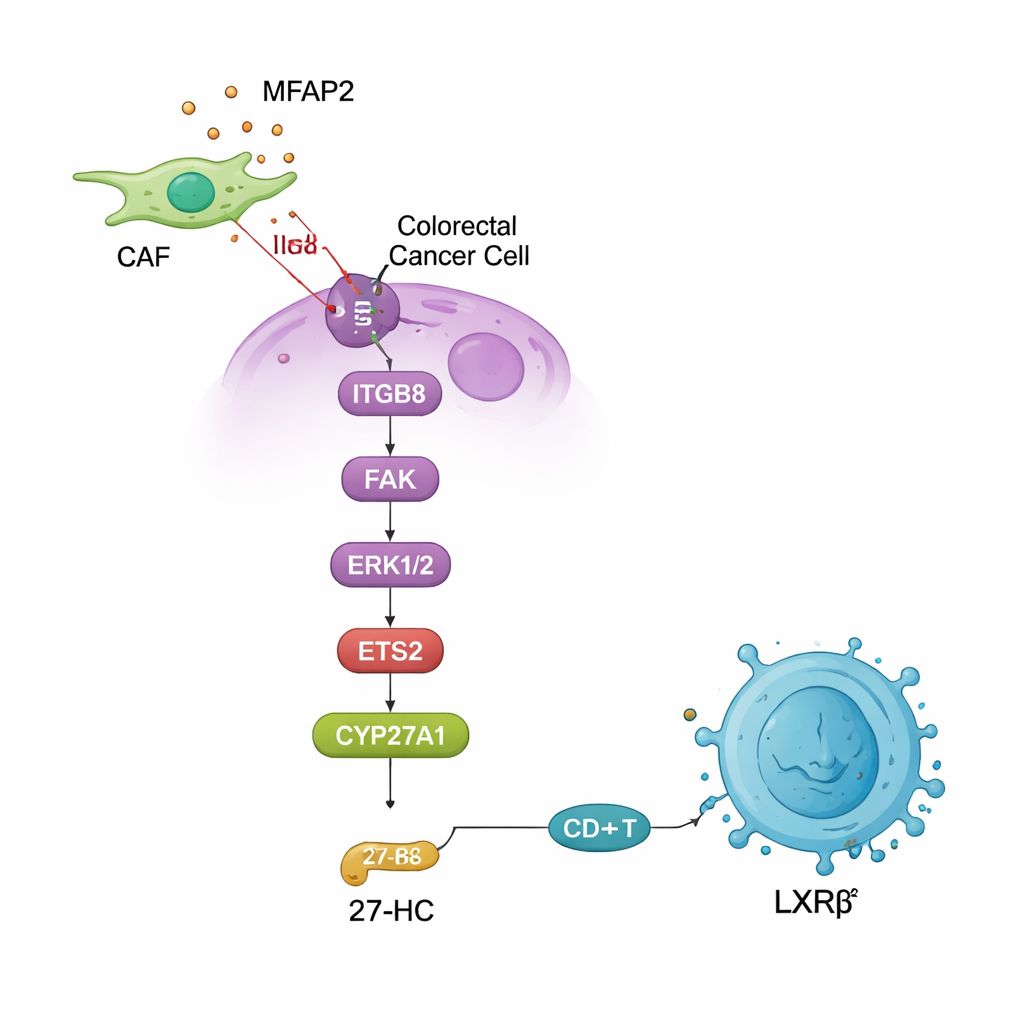
The team then asked how MFAP2 actually pushes cancer cells to grow and spread. They discovered that MFAP2 released by CAFs sticks to a receptor called integrin β8 (ITGB8) on the surface of colorectal cancer cells. This contact flips on an internal signaling chain known as the FAK–ERK1/2 pathway, which is well known for helping cells multiply and move. One of the key switches turned on by this chain is a gene regulator named ETS2. When ETS2 levels rise, colon cancer cells become more invasive and better able to survive, even when confronted by immune cells that are trying to kill them. When the researchers blocked MFAP2 or ITGB8, or reduced ETS2, tumors in mice shrank and formed fewer liver metastases.
How Tumors Starve Off Immune Attack
Colon tumors are often infiltrated by CD8 T cells—immune cells that specialize in seeking out and killing cancer. Patients whose tumors contain more of these cells generally live longer. Yet in tumors with high MFAP2, the researchers found fewer CD8 T cells and signs that those present were exhausted and less effective. They traced this effect to a change in how tumor cells handle cholesterol. ETS2 drives up the production of an enzyme called CYP27A1, which converts cholesterol into a molecule called 27‑hydroxycholesterol (27‑HC). This fatty molecule then acts on a sensor in T cells known as LXRβ, which dampens their activity. In both cell cultures and mice, more MFAP2 meant more 27‑HC in the tumor environment, more T‑cell death and dysfunction, and more tumor growth.
Linking Metabolism, Fibroblasts, and Immune Escape
This work ties together several seemingly separate aspects of cancer biology: support cells around the tumor, internal signaling in cancer cells, and the way the tumor rewires fat metabolism to disarm immune defenses. By placing MFAP2 at the top of a chain that runs through ITGB8, FAK, ERK1/2, ETS2, and CYP27A1, and ends with 27‑HC disabling CD8 T cells via LXRβ, the researchers outline a complete route from fibroblast signal to immune escape. Importantly, blocking MFAP2 or ETS2 not only slowed tumor growth but also restored T‑cell infiltration and function in mice, suggesting that this pathway could be targeted to make immunotherapy and standard treatments more effective.
What This Means for Future Treatments
For non‑specialists, the take‑home message is that some of the most damaging players in colon cancer are not the tumor cells alone, but their accomplices and the chemical messages they send. MFAP2, produced by fibroblasts in the tumor, helps cancer cells grow and shields them from attack by weakening the body’s own killer T cells through a cholesterol‑based signal. Because this MFAP2‑driven chain has multiple steps—at the fibroblast, the cancer cell surface, the signaling inside the cell, and the T cell—it offers several potential targets for new drugs. Therapies that interrupt this pathway could both slow tumor spread and "reawaken" exhausted T cells, improving outcomes for patients with colorectal cancer.
Citation: Zhang, X., Fei, Y., Xie, C. et al. Cancer-associated fibroblasts (CAFs) derived from MFAP2 promote CRC proliferation and metastasis while suppressing CD8+ T cell-mediated antitumor immunity. Cell Death Dis 17, 159 (2026). https://doi.org/10.1038/s41419-026-08413-w
Keywords: colorectal cancer, tumor microenvironment, cancer-associated fibroblasts, immune evasion, cholesterol metabolism