Clear Sky Science · en
FOXM1 induces therapy resistance and inhibits apoptosis in a variety of human cancers
Why some cancers stop responding to treatment
Many people know someone whose cancer initially shrank with therapy, only to return in a tougher, more drug-resistant form. This review article explores one of the key culprits behind that problem: a protein called FOXM1, which helps cancer cells survive attacks from chemotherapy and targeted drugs. Understanding how FOXM1 works could open the door to treatments that make existing cancer therapies far more effective.
A master switch in cancer cells
FOXM1 is a transcription factor, a type of protein that turns many genes on or off. In healthy tissues, it mainly helps cells divide in an orderly way and maintain their DNA. In most cancers, however, FOXM1 is produced at abnormally high levels. Large patient studies show that tumors with more FOXM1 tend to be more aggressive, appear at later stages, and respond poorly to treatment. Because FOXM1 controls a wide network of genes involved in cell growth, DNA repair, metabolism, and movement, it effectively supports nearly all of the classic "hallmarks" of cancer.
How FOXM1 helps cancer dodge chemotherapy
Many standard chemotherapies kill cancer cells by damaging their DNA, stalling cell division, or pushing them into a self-destruct program called apoptosis. The review assembles evidence that FOXM1 blunts these effects in several ways. It boosts the activity of DNA repair systems, helping cells fix chemotherapy-induced damage instead of dying. It increases proteins that pump drugs back out of the cell and activates pathways that keep the cell’s internal chemistry balanced under stress. FOXM1 also raises levels of anti-apoptotic proteins that block the suicide pathway. Together, these changes let tumors survive treatments based on platinum drugs, anti-metabolites like 5‑fluorouracil, and topoisomerase or taxane drugs that target DNA handling and cell division. 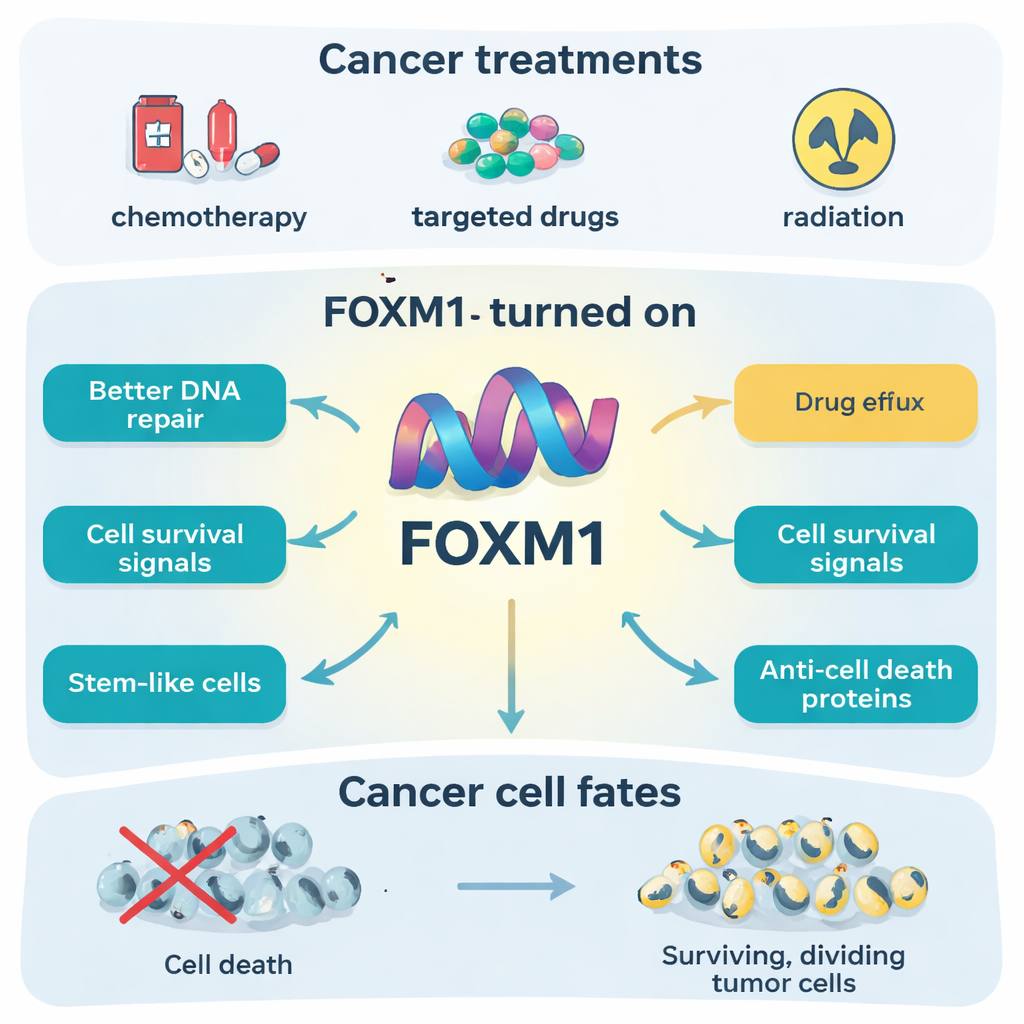
Fueling resistance to modern targeted therapies
FOXM1 is just as important in the era of targeted drugs. The article highlights how high FOXM1 levels are linked to resistance against hormone therapies in breast and prostate cancer, drugs that hinder DNA repair enzymes such as PARP, inhibitors of cell-cycle regulators like PLK1 and AURKA, and especially venetoclax, a medicine that blocks the survival protein BCL2 in blood cancers. In acute myeloid leukemia, FOXM1 activates another survival protein, BCL2A1, which can take over when BCL2 is blocked, allowing leukemia cells to resist venetoclax-induced death. FOXM1 also fosters more stem-like cancer cells, which are often the hardest to eradicate and most likely to seed relapse.
Designing drugs that target FOXM1
Because FOXM1 sits so high in the survival hierarchy of cancer cells, researchers are racing to develop drugs that shut it down. The review describes several experimental strategies, including small molecules that block FOXM1’s ability to bind DNA or mark it for degradation, peptides that disrupt its interactions, and designer PROTAC molecules that tag FOXM1 for cellular disposal. One particularly promising compound, called STL001, does not kill cancer cells outright but makes them much more sensitive to a broad range of chemotherapies and targeted agents. Early studies in cells and animal models suggest that combining FOXM1 inhibitors with existing treatments could overcome resistance while sparing most normal tissues, where FOXM1 is generally lower. 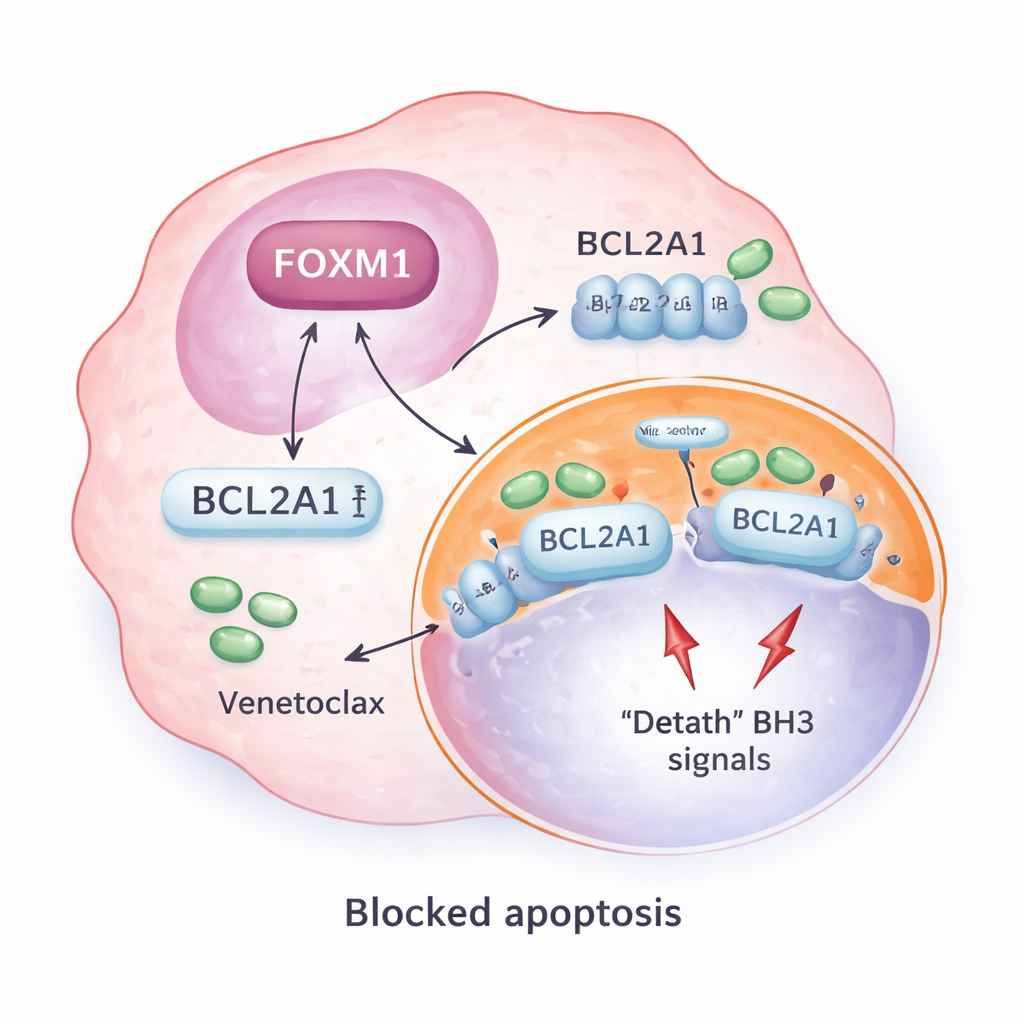
What this means for future cancer treatment
To a non-specialist, the core message is this: many different cancer drugs fail for a surprisingly similar reason—cancer cells switch on FOXM1, which coordinates a powerful survival program. By itself, blocking FOXM1 may not cure cancer, but using FOXM1 inhibitors alongside current therapies could prevent tumors from repairing their DNA, pumping drugs out, or switching to backup survival proteins. Although no FOXM1 inhibitor has yet reached clinical trials, the accumulating laboratory evidence suggests that targeting this single protein could make many existing cancer treatments work better and longer for patients.
Citation: Raghuwanshi, S., Gartel, A.L. FOXM1 induces therapy resistance and inhibits apoptosis in a variety of human cancers. Cell Death Dis 17, 230 (2026). https://doi.org/10.1038/s41419-025-08321-5
Keywords: FOXM1, cancer drug resistance, apoptosis, targeted therapy, venetoclax