Clear Sky Science · en
Toward a cure for multiple myeloma within a decade
Why this matters for patients and families
For decades, multiple myeloma was considered a lifelong, ultimately deadly blood cancer. This review article argues that we are now entering a new era in which a meaningful share of patients may actually be functionally cured within the next decade. By combining earlier diagnosis, smarter use of powerful new drugs and cell therapies, and careful tracking of tiny traces of disease, doctors are learning how to push myeloma into deep, long-lasting remission—and in some people, keep it away for many years without ongoing treatment.

Catching the disease before it fully declares itself
The authors explain that the best chance to control myeloma is at its earliest stages, before cancer cells have had time to evolve, spread, and outsmart the immune system. Many people pass through a “smoldering” phase, where abnormal plasma cells are present but serious organ damage has not yet occurred. Traditionally, these patients were simply watched. New clinical trials now show that, in those with especially high risk of progression, early treatment with modern antibody combinations can delay or even prevent full-blown disease, and in some cases extend survival. The key challenge is deciding who truly needs early therapy and who can safely avoid potentially toxic treatment for years.
Using smart tools to decide when to treat
To refine this decision, doctors are moving beyond simple blood tests and X-rays. The article describes how risk models now combine genetic changes inside the cancer cells, the pattern of cells in the bone marrow, and features of the surrounding immune environment. Advanced imaging scans can uncover hidden spots of disease in bones and organs. Emerging artificial intelligence systems can sift through this complex information to predict who is likely to progress and when. This approach aims to treat just early enough to prevent organ damage and aggressive relapses, without overtreating people whose disease might otherwise remain quiet.
Driving the cancer down to almost nothing
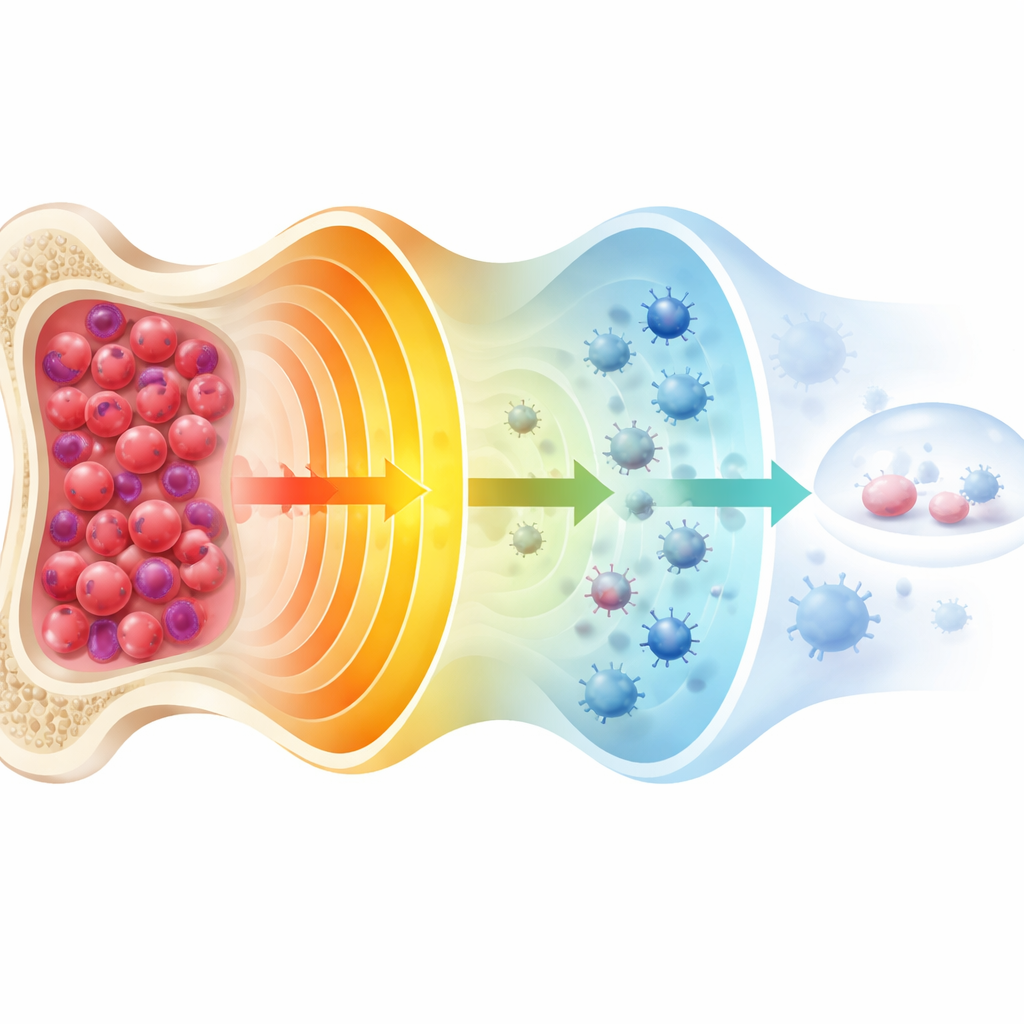
A central idea in the paper is the importance of “minimal residual disease,” or MRD—the tiny number of cancer cells that can remain even when standard tests say a patient is in remission. Highly sensitive methods can now detect one myeloma cell among a million normal cells, and when no cancer is found at this level, patients tend to stay well for much longer. The authors highlight that maintaining this deep, MRD-negative state for around two years in standard-risk patients, and three years or more in high-risk patients, strongly predicts very long periods without relapse. Intensive first-line treatment, often using four-drug combinations, stem-cell transplant in suitable patients, and tailored maintenance therapy, is designed to achieve and maintain this extremely low level of remaining disease, confirmed by both bone marrow testing and full-body scans.
Harnessing the immune system and new therapies
The article emphasizes that cure does not always mean every last cancer cell must be eradicated. In some people, a stable, low-level presence of abnormal cells behaves more like a harmless precursor condition, kept in check by a “reset” immune system. Powerful new treatments—such as monoclonal antibodies, bispecific antibodies that link immune cells to myeloma cells, and CAR-T cell therapies that reprogram a patient’s own immune cells—can both sharply reduce the tumor burden and rebuild immune surveillance. Early results from cellular therapy trials show that a substantial fraction of heavily pretreated patients can remain treatment-free and relapse-free for many years, hinting at long-term control that was previously unheard of in advanced disease.
Balancing intensity, safety, and access
While aggressive treatment strategies can deepen responses, they also bring more side effects, costs, and practical challenges. The authors stress that any push toward cure must protect patients’ quality of life. Treatment intensity should be adjusted for age, frailty, and other illnesses, and side effects must be closely managed. They also call for standardized testing methods, MRD-guided clinical trials to decide when therapy can safely be stopped, and global efforts to ensure that advances are accessible beyond a few wealthy centers. With coordinated research and careful patient-centered decision making, the authors argue that multiple myeloma can shift from a chronic, life-limiting condition to one that is often controllable—and increasingly, functionally curable—within the next 5 to 10 years.
Citation: Mohty, M., Malard, F., Facon, T. et al. Toward a cure for multiple myeloma within a decade. Blood Cancer J. 16, 33 (2026). https://doi.org/10.1038/s41408-026-01461-7
Keywords: multiple myeloma, minimal residual disease, early intervention, cellular immunotherapy, long-term remission