Clear Sky Science · en
A two year randomized clinical trial comparing opposing enamel wear from milled resin-matrix ceramic and direct bulk-fill composite overlays
Why this matters for everyday smiles
Many people notice their teeth getting shorter, flatter, or more sensitive as they age, but few realize how big a problem tooth wear has become. When the biting surfaces slowly grind away, it can change how your teeth fit together, affect your smile, and even make eating uncomfortable. Dentists now have modern, tooth-sparing options to rebuild worn or badly damaged back teeth—but a key question remains: do these new materials grind down the teeth they bite against faster than normal? This study followed patients for two years to see how two popular rebuilding methods affect the natural enamel of the opposing teeth.
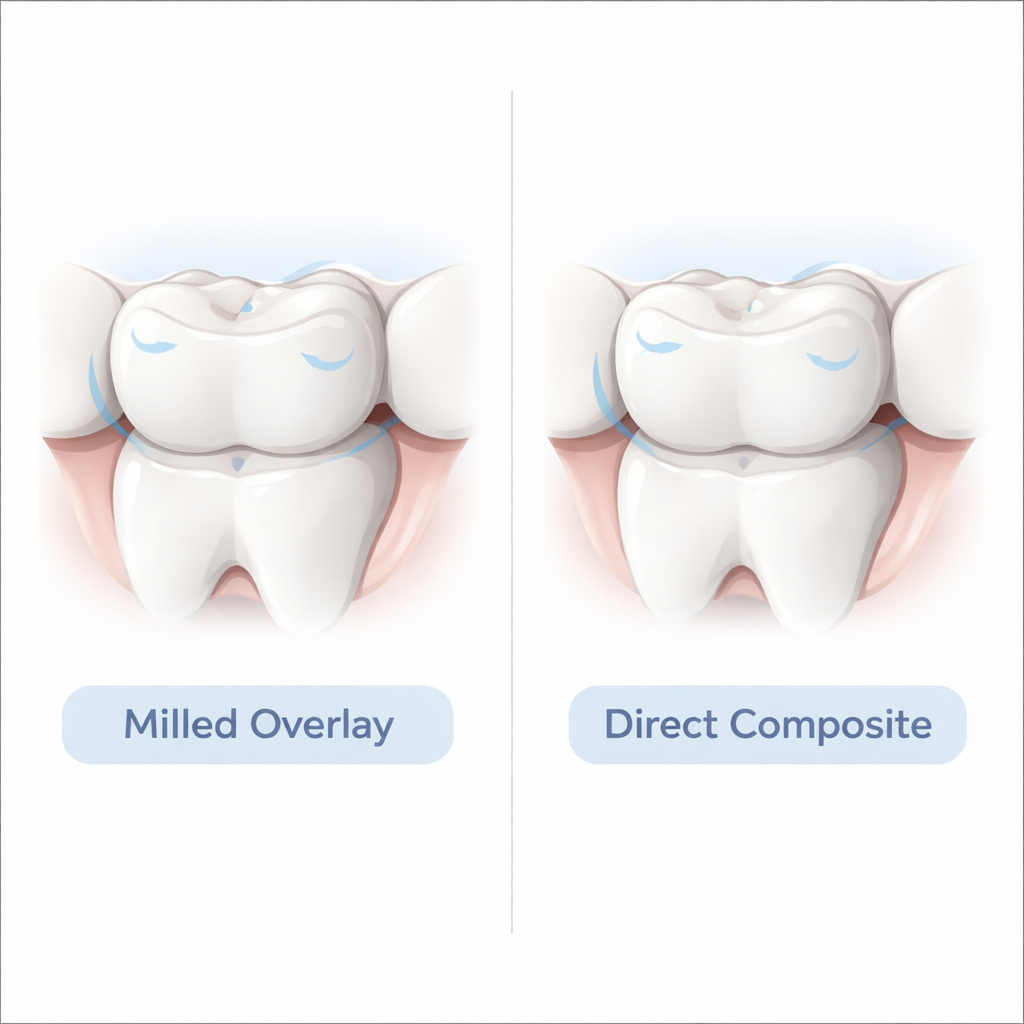
Two modern ways to rebuild a tooth
The research team focused on people who had severely damaged, root canal–treated molars that needed large restorations called overlays. Instead of classic metal crowns—which require removing a lot of healthy tooth—they used two more conservative options. One group received overlays milled from resin-matrix ceramic blocks using a computer-guided machine. The other group received overlays built directly in the mouth using a bulk-fill composite resin. Both materials are partly ceramic and partly plastic-like, designed to be strong yet gentle on opposing teeth. The central question: over two years of chewing, would one type cause more wear on the natural tooth it bites against?
How the team measured tiny changes
To capture wear precisely, the researchers used digital dentistry tools rather than messy molds and stone models. After the overlays were placed and adjusted, they scanned the patients’ teeth with an intraoral 3D scanner. The same teeth were scanned again after 12 and 24 months. Using specialized measurement software, the team superimposed the digital models and examined only the natural tooth surfaces opposite the restorations. They then calculated how much enamel had been lost in depth (a linear measure, like how much shorter a cusp became) and in volume (how much tooth material was gone in cubic millimeters). Only scans with extremely small alignment errors were accepted, so that any differences reflected real wear and not digital noise.
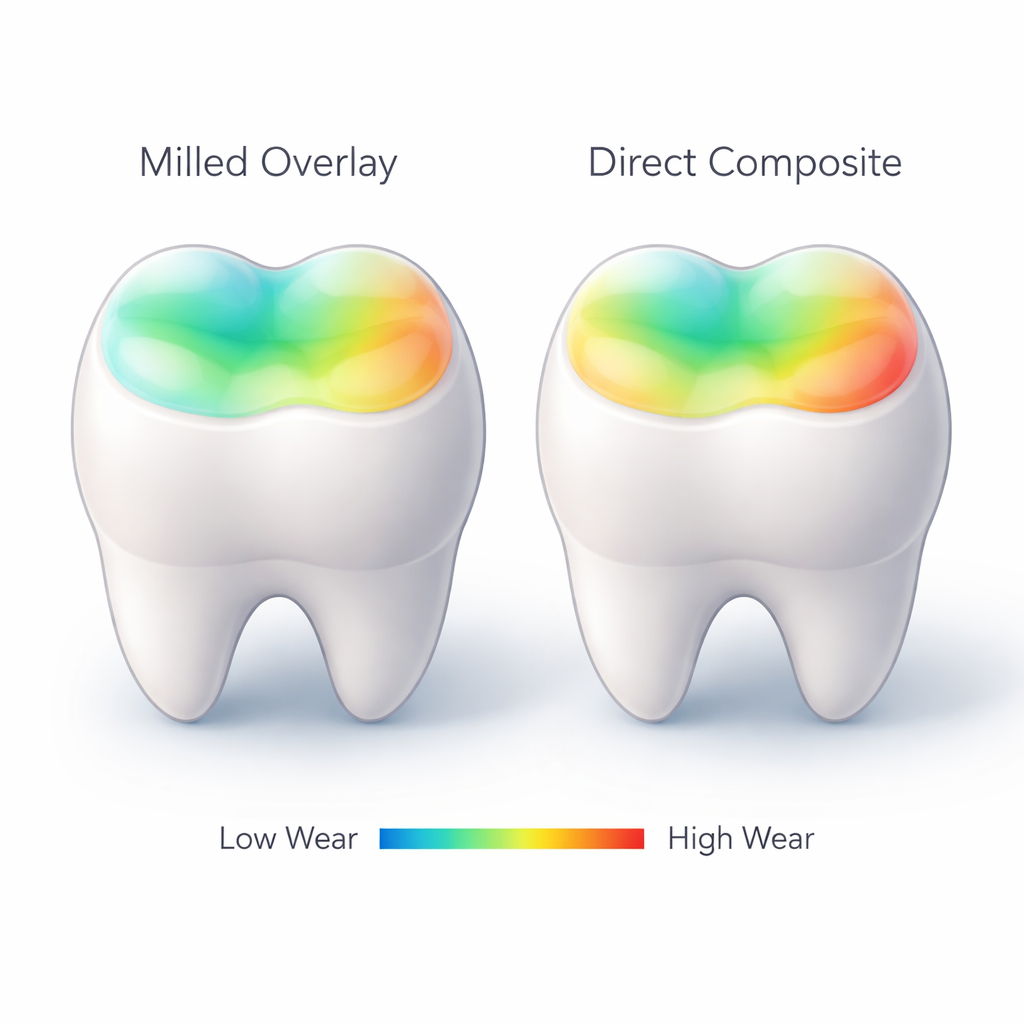
What happened to the opposing teeth
After two years, both types of overlay led to small amounts of enamel wear on the opposing teeth—well within what is considered normal for everyday chewing. Teeth facing the milled resin-matrix ceramic overlays showed, on average, slightly more vertical loss (about 0.41 millimeters) than those facing direct composite overlays (about 0.20 millimeters). However, this difference was not statistically significant, meaning it could easily be due to chance in a small study sample. When the researchers looked at the total volume of enamel lost, the two groups were almost identical, with averages around 0.13 and 0.12 cubic millimeters. In other words, neither material clearly ground down the opposing tooth more than the other.
Why the materials behaved so similarly
Both overlay types are engineered to mimic tooth behavior: strong enough to withstand biting forces, but not so hard or abrasive that they excessively wear the tooth they contact. Earlier laboratory work has shown that the hardness of these composites is slightly higher than natural enamel but quite close to each other. The fillers inside—tiny particles of ceramic—strongly influence how the material wears and how it affects the opposite tooth. Because the two materials used here have similar hardness and filler content, it makes sense that they produced nearly the same level of enamel wear, matching the lower end of what is seen in natural tooth wear studies.
What this means for patients and dentists
For people needing large restorations on back teeth, this study offers reassuring news. Over two years, both milled resin-matrix ceramic overlays and direct bulk-fill composite overlays behaved gently toward the natural teeth they bite against, with no meaningful differences between them. That gives dentists flexibility to choose based on other factors—such as cost, chair time, and ease of repair—without worrying that one option will grind down the opposing teeth more than the other. While longer studies with more patients are still needed, these findings support the idea that modern, conservative overlay restorations can restore function and appearance without sacrificing the health of the neighboring enamel.
Citation: Elhaddad, E.E.H., Elkady, A.A.M. & Diab, D.F.S. A two year randomized clinical trial comparing opposing enamel wear from milled resin-matrix ceramic and direct bulk-fill composite overlays. BDJ Open 12, 19 (2026). https://doi.org/10.1038/s41405-026-00400-9
Keywords: tooth wear, dental overlays, resin composite, enamel erosion, digital dentistry