Clear Sky Science · en
Blood plasma proteomic biomarkers for forecasting transition to psychosis in an Asian cohort
Why blood can reveal early warning signs in the mind
Psychotic disorders such as schizophrenia often strike in young adulthood and can change the course of a person’s life. Clinicians can spot people who are at especially high risk, but today’s assessments rely mostly on interviews and observations, which can be subjective and may miss subtle warning signs. This study explores whether a simple blood test, looking at many different proteins in the blood at once, can help forecast which at‑risk young people will go on to develop psychosis, and whether tests first developed in European groups also work in Asian populations.
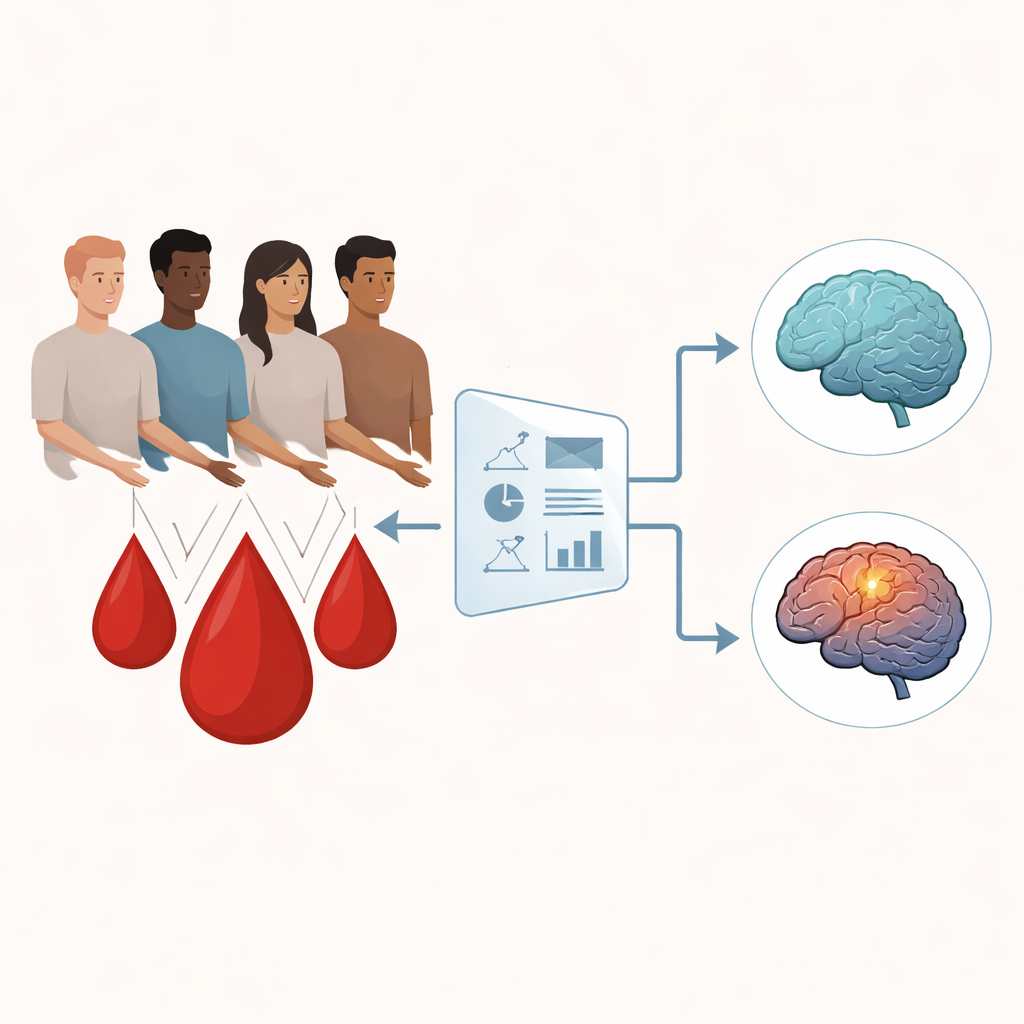
Following young people on the edge of illness
The researchers drew on a two‑year study in Singapore that followed 135 youths aged 14 to 29. All had regular mental health check‑ups and repeated blood draws. About half were judged to be at “ultra‑high risk” of psychosis, based on detailed interviews, while the rest had no such risk factors and served as controls. Among the high‑risk group, 13 people later experienced a first episode of psychosis, while 52 did not. The team focused on blood taken before any psychotic break occurred, so they could ask whether early biological signals in the blood differed between those who later became ill and those who did not.
Reading complex protein patterns in blood
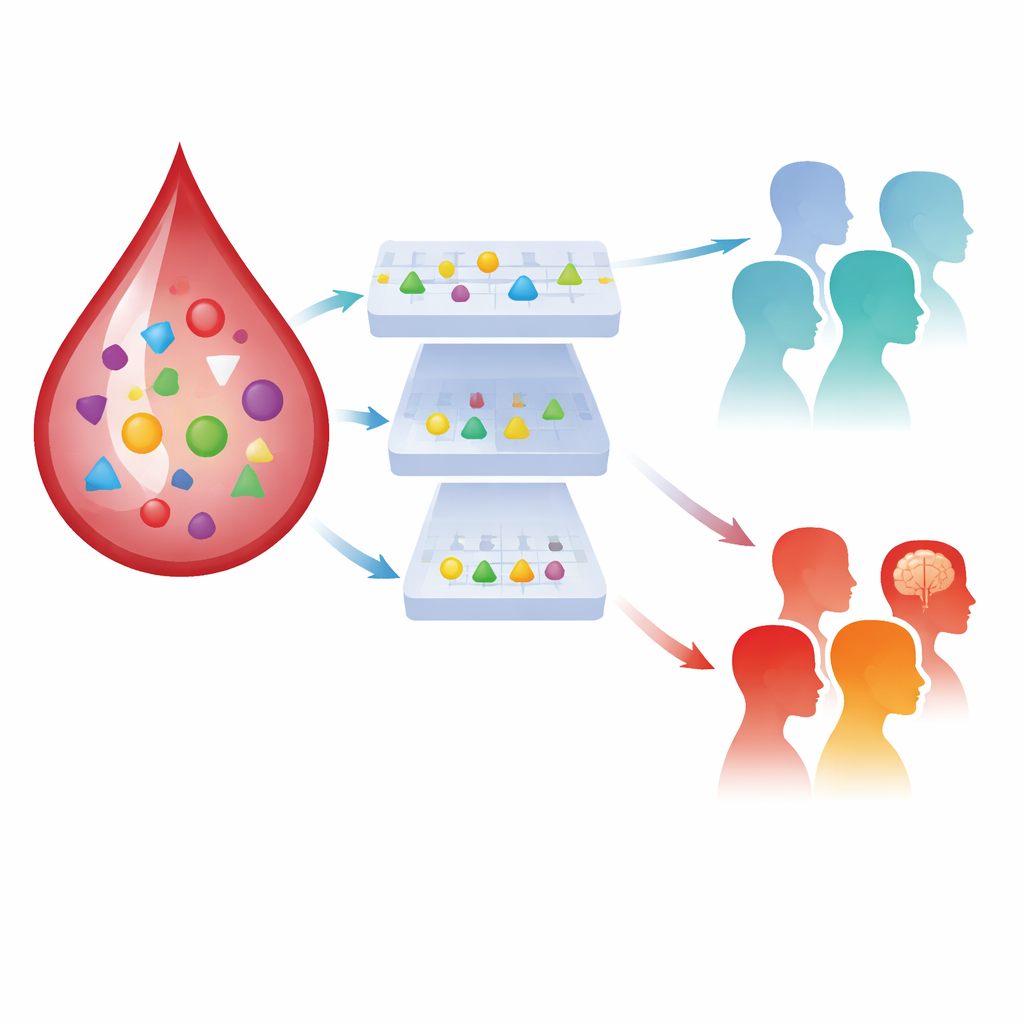
Instead of looking at just one or two molecules, the scientists measured more than 1,700 different proteins in the plasma portion of blood using a highly sensitive mass spectrometer. They then cleaned and standardized the data to handle technical noise and missing values. From this set they kept 605 reliably measured proteins and fed these into machine‑learning algorithms—computer models that learn patterns—to see whether combinations of protein levels could distinguish future “converters” from non‑converters. To avoid fooling themselves with chance patterns in a small sample, they used careful cross‑checking methods and compared their results with thousands of models built on randomly chosen protein sets.
Testing European signatures in an Asian cohort
Earlier work in mostly European participants had already proposed specific groups of blood proteins that might predict psychosis. The Singapore team first asked: do those same protein groupings work in an Asian cohort? When they applied two previously published protein “signatures” to their dataset, the models performed reasonably well, correctly distinguishing converters from non‑converters much more often than chance. This suggests that at least some biological signals linked to emerging psychosis are shared across populations, easing worries that earlier findings might be limited to people of European ancestry.
Building stronger, population‑specific prediction tools
Next, the researchers let their models search directly within the Asian dataset for the most informative proteins. They built three versions of prediction models using different but related statistical approaches. All three outperformed the imported European signatures, with the best achieving excellent accuracy. When they compared the actual proteins involved, they found surprisingly little overlap in the exact molecules selected in Asian versus European models. Yet the proteins tended to cluster in the same biological families and pathways, particularly those involved in the body’s immune defense, blood clotting, and fat‑carrying particles in the blood. This suggests that the same underlying systems are disturbed, even if the detailed protein pattern differs by population.
What the findings mean for mental health care
For non‑specialists, the key message is that a blood test reflecting many proteins at once can help flag which high‑risk young people are most likely to develop psychosis, and that this idea appears to work in both European and Asian groups. The work also points to the immune system, blood clotting, and fat‑related molecules as recurring players in the biology of mental illness. While these results still need to be confirmed in larger and more diverse groups before any routine test is rolled out, they bring psychiatry a step closer to objective, lab‑based tools that can complement clinical interviews, support earlier intervention, and potentially change long‑term outcomes for vulnerable youths.
Citation: Chan, W.X., Wong, J.J., Yang, Z. et al. Blood plasma proteomic biomarkers for forecasting transition to psychosis in an Asian cohort. Transl Psychiatry 16, 219 (2026). https://doi.org/10.1038/s41398-026-04004-7
Keywords: psychosis risk, blood biomarkers, proteomics, mental health prediction, machine learning