Clear Sky Science · en
The ventral hippocampus to paraventricular thalamus circuit regulates context-dependent hyperlocomotion through PAC1 receptor signaling in the chronic stress-induced PTSD mouse model
Why Certain Places Can Trigger Powerful Memories
Many people living with post-traumatic stress disorder (PTSD) find that simply walking into a familiar room or neighborhood can suddenly bring back racing heart, unease, or a sense of reliving the trauma. This study asks a basic question behind that experience: what happens inside the brain that makes certain places such powerful triggers, and could that knowledge point to new treatments?
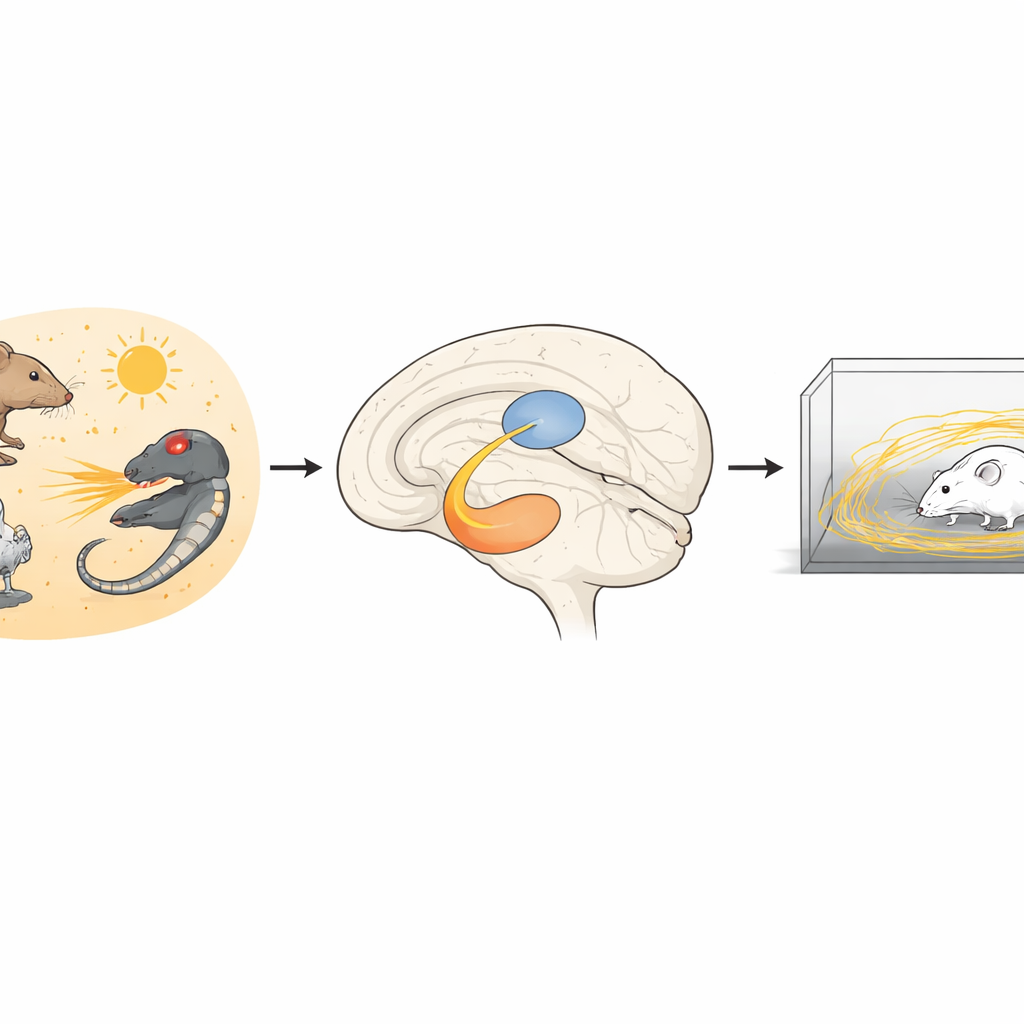
Stress, Space, and a Restless Mouse
The researchers used mice to mimic one key feature of PTSD: strong reactions that appear only in trauma-related settings. They subjected male mice to repeated social defeat, in which a larger aggressive mouse intimidates a smaller one over several days. Later, when the smaller mice were put back into the same kind of chamber where the bullying occurred, they moved far more than before, darting around with unusually high activity. Crucially, this restless behavior did not appear in a different, neutral chamber. The animals also showed other PTSD-like signs—avoiding open spaces, avoiding social contact, and exaggerated startle responses—yet they did not show typical depression-like behaviors. This combination suggests that the model captures PTSD-like hyperarousal tied to context, rather than a general mood disorder.
A Hidden Hub Deep in the Brain
To find out which brain area was involved, the team looked for neurons that became active when the mice showed this context-linked hyperactivity. They found a strong signal in a small, midline structure called the paraventricular thalamus (PVT), known to connect emotional and memory centers. When the scientists artificially boosted activity in PVT cells with light-based stimulation in a specific chamber, healthy mice later became hyperactive only in that chamber, and also developed the same avoidance, social problems, and heightened startle seen after chronic stress. This showed that ramping up PVT activity in a particular setting is enough to create PTSD-like, context-dependent behavior.
A Memory Pathway from the Hippocampus
The next step was to discover where the PVT was getting its information about context. Using tracing methods and recordings from brain slices, the researchers mapped a direct, excitatory pathway from the ventral hippocampus—a region important for emotional memory—into the PVT. Chronic social stress strengthened excitatory signals arriving at PVT neurons and made these cells easier to fire. When the team selectively silenced ventral hippocampus cells that project to the PVT, stressed mice no longer developed the hyperactive response in the trauma-related chamber, although other anxiety-like behaviors remained. In contrast, silencing the PVT cells that receive ventral hippocampus input reduced not only the context-linked hyperactivity but also broader PTSD-like symptoms. Similar results were seen when mice experienced other long-lasting stressors such as sustained heat or repeated predator threat, suggesting that this circuit is a common route through which many forms of chronic stress can imprint on context.
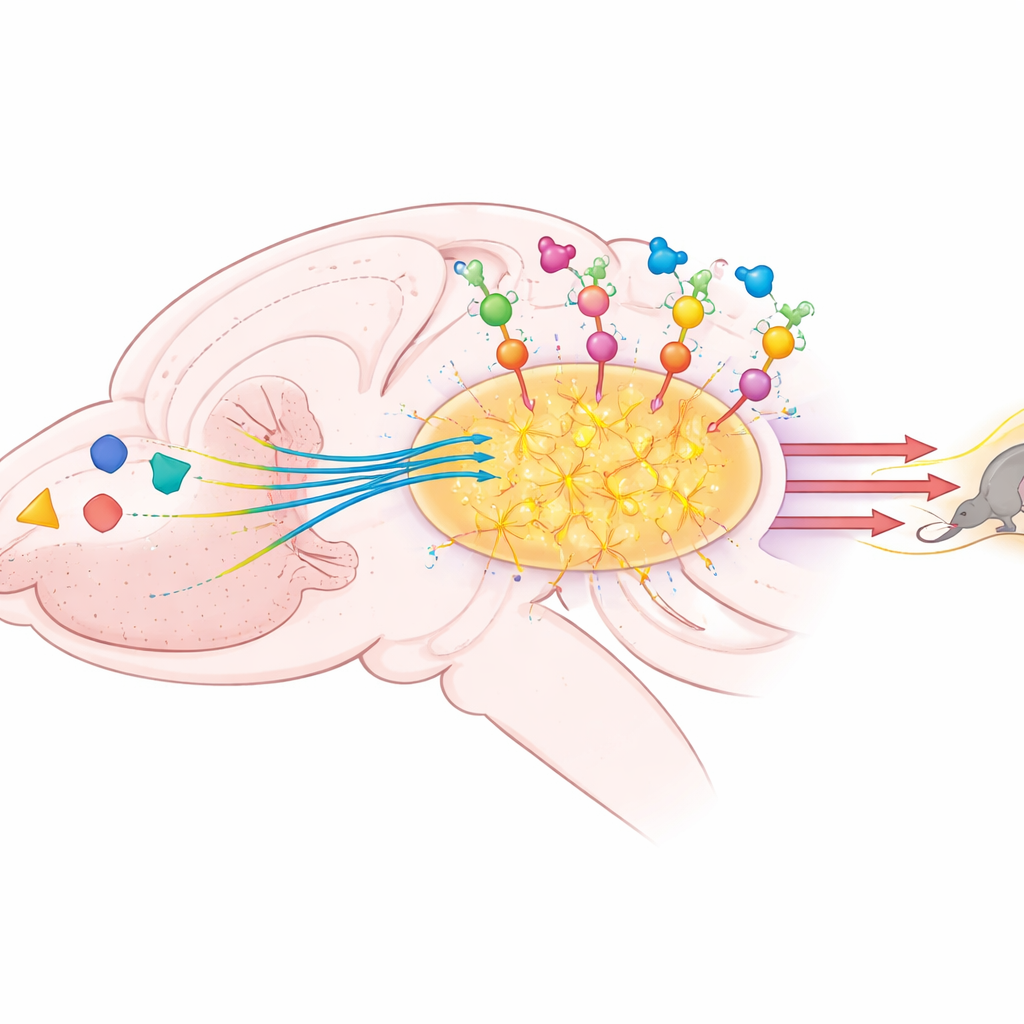
A Chemical Signal That Turns Up the Volume
Finally, the researchers looked at a stress-related chemical messenger called PACAP and its PAC1 receptor, which previous human studies have linked to PTSD risk. In the PVT of stressed mice, PAC1 receptors were more abundant, and activating these receptors made PVT neurons more excitable. Blocking PAC1 receptors had the opposite effect, calming these cells. When the scientists infused a PAC1 blocker directly into the PVT during chronic social stress, the mice were largely protected: they did not develop context-linked hyperactivity, and their avoidance, social behavior, and startle responses all improved. This suggests that increased PAC1 signaling in the PVT acts like a volume knob, turning up the brain’s response to contextual reminders of trauma.
What This Could Mean for People
Together, these findings outline a chain of events linking chronic stress to place-triggered symptoms: stressful experiences sensitize a hippocampus–PVT pathway, PAC1 signaling makes PVT neurons overly reactive, and this overreactivity helps drive bursts of hyperarousal when an individual re-enters a trauma-related setting. While the work was done in male mice, and many steps remain before it can inform therapies in people, it highlights the PVT and PAC1 receptor as promising targets. In the future, drugs or brain-based interventions that gently dial down this circuit might help lessen the impact of trauma-linked environments on daily life.
Citation: Cao, Z., Gao, H., Tang, B. et al. The ventral hippocampus to paraventricular thalamus circuit regulates context-dependent hyperlocomotion through PAC1 receptor signaling in the chronic stress-induced PTSD mouse model. Transl Psychiatry 16, 176 (2026). https://doi.org/10.1038/s41398-026-03963-1
Keywords: PTSD, chronic stress, hippocampus, thalamus, neuropeptides