Clear Sky Science · en
Managing emotional distress in older adults with mental illness: a randomized controlled trial evaluating virtual reality relaxation
Why this matters for everyday worry
Many older adults live with ongoing anxiety, low mood, or stress, yet getting relief can be hard, especially in busy clinics with limited staff. This study asks a simple but timely question: can a short session in a virtual reality (VR) nature scene help older patients calm their emotions as well as a classic relaxation method that relies on imagination alone? The answer could shape how we care for a fast-growing group of older people living with serious mental health problems.
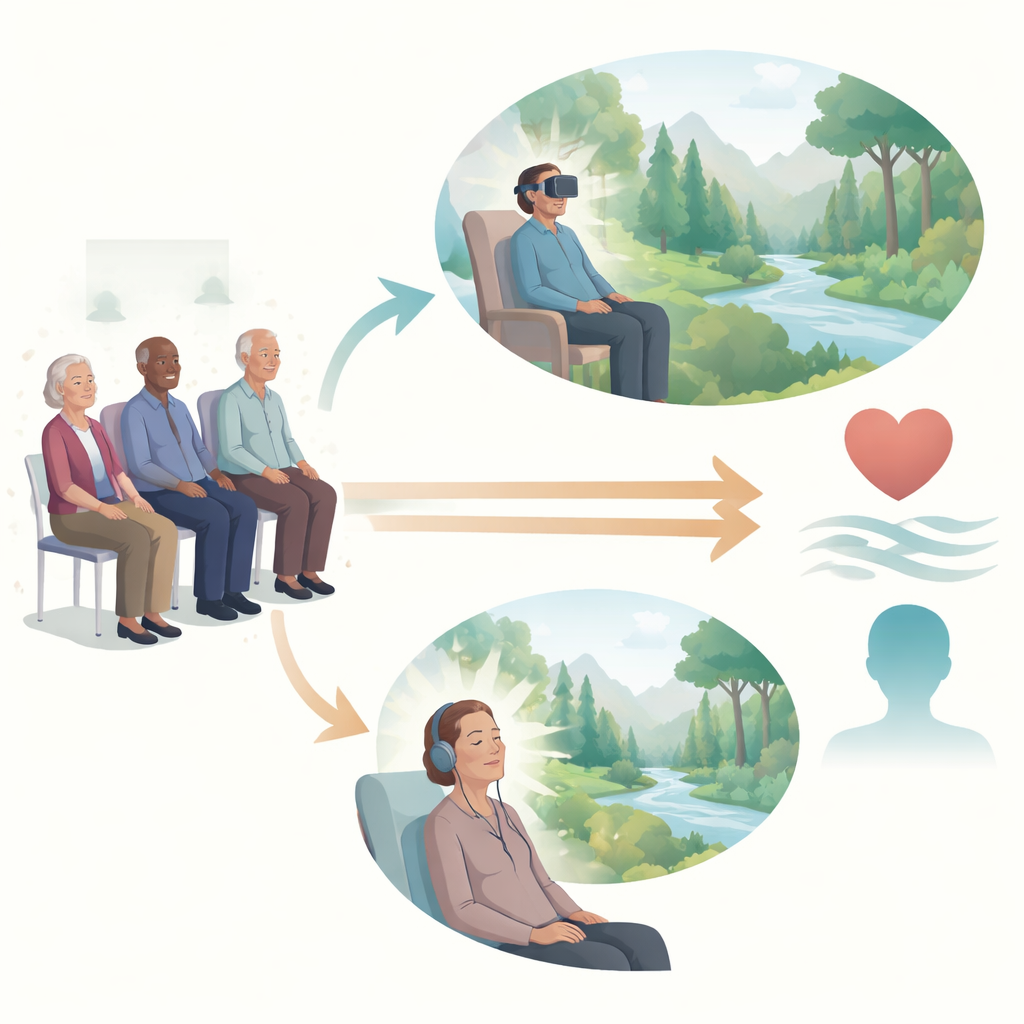
Two different paths to a calm place
The researchers focused on two ways to help people unwind. One was guided imagery, a long-standing practice in which a person listens to a spoken "dream journey" and pictures a peaceful scene in their mind. The other was VR relaxation, where a headset places the person directly inside a soothing virtual landscape, complete with trees, water, mountains, and gentle nature sounds. Both approaches aimed to ease emotional distress in older adults receiving psychiatric care, but they differ in how much mental effort and imagination they demand.
Who took part and what they experienced
Forty-four patients between 58 and 87 years old, treated at a large university psychiatric clinic, were randomly assigned to one of the two methods. Everyone took part in a single 10-minute session: either wearing a VR headset showing the same calm forest scene or listening to an audio script that described a nearly identical forest setting. Before and after the session, participants rated their anxiety, stress, mood, sense of relaxation, and overall well-being. The VR group also reported how “present” they felt in the virtual world and whether they experienced motion sickness.
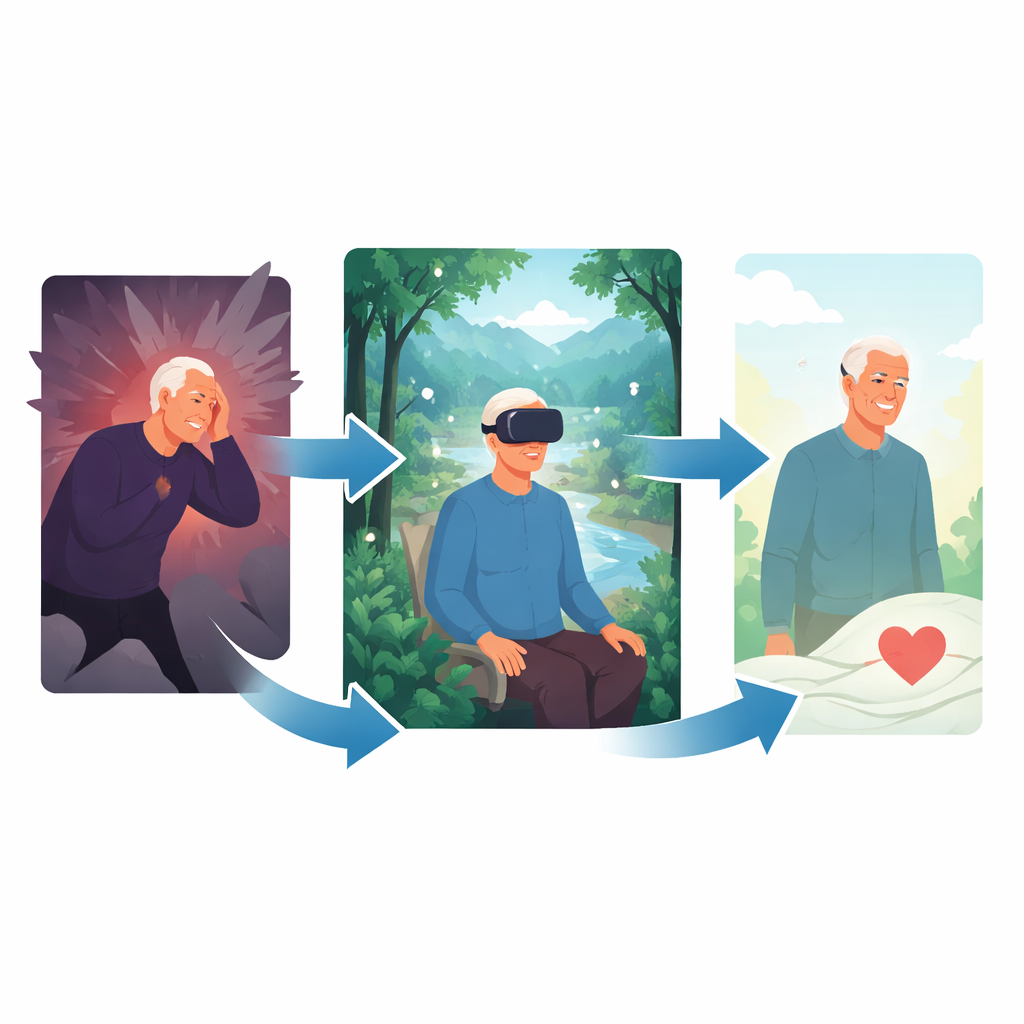
How well it worked and how people felt about it
Both groups showed clear, immediate benefits. After just one session, older adults in both the VR and guided imagery conditions reported less anxiety, less stress, and fewer unpleasant feelings, along with more positive mood, greater relaxation, and improved well-being. The size of these changes was large, suggesting that even a brief, focused relaxation session can make a noticeable difference. Importantly, the two methods worked about equally well on all these measures; VR was not superior overall, but it did keep pace with the established standard.
Comfort, safety, and the power of feeling "there"
The study also looked closely at comfort and safety, especially because some worry that advanced technology may be overwhelming for older adults. In practice, VR proved highly acceptable: no one stopped the session because of the headset, and motion sickness scores were near zero for almost all participants. In contrast, a few patients in the guided imagery group ended their session early, often because imagining the scene stirred up distressing memories or was simply too hard to visualize. Most participants in both groups said they were satisfied, found the session helpful, and felt connected to nature. Among those using VR, a stronger sense of really "being" in the virtual forest was linked to greater reductions in anxiety, hinting that immersion itself may help the mind let go of worry.
What this means for care in an aging world
For a layperson, the main takeaway is straightforward: for older adults with mental illness, slipping into a gentle virtual forest for ten minutes can calm anxiety and boost well-being just as much as a traditional spoken relaxation exercise—and it appears safe, acceptable, and engaging, even at advanced ages. Because VR can be delivered in a standardized way and may require less imaginative effort, it offers a promising, scalable tool that could supplement overburdened mental health services. While longer-term studies are still needed, this work suggests that thoughtfully designed digital tools can help close the “gray digital divide,” giving older people access to new forms of emotional relief rather than leaving them behind as technology advances.
Citation: Seethaler, M., Güntner, L., Lütt, A. et al. Managing emotional distress in older adults with mental illness: a randomized controlled trial evaluating virtual reality relaxation. Transl Psychiatry 16, 162 (2026). https://doi.org/10.1038/s41398-026-03955-1
Keywords: virtual reality relaxation, older adults mental health, guided imagery, anxiety and stress relief, digital therapies