Clear Sky Science · en
A proof-of-concept machine learning model for short-term suicide risk stratification in depressed youth
Why this matters for families and caregivers
Suicide is one of the most frightening risks facing teenagers and young adults with depression. Families and clinicians often struggle to tell who is in immediate danger and who is relatively safe after treatment. This study explores whether computer-based pattern finding—known as machine learning—can help quickly sort young patients into different short-term risk levels, potentially guiding closer follow-up for those who need it most.

A closer look at young people after treatment
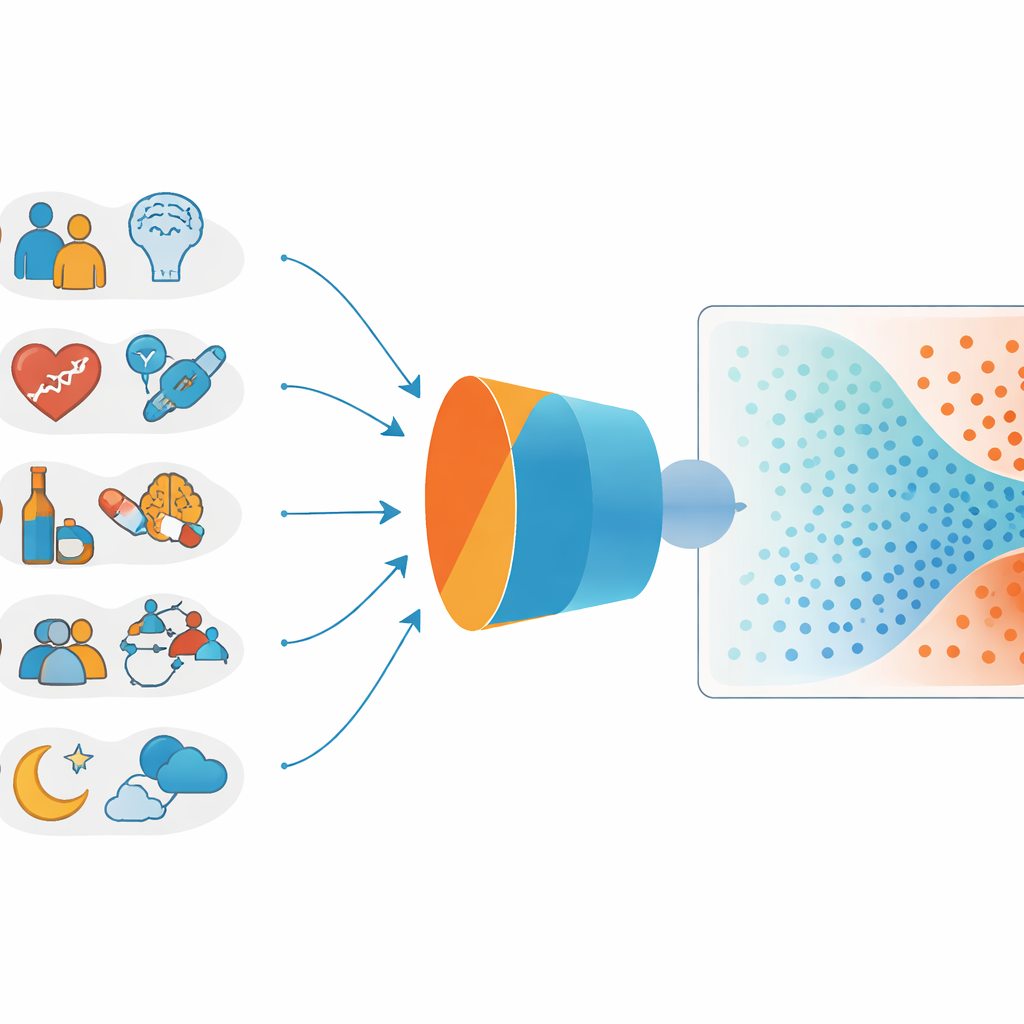
The research followed 602 adolescents and young adults in China, ages 15 to 24, all receiving care for depressive disorders in hospitals and clinics. For 30 days after treatment, the team checked whether each person made a suicide attempt. During their visits, patients completed a wide range of questionnaires and interviews about mood, anxiety, sleep, stress, self-harm history, family background, and daily functioning, and clinicians recorded medical details such as inpatient or outpatient status and medication use. This rich mix of information created a detailed picture of each patient’s life and symptoms at the moment they were treated.
Teaching computers to spot hidden patterns
Researchers then trained several types of machine learning models to predict who would attempt suicide in the month after treatment. They fed the models 102 different pieces of information per patient and split the group so that most patients were used to train the models, while a separate smaller group was held back to test how well the models worked on new cases. Rather than chasing raw complexity, the team focused on approaches that keep models simpler and less likely to latch onto random noise in the data.
What the models could and could not do
Among seven tested approaches, two relatively simple methods—called support vector machines and elastic net regression—performed best. When combined into a single ensemble model, they achieved strong ability to distinguish higher- from lower-risk patients. The model was especially good at identifying a small subgroup, about one in ten patients, whose risk of attempting suicide was several times higher than the rest of the group. At the same time, its predictions were more reliable for ruling out near-term danger than for pinpointing exactly who would make an attempt, meaning that many flagged as high risk would still not go on to harm themselves.
Signals that stood out in everyday life
The study also shed light on what types of information mattered most to the computer’s decisions. Some factors were fixed, such as gender, education level, or a broad family history of mental illness. Others were changeable and closely linked to day-to-day life: how severe a person’s depression was, whether they drank alcohol, how faithfully they took prescribed medication, how intensely they brooded on negative thoughts, and how close and supportive their family relationships felt. Different algorithms emphasized slightly different details, but both agreed that current depression severity was central, reinforcing the importance of treating symptoms aggressively and supporting healthy routines.
Limits and what comes next
Despite promising results, the authors stress that their model is not ready to guide clinical decisions on its own. Only 30 suicide attempts occurred in the study, which makes any model fragile, and all participants came from a single country and mostly from similar clinical settings. The model was tested only over an 18-month period, so it is unclear how well it would hold up as treatment practices and social pressures change. The work should therefore be seen as a proof of concept: it shows that combining detailed clinical and life information with carefully chosen machine learning methods can meaningfully sort young patients by short-term suicide risk, and it points to specific, modifiable areas—like depression severity, alcohol use, medication habits, and family connection—where focused support may help keep vulnerable youth safer.
Citation: Sun, B., Zhang, J., Ma, Y. et al. A proof-of-concept machine learning model for short-term suicide risk stratification in depressed youth. Transl Psychiatry 16, 187 (2026). https://doi.org/10.1038/s41398-026-03944-4
Keywords: youth depression, suicide risk, machine learning, risk prediction, mental health screening