Clear Sky Science · en
Transcranial alternating current stimulation over left DLPFC modulates feedback processing: a simultaneous tACS-fMRI study
Why this matters for everyday choices
Every day, we learn from what goes right and what goes wrong—whether it is winning a small bet, getting a work bonus, or making a costly mistake. This study asks a striking question: can gentle, noninvasive electrical stimulation of the brain selectively tune how we react to wins and losses, and might that help us understand—and eventually treat—problems like impulsivity and mood disorders?
Watching the brain learn from a simple gamble
To explore this, researchers invited healthy adults to lie in an MRI scanner and play a straightforward gambling game. On each round, players chose between two point values and then saw whether they had gained or lost points, much like repeatedly picking between a small and a big bet. While they played, their brain activity was recorded, and at the same time a weak, rhythmically alternating electrical current was delivered through electrodes placed over the left side of the forehead, near a region important for planning and self-control. On different days, participants received stimulation at a slow rhythm (theta, 5 cycles per second), a faster rhythm (beta, 25 cycles per second), or a sham condition that mimicked stimulation without actually delivering it. 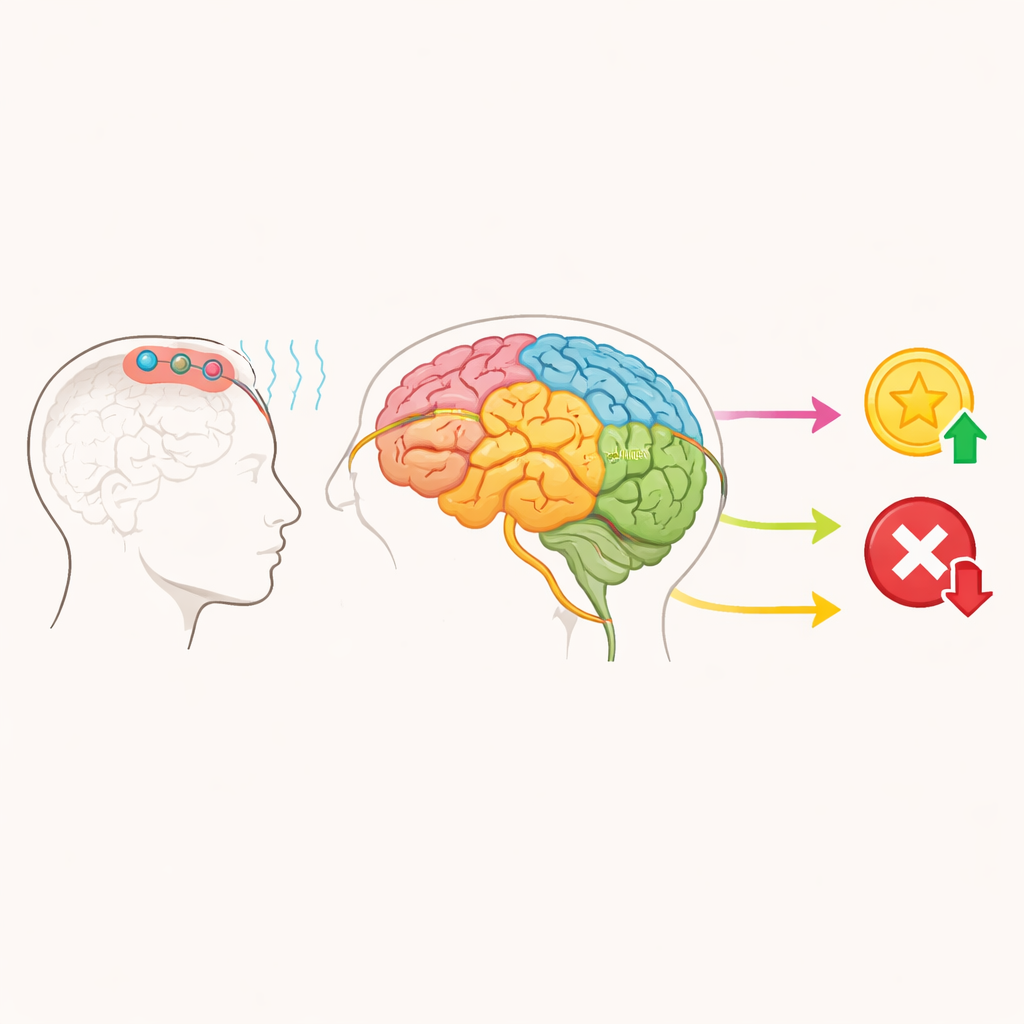
Two brain rhythms, two kinds of feedback
Earlier work had shown a split in how the brain handles feedback: slow theta rhythms tend to rise after negative outcomes, while faster beta rhythms are more strongly tied to positive outcomes. In this study, the team tested whether driving these rhythms externally would change activity in brain networks that evaluate gains and losses. When they applied theta stimulation and compared it with sham during loss feedback, they saw stronger responses in a broad set of regions. These included areas for seeing and paying attention to feedback, zones involved in monitoring mistakes and exerting cognitive control, and deep structures that process emotion and motivation. In contrast, beta stimulation had its clearest impact during gain feedback, boosting activity mainly in the putamen—a key reward hub—and the amygdala, which helps attach emotional value to events.
Zooming in on control and emotion
The slow-rhythm (theta) condition during losses especially lit up the left dorsolateral prefrontal cortex, a region involved in weighing options, inhibiting rash actions, and adjusting behavior after setbacks. It also increased responses in the anterior cingulate cortex, often described as a monitoring center that flags errors and conflicts, as well as in sensorimotor areas that help prepare adaptive responses. At the same time, structures like the amygdala, caudate, and putamen—central players in feeling bad about losses and learning from them—showed heightened engagement. Beta stimulation, on the other hand, seemed to sharpen the brain’s sensitivity to rewards: during gains, the putamen and amygdala showed stronger signals, suggesting a more vivid registration of positive outcomes and their emotional impact. Together, these findings support the idea that different brain rhythms help route information through partially distinct circuits for handling good and bad news.
Individual differences in impulsivity
The researchers also examined how personality traits shaped these brain effects. They focused on impulsivity—the tendency to act quickly without much forethought—measured with a standard questionnaire. Under theta stimulation, people with higher impulsivity showed weaker activation in the left prefrontal control region when processing losses. In other words, when the brain was externally nudged into a loss-processing rhythm, those who were more impulsive seemed less able to recruit the very area that supports careful evaluation and self-control. This pattern fits with prior work linking impulsivity to dampened feedback signals and poorer use of negative outcomes to guide behavior. 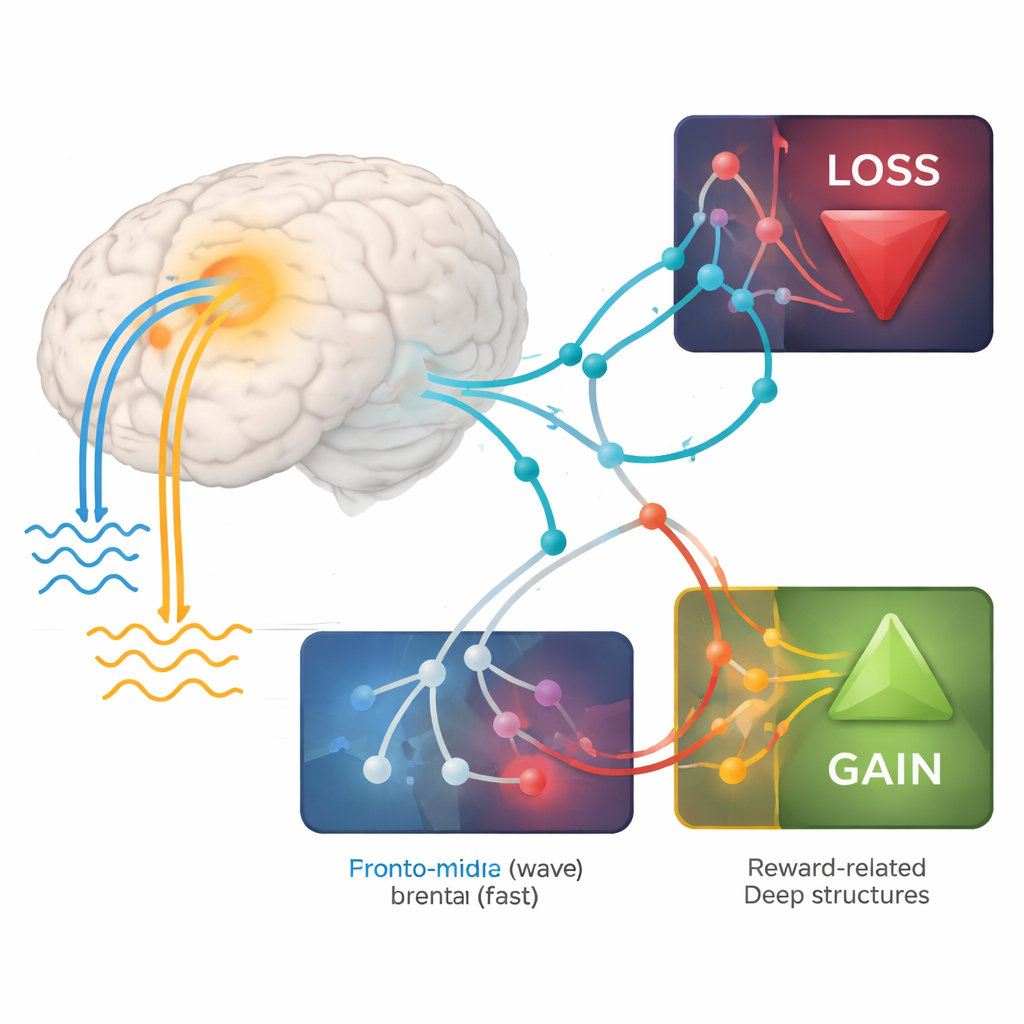
What this could mean for future brain therapies
Overall, the study shows that gently driving the brain at different rhythms over a key control area can selectively amplify networks for handling losses versus gains, without changing people’s overt gambling behavior in this simple task. For a lay reader, the takeaway is that our reactions to wins and losses are not fixed; they depend on rhythmic patterns of brain activity that can, in principle, be tuned from the outside. Although this work is still basic research in healthy volunteers, it points toward the possibility that rhythm-specific brain stimulation could one day help correct unbalanced feedback processing seen in conditions such as depression, addiction, or personality disorders—by boosting the circuits that help us learn from our mistakes and appropriately value rewards.
Citation: Debnath, R., Lenz, E., Tobelander, J. et al. Transcranial alternating current stimulation over left DLPFC modulates feedback processing: a simultaneous tACS-fMRI study. Transl Psychiatry 16, 179 (2026). https://doi.org/10.1038/s41398-026-03942-6
Keywords: brain stimulation, reward and punishment, decision making, impulsivity, neuroimaging