Clear Sky Science · en
Transdiagnostic mental health symptom dimensions predict use of flexible model-based inference in complex environments
Why Everyday Minds and Tough Choices Matter
We all constantly guess what other people will do next—whether a driver will merge into our lane, or how a friend will react to a text. For many people living with anxiety, depression, ADHD, or other conditions, these everyday judgments can feel especially hard. This study asks a simple but powerful question: do certain patterns of mental health symptoms change how flexibly we plan ahead about others’ actions in complex situations?
A Game of Cat and Mouse
To explore this, researchers asked nearly a thousand adults to play an online “predator–prey” game. Players guided a small robot around a grid to collect coins while avoiding a roaming blob-like predator. The twist was that the predator had a hidden goal: it preferred one type of terrain (trees) and moved in a way that pursued that goal. The predator did not actively chase the player, so anyone who figured out its goal could easily stay safe. On every turn, players predicted where the predator would move next, rated their confidence, and later judged what features in the world the predator seemed to prefer. This setup allowed the scientists to see how well people could infer another agent’s intentions in a rich, changing environment. 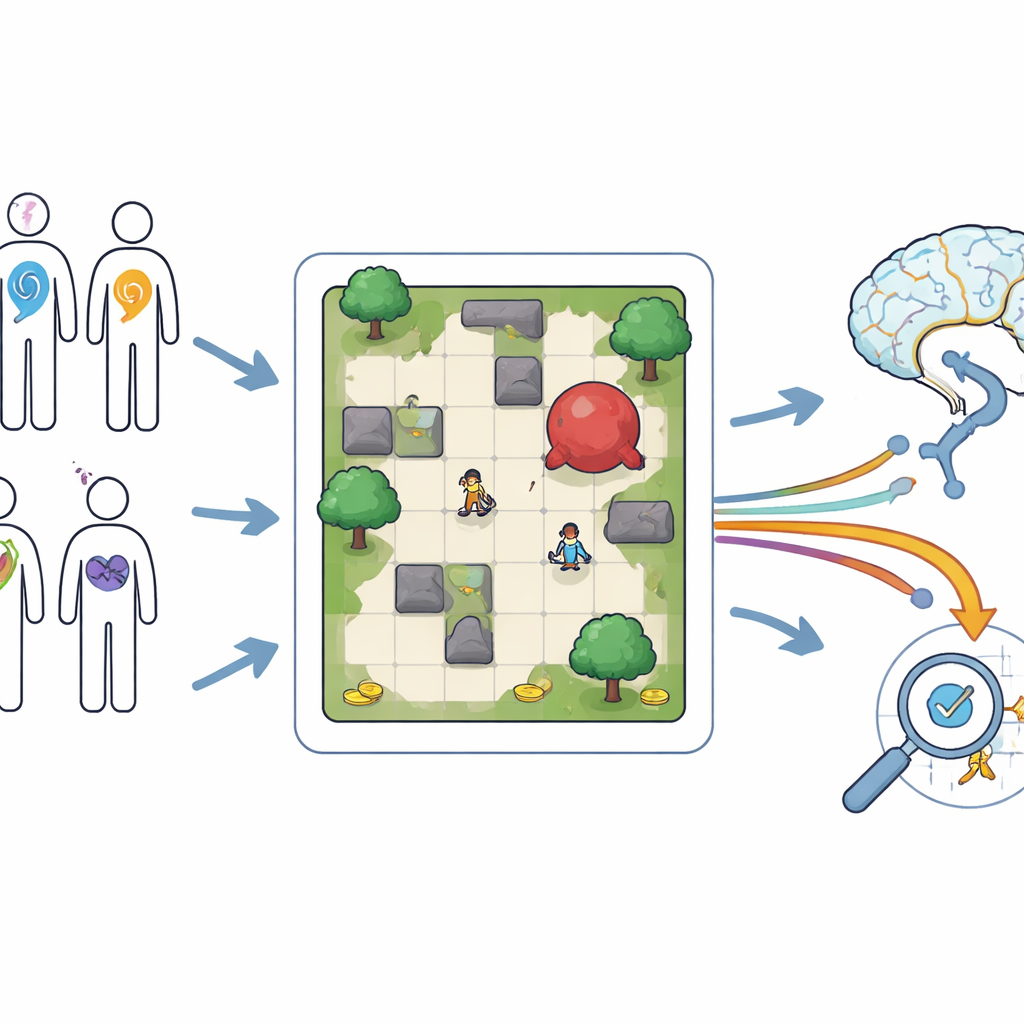
Different Symptom Patterns, Different Decision Styles
Participants also completed questionnaires spanning a wide range of mental health and neurodevelopmental symptoms—covering anxiety and mood, psychosis-like experiences, externalising tendencies such as impulsive or aggressive behaviour, and traits linked to conditions like ADHD and autism. Rather than slotting people into diagnoses, the team used a “hierarchical” approach that grouped individual questions into broader dimensions. At the top sat a general distress factor. Below it, this split into internalising (anxiety and mood) and externalising (outwardly directed problems). At a more fine-grained level, an inattentive/neurodevelopmental dimension and a social withdrawal dimension emerged alongside those broader categories. This structure reflects the modern view that mental health exists on overlapping continua rather than in neat boxes.
Surprising Strengths and Hidden Overconfidence
When the researchers linked these dimensions to game performance, a striking pattern appeared. People higher in inattentive/neurodevelopmental traits—often associated with ADHD-like difficulties—were actually better at predicting the predator’s moves and at inferring its true preference, yet they felt less confident about their judgments. In contrast, those higher in externalising symptoms tended to make more incorrect predictions but reported greater confidence. For internalising symptoms, the main effect was more error in judging the predator’s underlying preferences, again paired with relatively high confidence. In other words, some symptom profiles were tied to “quiet competence with self-doubt,” while others related to “confident but wrong” inferences about another agent’s behaviour.
Peeking Under the Hood of the Mind
To understand why, the team built computational models capturing different ways people might learn about the predator. One approach, called “model-free,” simply leans on past experience: expecting the predator to repeat what it did recently. The more flexible “model-based” approach uses an internal map of the grid and the predator’s goal to mentally simulate where it will go next. The best-fitting model combined both strategies but allowed individuals to lean more heavily on one or the other. People with more inattentive/neurodevelopmental traits relied more on model-based planning, which explained much of their superior accuracy. Those with higher externalising and internalising symptoms used this planning style less and depended more on simple trial-and-error, helping explain their poorer predictions and misplaced confidence. 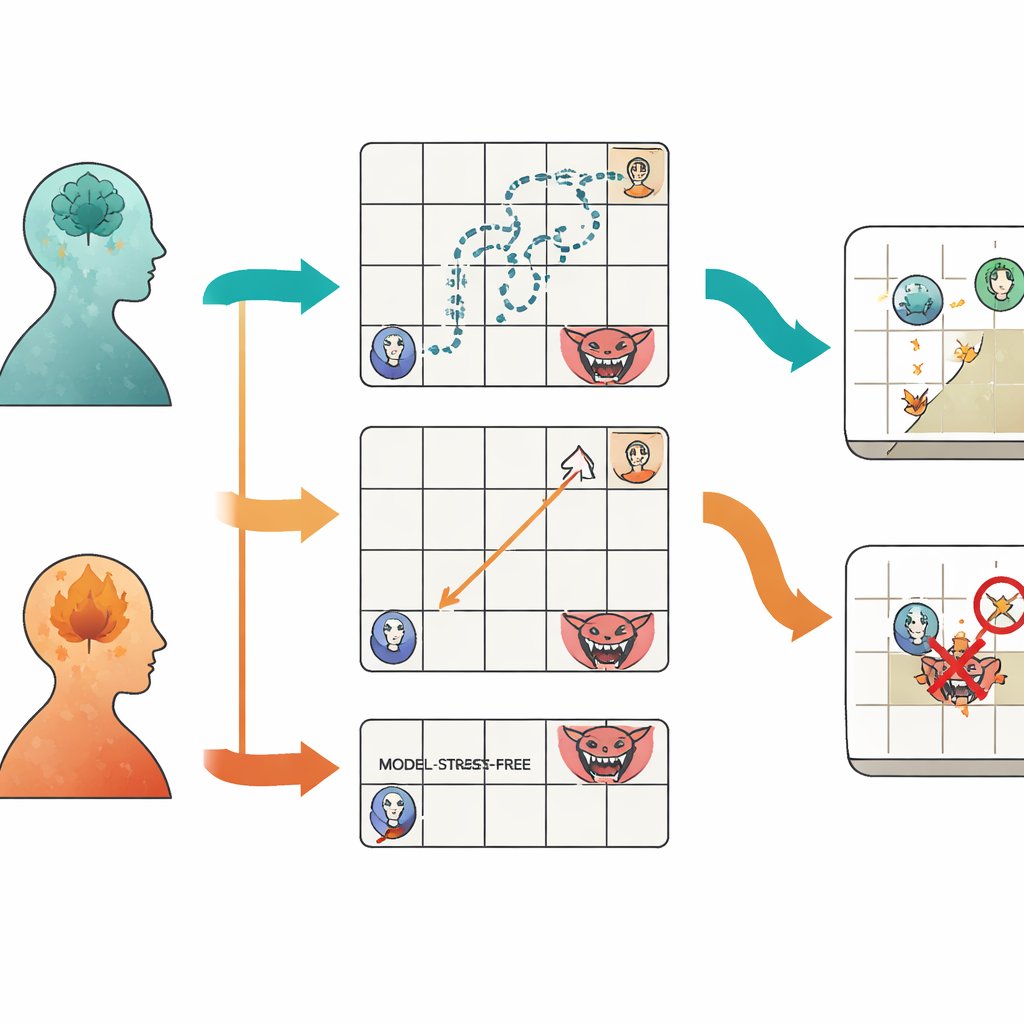
What This Means for Real Life
For a layperson, the key message is that mental health traits do not just change how we feel—they also shape how we learn about and anticipate other agents in complex situations. This study shows that people who describe themselves as inattentive may actually excel at deep, goal-focused planning when a task is engaging and meaningful, even if they doubt their own abilities. Meanwhile, some outwardly driven or anxious–depressed tendencies may bring a risk of firm but faulty beliefs about others’ intentions. By analysing behaviour in a realistic game and modelling the hidden decision processes, the work suggests that everyday social and threat-related difficulties may stem from how strongly we recruit flexible planning mechanisms, not just from broad diagnostic labels.
Citation: Wise, T., Sookud, S., Michelini, G. et al. Transdiagnostic mental health symptom dimensions predict use of flexible model-based inference in complex environments. Transl Psychiatry 16, 141 (2026). https://doi.org/10.1038/s41398-026-03922-w
Keywords: goal-directed decision-making, computational psychiatry, model-based learning, ADHD and attention, social prediction