Clear Sky Science · en
Spatial alignment of chemoarchitecture and resting-state functional connectivity predicts short term weight restoration in anorexia nervosa
Why Brain Chemistry Matters for Eating Disorders
Anorexia nervosa is often seen as a disorder of willpower and body image, but it is also a serious brain-based illness. Many patients struggle for years, and doctors still lack medications that directly target the core problem. This study asks a key question with real-world consequences: do differences in brain chemistry and brain activity help explain why some patients gain weight during treatment while others have a harder time?
Looking at the Resting Brain
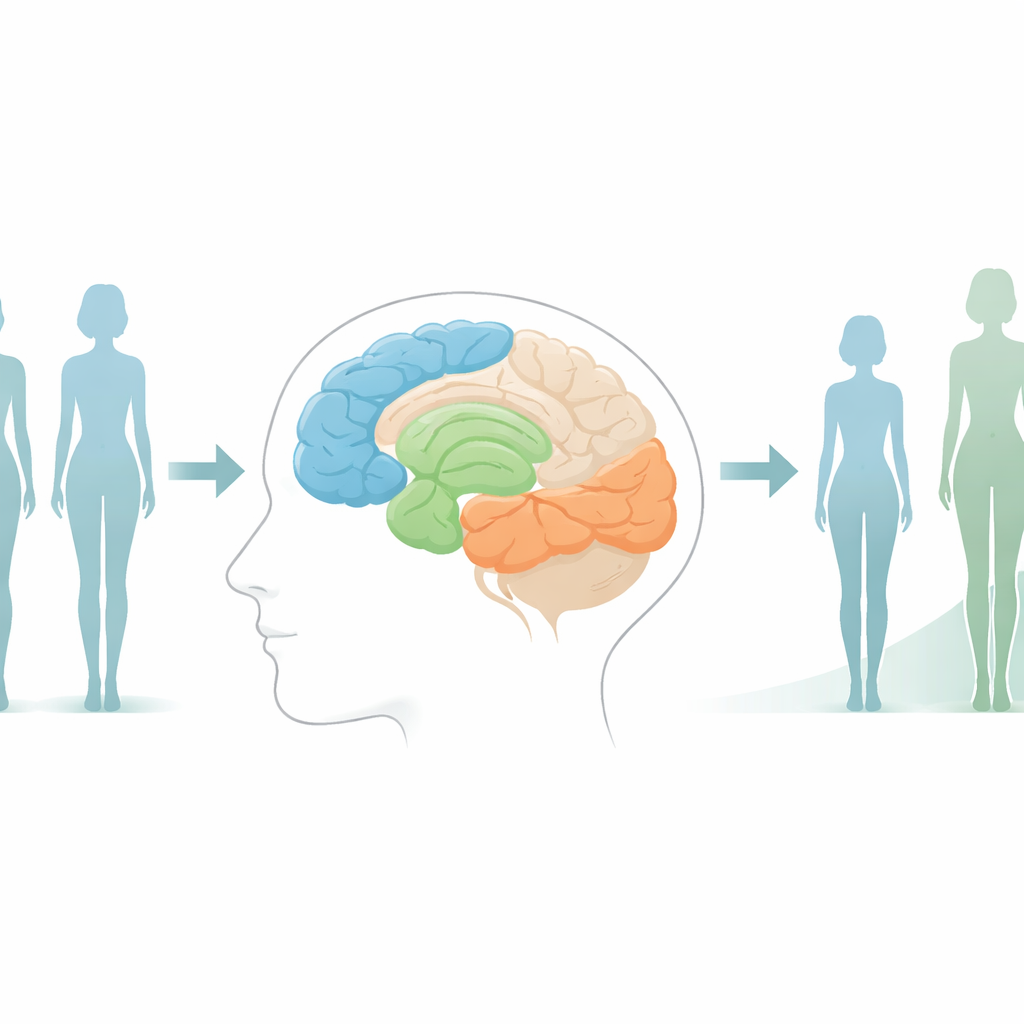
The researchers focused on what the brain is doing at rest, when a person is not performing any task. Using functional MRI, they measured how strongly different brain areas “talk” to each other spontaneously. Two measures were central. One, called degree centrality, reflects how well-connected a brain region is within the overall network. The other, regional homogeneity, captures how tightly a small cluster of neighboring points in the brain pulses together. The team compared these resting patterns in 87 adolescent and young adult girls and women with anorexia nervosa to 87 healthy peers, then scanned the patients again after intensive weight-restoration treatment.
Brain Activity Meets Brain Chemistry
To understand why certain brain areas looked different, the authors linked their MRI findings to maps of brain chemistry built from previous PET scans in other people. These reference maps show where in the cortex certain chemical transporters are most dense. In particular, they looked at transporters related to acetylcholine, dopamine, and serotonin—systems known to affect motivation, reward, and mood. They asked whether the brain regions that showed altered connectivity in anorexia overlapped with regions rich in these transporters, a property they call the brain’s “chemoarchitecture.”
What Changes in the Starved Brain
In the acute underweight state, patients with anorexia showed a striking pattern: degree centrality was higher in many midline and deep regions involved in self-focus, emotion, and internal bodily signals, while it tended to be lower in more outer areas associated with thinking and perception. Overall local synchrony, captured by regional homogeneity, was reduced across much of the brain. Crucially, the regions with heightened centrality strongly overlapped with areas that have higher densities of acetylcholine, dopamine, and serotonin transporters. This suggests that the wiring changes seen in anorexia do not occur randomly; they are anchored in specific chemical neighborhoods of the brain.
Changes with Treatment and Links to Weight Gain
After around three months of structured refeeding and psychotherapy, patients gained substantial weight and showed a partial normalization of brain connectivity. The biggest reductions in degree centrality occurred in regions rich in the dopamine transporter, hinting that dopaminergic circuits may be especially tied to state-related effects of starvation and early recovery. The team then went a step further, calculating how closely each patient’s individual brain pattern at admission matched the “typical” anorexia-related pattern in these chemically defined regions. Those whose connectivity aligned most strongly with areas dense in acetylcholine, dopamine, and serotonin transporters tended to gain less weight over the first 90 days, even after accounting for how underweight they were at the start.

What This Could Mean for Future Care
Taken together, the study suggests that how the resting brain is organized in key chemical territories may foreshadow early treatment success in anorexia nervosa. A more “anorexia-typical” pattern of connectivity in regions rich in certain neurotransmitter systems was linked to slower early weight restoration, which is itself a known warning sign for poorer long-term outcome. While these findings need confirmation—ideally using PET scans tailored to individual patients—they point toward a future in which brain-based markers help identify who might need more intensive or specialized support, and eventually guide more personalized, biologically informed treatment strategies.
Citation: Doose, A., Tarchi, L., Seidel, M. et al. Spatial alignment of chemoarchitecture and resting-state functional connectivity predicts short term weight restoration in anorexia nervosa. Transl Psychiatry 16, 138 (2026). https://doi.org/10.1038/s41398-026-03920-y
Keywords: anorexia nervosa, brain connectivity, neurotransmitters, weight restoration, resting-state fMRI