Clear Sky Science · en
Electrophysiological effects of psilocybin co-administered with midazolam
Why this study matters
Psychedelic-assisted therapy with psilocybin shows promise for treating depression and addiction, but many people are wary of the intense, sometimes overwhelming experiences it can bring. This study asked a simple but important question: can the brain effects of psilocybin be preserved while a sedative drug dulls the memory of the trip? By looking directly at patterns of brain activity, the researchers explored whether the therapeutic "brain reset" associated with psilocybin can still occur when the experience itself is partly forgotten.
Two drugs, one unusual combination
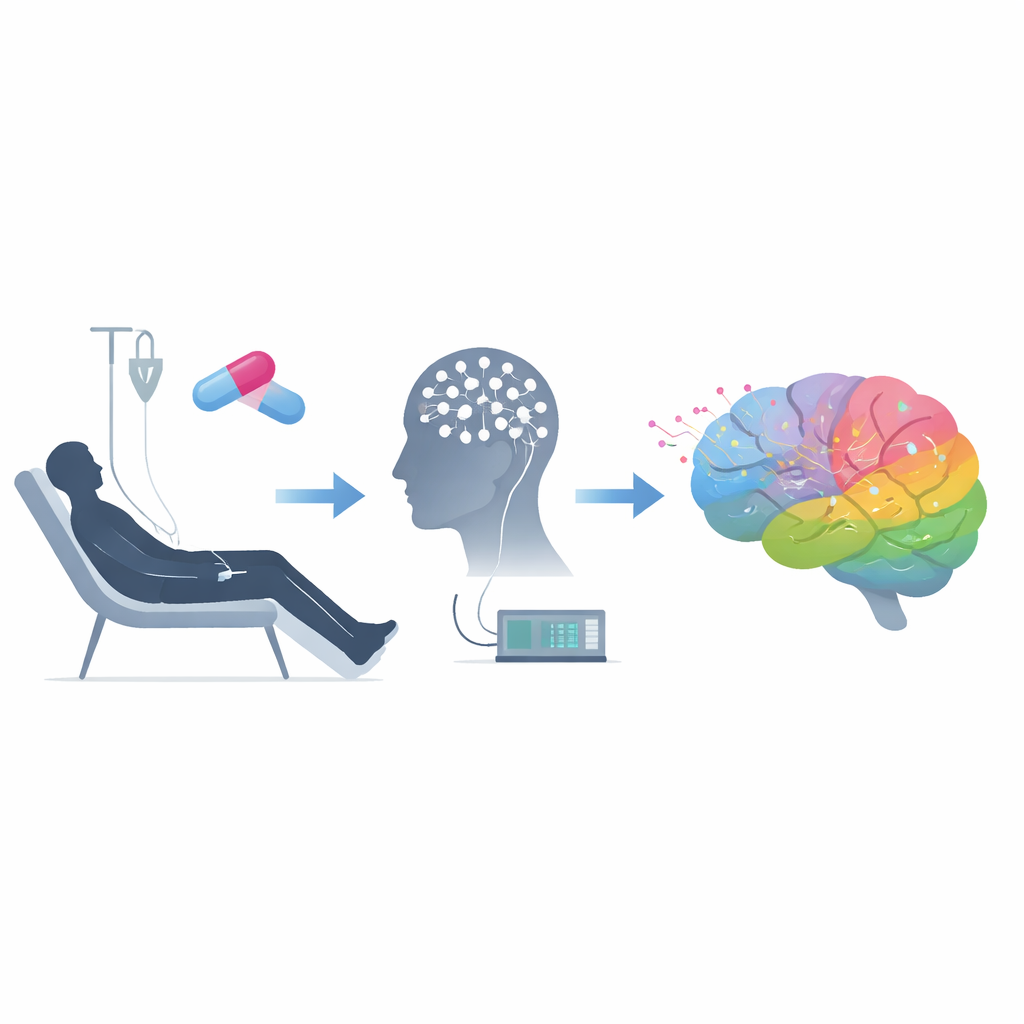
The team worked with eight healthy volunteers who received a standard oral dose of psilocybin together with midazolam, a common hospital sedative given through a vein. Psilocybin is known to boost brain flexibility and produce vivid changes in perception and thought. Midazolam, in contrast, calms people, weakens the formation of new memories, and typically dampens some forms of brain plasticity. The idea was to use midazolam’s amnesia-inducing effects to separate the immediate psychedelic experiences from the later memories of those experiences, while still letting psilocybin act on the brain. Throughout a six-hour session, the researchers monitored brain activity using high-density electroencephalography (EEG), a noninvasive technique that records electrical signals from hundreds of sensors on the scalp.
Listening in on the brain’s rhythms
From these EEG recordings, the scientists extracted three kinds of measures. First, they looked at the strength of classic brain rhythms—slow waves like delta and theta, the well-known alpha band, and faster beta and gamma activity. Second, they calculated a measure called Lempel–Ziv complexity, which captures how richly varied and hard-to-compress the brain’s electrical patterns are over time; more variety is often interpreted as the brain exploring a wider range of network states. Third, they estimated the “spectral exponent,” a summary of how power in the signal falls off from slow to fast frequencies, which has been tied to the balance between excitation and inhibition in brain circuits and to levels of arousal.
What changed when the drugs took hold
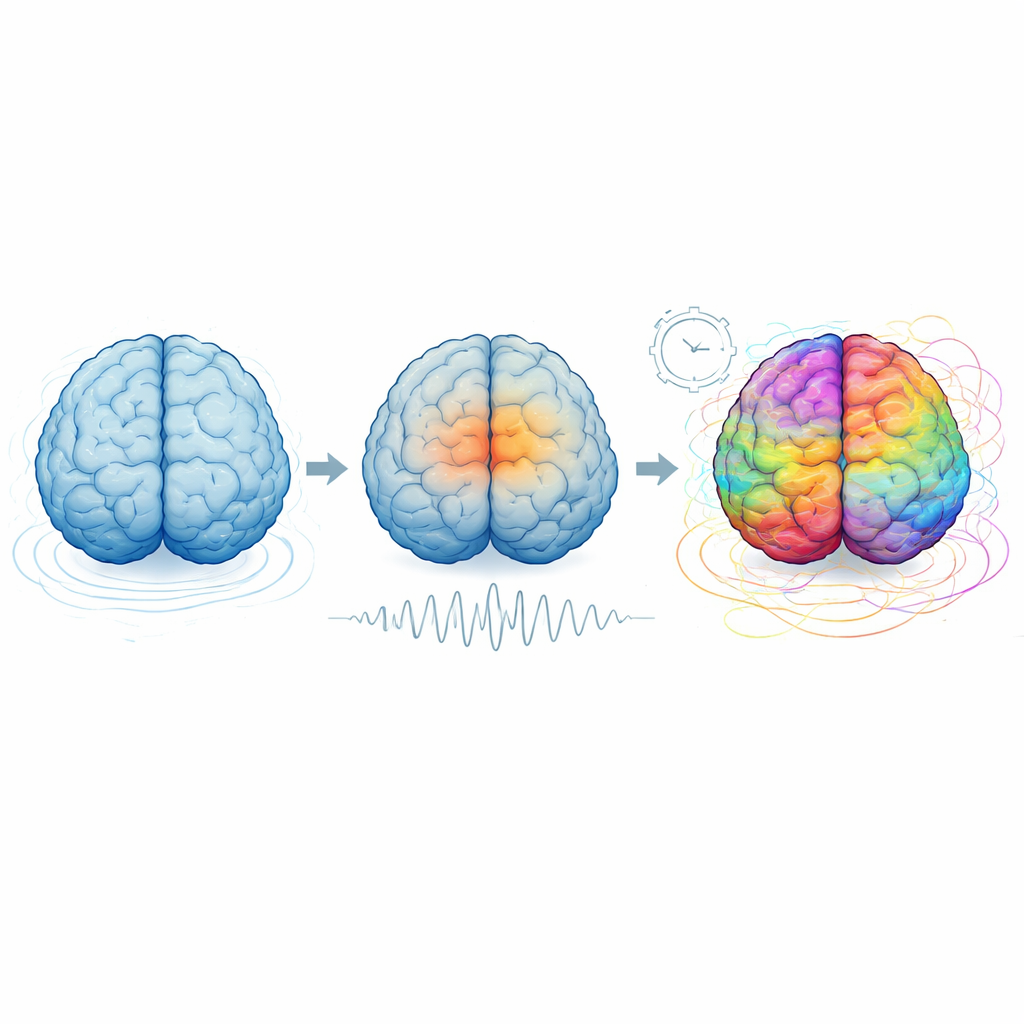
Early in the session, about 15 to 30 minutes after dosing, midazolam’s sedative effect was expected to be present while psilocybin’s full subjective impact had not yet arrived. At this stage, the researchers saw a brief rise in beta activity along with a steeper drop-off in higher frequencies—patterns consistent with the known action of midazolam alone. As psilocybin’s effects grew over the next several hours, the overall power of brain rhythms declined, especially in the slower delta, theta, and alpha bands. At the same time, signal complexity increased: brain activity became less repetitive and more diverse. The spectral exponent also rose, suggesting a shift in the underlying balance of brain activity toward a more excited, flexible regime. These changes lined up with volunteers’ reports of altered perception and thinking, even though midazolam reduced how much of the session they later remembered.
Linking brain patterns to subjective experience
To connect brain signals to what people actually felt, the researchers compared EEG changes with two types of ratings collected during the session. One scale tracked how sedated and unresponsive participants appeared, mainly reflecting midazolam. The other gathered brief self-reports of the psychedelic experience, including feelings of profound thoughts, inner peace, or being at one with surroundings. The depth of sedation offered only limited extra explanation for the EEG patterns. In contrast, higher ratings of psychedelic intensity were clearly associated with greater signal complexity and higher spectral exponent. In other words, the more strongly people were undergoing a psychedelic-like state in the moment, the more their brain activity took on the distinctive signature seen in earlier psilocybin studies without sedation.
What this means for future psychedelic therapy
Despite the small number of volunteers and varying doses of midazolam, the brain changes observed here closely resembled those seen with psilocybin alone. This suggests that the key neural effects of psilocybin—reduced strength of usual brain rhythms, more complex activity, and altered balance of slow and fast signals—can still emerge even when a sedative blurs memory of the experience. For patients who might benefit from psychedelic-based treatments but fear recalling every detail of the trip, this line of research hints at a possible compromise: preserving the brain’s capacity to change while softening the lasting imprint of the journey. Larger, controlled studies are now planned to test whether this approach can safely maintain psilocybin’s therapeutic power while reshaping how the experience is lived and remembered.
Citation: Sutherland, M.H., Nicholas, C.R., Lennertz, R.C. et al. Electrophysiological effects of psilocybin co-administered with midazolam. Transl Psychiatry 16, 160 (2026). https://doi.org/10.1038/s41398-026-03894-x
Keywords: psilocybin, midazolam, EEG, psychedelic therapy, brain complexity