Clear Sky Science · en
Lipidomic signatures reveal biomarkers of mild cognitive impairment
Why tiny fats in the body may flag early memory loss
Mild cognitive impairment (MCI) sits between normal aging and dementia: people notice problems with memory and thinking, but can still manage everyday life. If doctors could reliably spot MCI early, they might slow or prevent progression to Alzheimer’s disease. This study asks a simple but powerful question: can tiny fat molecules, measured in everyday body fluids like saliva, blood, and stool, act as early warning lights for the brain?

Looking for clues in everyday samples
Researchers in the Microbiome in Aging Gut and Brain consortium collected saliva, blood plasma, and fecal samples from older adults aged 65 to 85. Some participants were cognitively healthy, others had MCI, and a smaller group had dementia. Instead of focusing on one fluid or one type of molecule, the team used a broad "lipidomics" approach, profiling over 200 different fat-related molecules across five major classes. Using high‑performance liquid chromatography and high‑resolution mass spectrometry, they created a detailed fingerprint of the fats present in each sample, then applied advanced statistics to see how these patterns differed between healthy and impaired groups.
Different fats tell different parts of the story
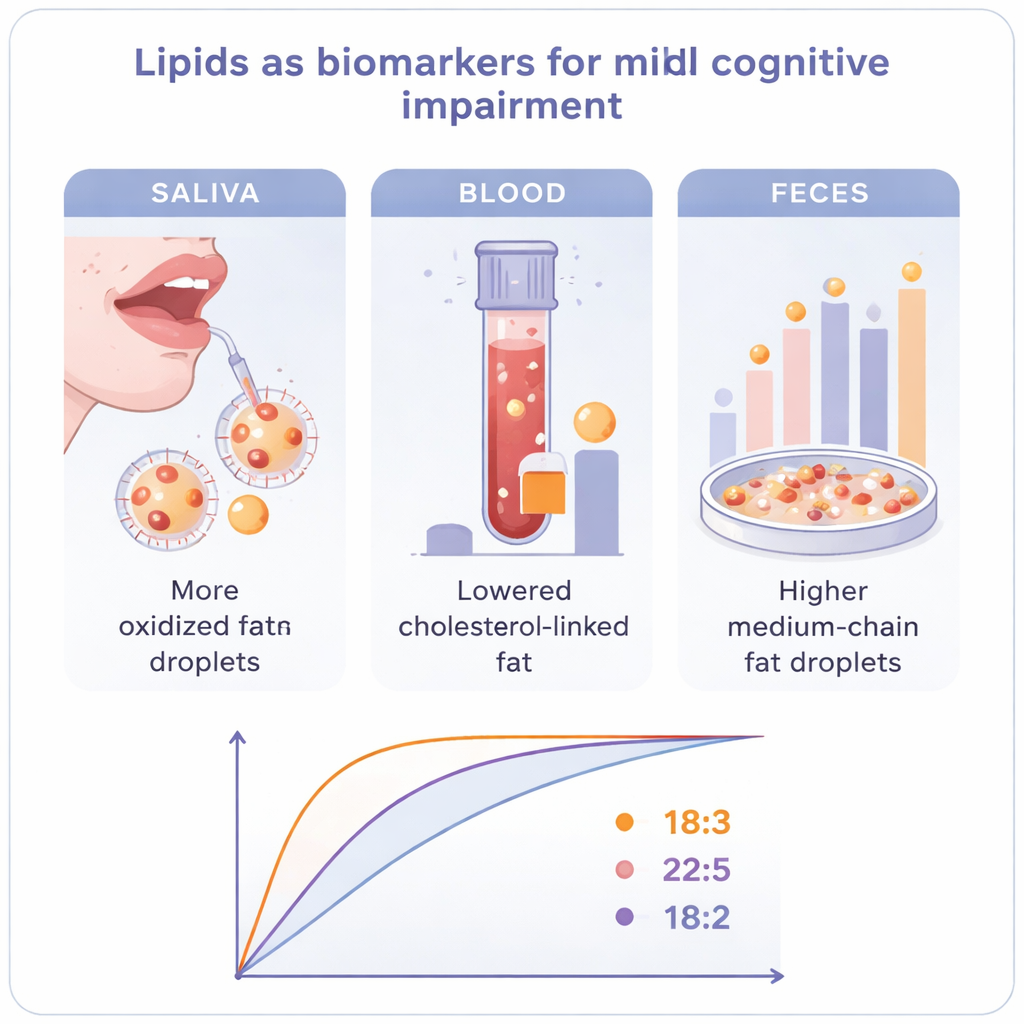
The overall mix of lipid types looked broadly similar between people with and without MCI, reflecting the strong influence of age, diet, and lifestyle. But when the team zoomed in on specific molecules, telling differences emerged. In saliva from people with MCI, several triacylglycerols—storage fats—and their oxidized forms were higher, especially those containing certain building-block fatty acids. The ratio of omega‑6 to omega‑3 polyunsaturated fats was lower in saliva, hinting at shifts in fatty acids linked to inflammation and brain health. In plasma, some free fatty acids and lysophospholipids (lipids associated with cell membranes and inflammation) were elevated, while one particular cholesteryl ester, cholesteryl linoleate (CE 18:2), was reduced in MCI compared with healthy controls.
The gut leaves a strong chemical footprint
Stool samples turned out to be especially informative. In feces from people with MCI, the researchers found higher levels of triacylglycerols and diacylglycerols that contained medium‑chain fatty acids—fats that are normally quickly absorbed and can be turned into ketones, an alternative fuel for the brain. At the same time, levels of FAHFAs, a newer class of fats with anti‑inflammatory and metabolic benefits, were lower. This combination suggests that in MCI, the gut may be absorbing fats less efficiently or processing them differently, possibly forcing the body and brain to make do with altered fuel supplies and inflammatory signals.
Testing how well these fats flag early trouble
To see whether any of these lipids could help distinguish MCI from healthy aging, the team performed receiver operating characteristic (ROC) analyses—a standard way of measuring the diagnostic power of a marker. Three molecules stood out across fluids: the omega‑3–related fatty acids alpha‑linolenic acid (18:3) and docosapentaenoic acid (22:5), and the cholesteryl ester CE 18:2. Individually, they showed modest but meaningful ability to separate MCI from controls. Fecal medium‑chain triacylglycerols were especially elevated in MCI and emerged as promising non‑invasive candidates: unlike spinal taps or complex brain scans, stool sampling is simple and low‑risk, making it attractive for large‑scale screening and follow‑up.
What this could mean for everyday brain health
The authors conclude that specific patterns of fats in saliva, blood, and especially stool may act as early biomarkers of mild cognitive impairment. These lipid signatures do not yet offer a definitive test, and the study’s cross‑sectional design and modest sample sizes mean that larger, long‑term studies are needed. But the work points to a future in which a simple panel of fat molecules—reflecting how the brain, body, and gut handle lipids—could help identify people at higher risk of dementia years before major symptoms appear. That, in turn, could open a crucial window for diet, lifestyle, and medical interventions aimed at keeping the aging brain healthier for longer.
Citation: Jayaprakash, J., B. Gowda, S.G., Gowda, D. et al. Lipidomic signatures reveal biomarkers of mild cognitive impairment. Transl Psychiatry 16, 115 (2026). https://doi.org/10.1038/s41398-026-03893-y
Keywords: mild cognitive impairment, lipid biomarkers, saliva and fecal tests, gut–brain axis, Alzheimer’s risk