Clear Sky Science · en
Preliminary analysis of ayahuasca-induced anatomical alterations in the somatosensory cortex of juvenile non-human primates (Callithrix jacchus) subjected to chronic stress
Why this matters for mental health
Depression is often thought of as a problem of mood and feelings, but it is also a disease of the brain’s structure. This study looks at how a traditional Amazonian psychedelic drink, ayahuasca, might help protect the brains of young primates exposed to long-lasting stress. Because these animals’ brains develop in ways similar to ours, the findings hint at how new treatments could one day help teenagers at risk for serious, stress-related depression.
Stress, touch, and the teenage brain
The somatosensory cortex is the strip of brain that helps us feel touch, pressure, and the position of our bodies. Recent research has shown that this region is also involved in depression, where tiny branches on nerve cells can be lost, weakening the brain’s ability to process signals. At the same time, adolescence is a critical window of brain development, when experience can leave lasting marks on emotion and thinking. Chronic stress during this period – especially social isolation – is known to increase the risk of later mood disorders. The authors therefore asked a simple but important question: can ayahuasca, already under study as a fast-acting antidepressant in adults, prevent stress from damaging this sensitive brain area in young animals?
A controlled test in young marmosets
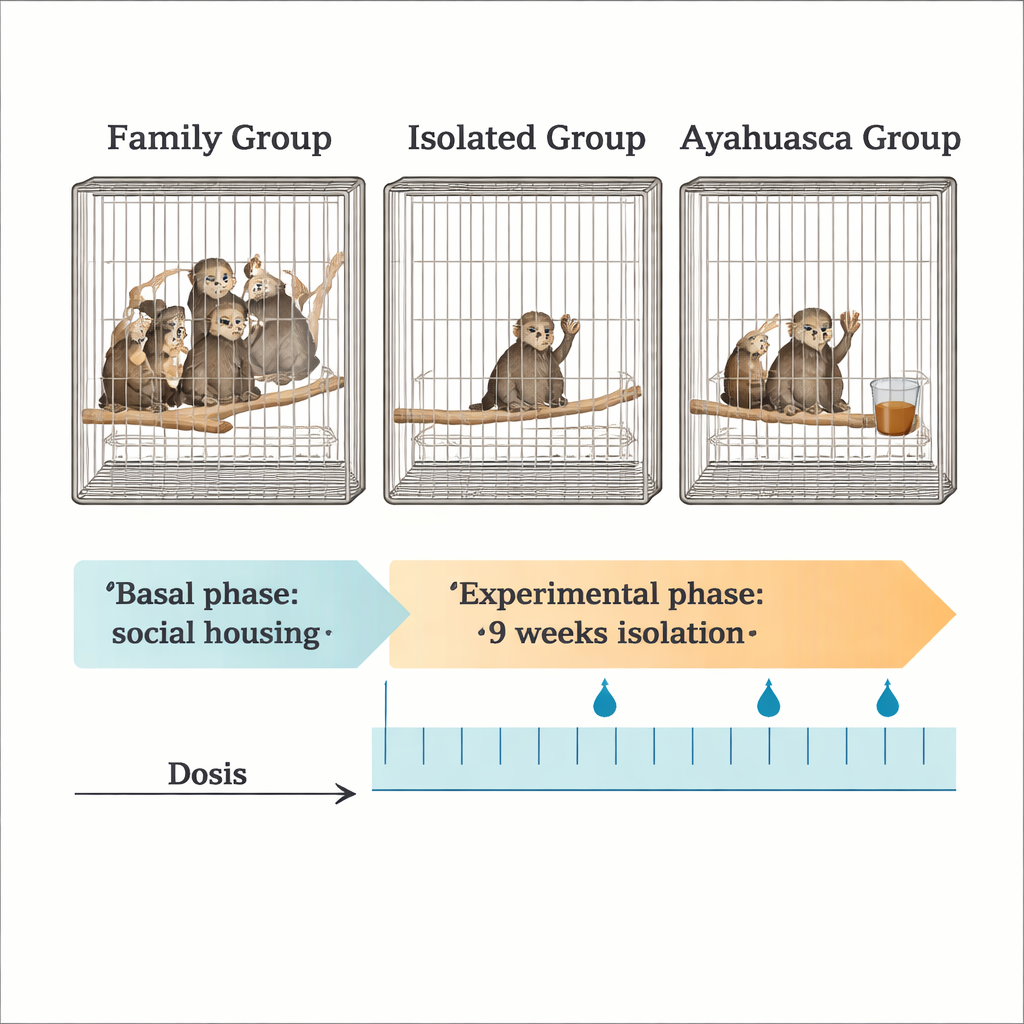
To explore this, researchers worked with six juvenile common marmosets, small New World monkeys often used in brain research because their social behavior and brain organization resemble ours more closely than rodents. The animals were divided into three groups. One group stayed with their families and acted as a healthy comparison group. A second group was separated and kept in complete social isolation for nine weeks, a well-established way to induce chronic stress and depression-like behavior. A third group was also isolated but received three oral doses of ayahuasca, starting just before isolation and continuing during the stressful period. After the experiment, the scientists examined the animals’ brains under the microscope, focusing on the somatosensory cortex.
Looking closely at brain cells
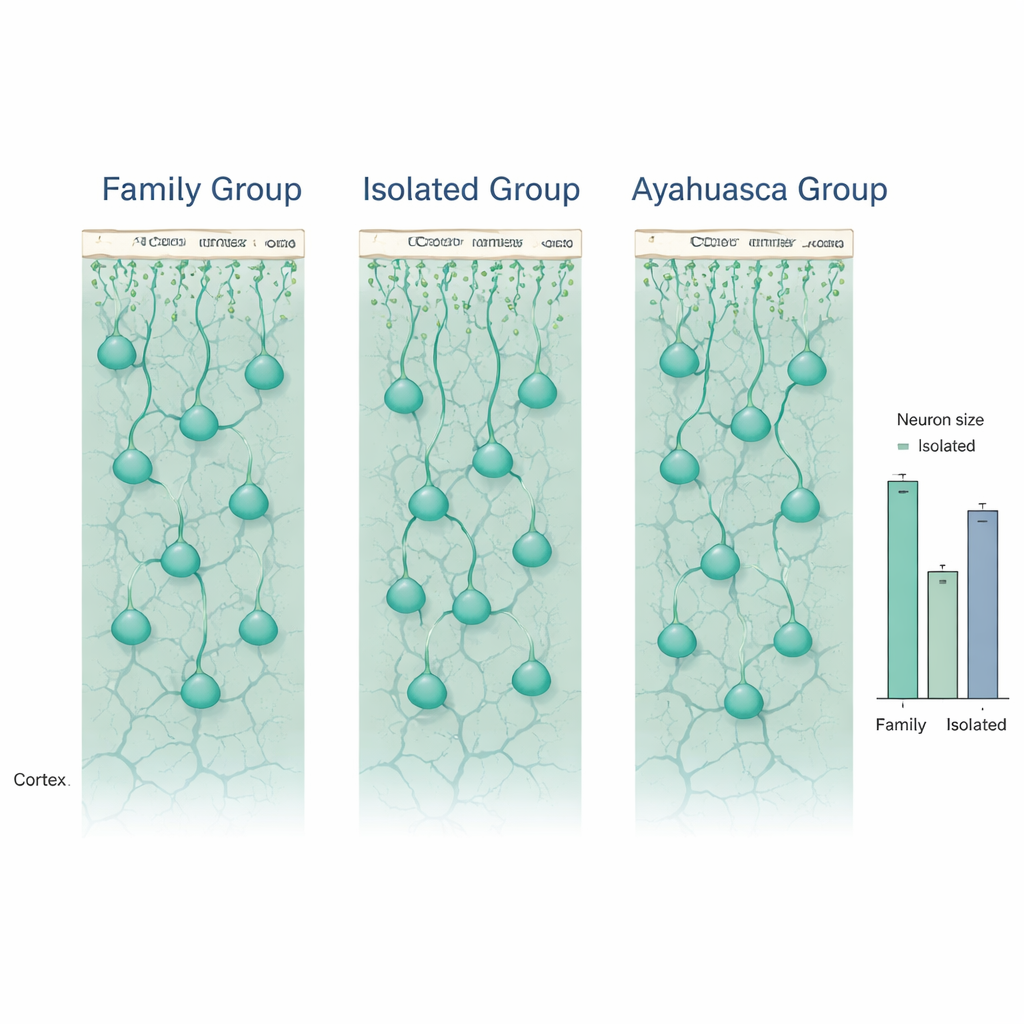
Using standard staining and 3D measurement techniques, the team quantified several features of the nerve cells in this brain region. They measured the average size of neurons, estimated how many were present, and how densely packed they were, comparing the three groups. The most striking finding was that neurons in isolated animals were noticeably shrunken. On average, their cell bodies were less than half the volume of those in animals that had remained with their families. In contrast, the animals that received ayahuasca had neuron sizes much closer to the family group and significantly larger than the stressed, untreated group. Although the small number of animals made it difficult to prove clear differences in overall cortex volume and neuron counts, there was a trend suggesting that ayahuasca-treated animals may also have preserved more tissue and more cells.
What the findings suggest about protection
These results, together with earlier behavioral work in the same animals, point toward a protective, or prophylactic, effect of ayahuasca. In previous studies, similarly treated marmosets showed fewer signs of stress and more normal hormone levels when isolated. Here, the brain data add another layer: ayahuasca appears to help maintain the physical bulk of neurons in a key sensory area, even under harsh social conditions. Other research in people and animals links ayahuasca’s active compounds to boosts in molecules that support brain plasticity, such as brain-derived neurotrophic factor, and to changes in brain connectivity. While this study cannot pinpoint the exact mechanism, it aligns with the idea that psychedelic-assisted approaches may help brains adapt rather than wither under chronic stress.
Limits, cautions, and future directions
As promising as these observations are, they are still preliminary. The study included only six animals, all male, and used a single preparation of ayahuasca. That means the patterns seen here must be confirmed in larger samples, with both sexes and more detailed molecular analyses. Importantly, these findings do not mean ayahuasca is ready to be used to prevent depression in teenagers. Instead, the work highlights a potential direction: treatments that promote healthy brain structure during vulnerable years might reduce the long-term impact of stress. By showing that a traditional psychedelic brew can partially shield young primate brain cells from shrinking under isolation, this study adds cautious but intriguing support to the broader effort to develop faster, more effective therapies for stress-related mental illness.
Citation: Fernandes Pereira, L.R., Lira-Bandeira, W.G., Medeiros-Bandeira, A.S. et al. Preliminary analysis of ayahuasca-induced anatomical alterations in the somatosensory cortex of juvenile non-human primates (Callithrix jacchus) subjected to chronic stress. Transl Psychiatry 16, 118 (2026). https://doi.org/10.1038/s41398-026-03887-w
Keywords: adolescent depression, ayahuasca, chronic stress, somatosensory cortex, neuroplasticity