Clear Sky Science · en
Differential associations of childhood abuse and neglect with neural responses to social reward and punishment in adults with anxiety or depression
Why early relationships matter for the social brain
Many people with anxiety or depression struggle to feel connected to others, even when they want close relationships. This study asks a simple but powerful question: can different kinds of difficult childhood experiences leave distinct fingerprints on how the adult brain responds to the possibility of social connection or rejection? By looking inside the brain while people anticipate praise or criticism from others, the researchers explore how early abuse or neglect may shape social motivation years later.
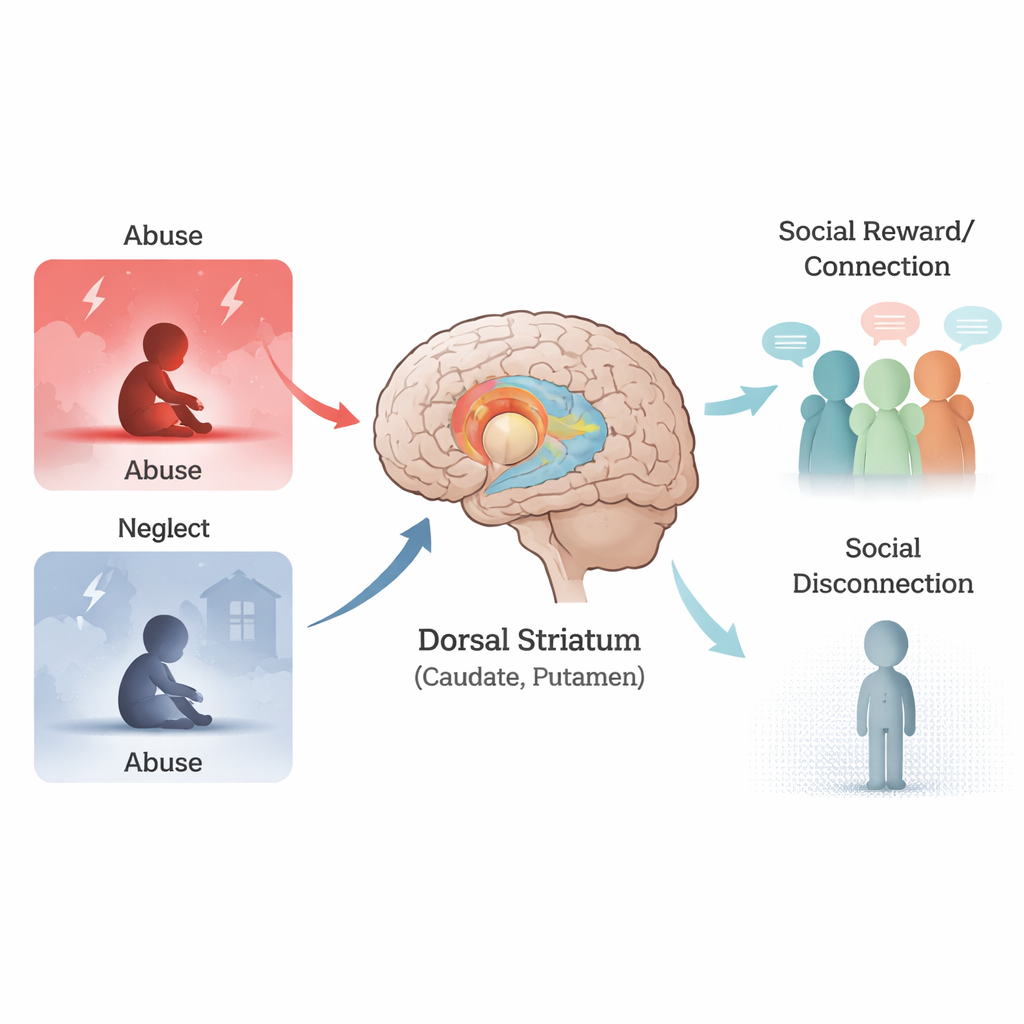
Two kinds of childhood hardship
The authors focus on two broad types of early adversity that often occur in close relationships. Abuse involves the presence of harmful events, such as emotional, physical, or sexual mistreatment from caregivers or others. Neglect involves the absence of expected care, like not receiving warmth, attention, or basic support. Both can damage trust and social confidence, but in different ways. The study asks whether these distinct experiences are linked to different patterns of brain activity when adults expect a positive reaction from others or hope to avoid negative judgment.
Peering into the social motivation system
The research team studied 57 adults who were seeking help for anxiety and/or depression and who also reported feeling socially disconnected and impaired in daily life. While in an MRI scanner, participants completed a “social incentive delay” task. They saw cues telling them they could either gain a social reward (such as a smiling face) or avoid social punishment (an angry face) if they pressed a button quickly enough. This setup allowed scientists to examine brain activity during anticipation—the moment when people are getting ready to act to gain approval or avoid criticism—rather than just when they see a happy or angry face.
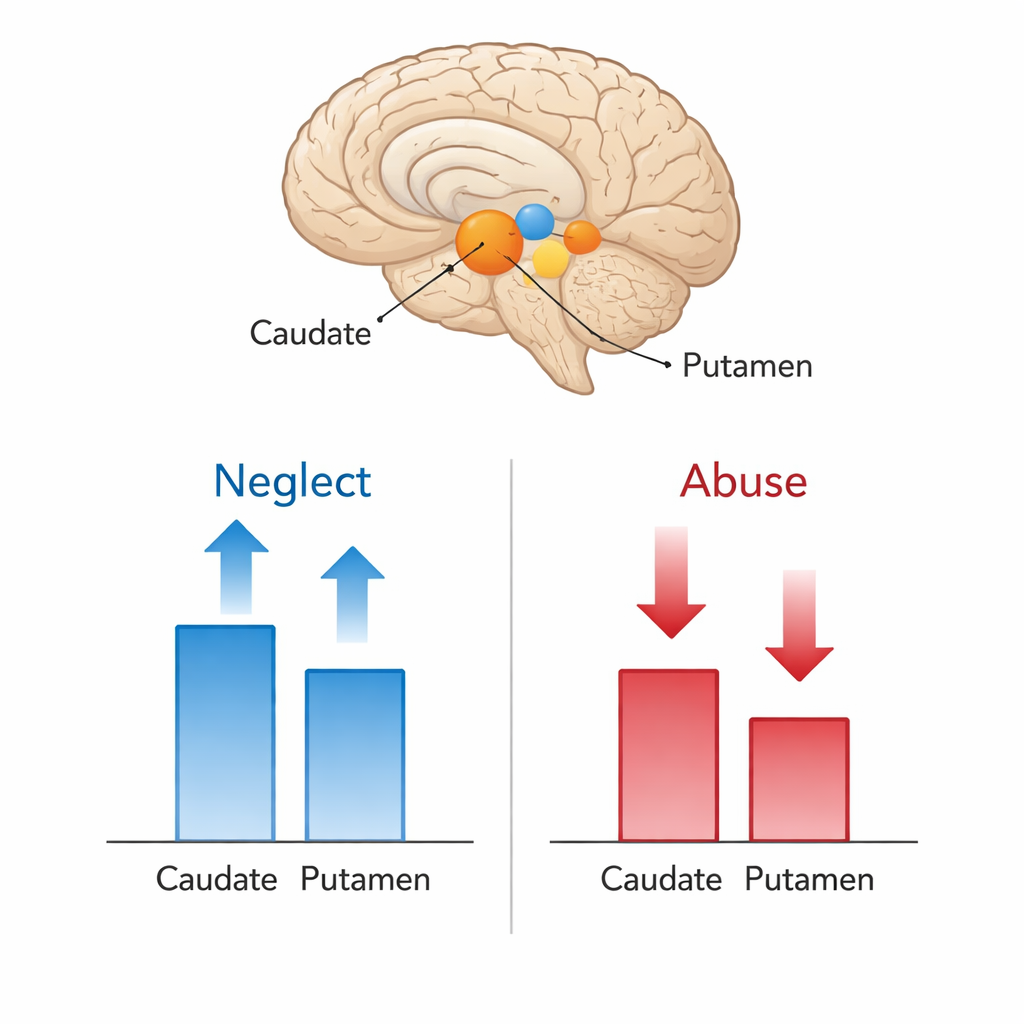
How neglect and abuse pull the brain in opposite directions
The researchers focused on the striatum, a set of deep brain regions that help us evaluate potential rewards and translate them into action. In particular, they examined the caudate and putamen, areas thought to push us toward or away from social opportunities. They found a striking pattern: people who reported more childhood neglect showed stronger activation in these regions when they were anticipating social reward. In contrast, those who reported more childhood abuse showed weaker activation in the same areas. When both abuse and neglect were considered together, neglect remained the more robust predictor of heightened response in one key region (the putamen). These effects were specific to anticipating social reward; links with anticipating the avoidance of social punishment were weaker and did not remain significant after stricter statistical checks.
What this might mean for adult social life
These brain patterns suggest that people who grew up with emotional or physical neglect may develop a kind of "social craving." Because warm interactions were scarce when they were young, their brains may become especially tuned to the chance of connection and may gear up strongly when a positive social outcome seems possible. By contrast, those who experienced abuse may learn that seemingly positive social situations can quickly turn painful. For them, a blunted brain response to potential social reward could signal reduced motivation to reach out, or a protective dampening of the system that normally drives approach toward others.
Implications for help and healing
The study’s takeaway for non-specialists is that not all difficult childhoods have the same impact on the social brain. Even among adults who currently have anxiety or depression, histories of abuse and neglect were linked to different patterns in the very brain regions that prepare us to seek connection. This supports the idea that treatments might need to be tailored: people shaped by neglect may benefit from approaches that safely harness and guide their strong drive for closeness, whereas those shaped by abuse may need help rebuilding a sense that social contact can truly be rewarding and safe. Understanding these neural differences could help clinicians design more personalized interventions to reduce loneliness and improve social functioning.
Citation: Spaulding, I.G., Stein, M.B. & Taylor, C.T. Differential associations of childhood abuse and neglect with neural responses to social reward and punishment in adults with anxiety or depression. Transl Psychiatry 16, 86 (2026). https://doi.org/10.1038/s41398-026-03881-2
Keywords: childhood adversity, social reward, anxiety and depression, brain imaging, social connection