Clear Sky Science · en
Treatment with perampanel alleviates depression-like behavior in mice via modulating GluN2B expression to improve excitatory synaptic transmission
Why a seizure drug might help with depression
Most antidepressants take weeks to work and don’t help everyone. In recent years, the anesthetic ketamine showed that targeting a brain chemical called glutamate can lift mood within hours, but it can also cause hallucinations and addiction. This study asks a compelling question for patients and clinicians alike: can an already-approved epilepsy drug, perampanel, tap into the same fast-acting pathway to relieve depression-like symptoms, but without ketamine’s troubling side effects?
Stress, brain circuits, and a new use for an old drug
To explore this, researchers used a well-established mouse model of depression called chronic social defeat stress. In this model, mice repeatedly face an aggressive opponent and many develop behaviors resembling human depression, such as social withdrawal and increased immobility in simple stress tests. The team focused on the medial prefrontal cortex (mPFC), a brain region that helps regulate mood and decision-making and is often disrupted in major depressive disorder. Perampanel is normally prescribed to control seizures by blocking a type of glutamate receptor called AMPA. The scientists wondered if, at a low dose, it could rebalance glutamate signaling in these stressed mice and quickly improve their behavior.
Fast mood changes tied to receptor rebalancing
When stressed, depression-susceptible mice received a single low injection of perampanel, their behavior shifted rapidly. Within hours, they were more willing to interact socially and spent less time immobile in water and suspension tests, behaving similarly to non-stressed mice. Anxiety-like signs also eased, without changes in overall movement, suggesting a genuine mood-related benefit. At the same time, measurements from the mPFC showed that perampanel reversed a stress-induced surge in a specific glutamate receptor component called GluN2B (part of the NMDA receptor), while boosting levels of another component, GluA1 (part of the AMPA receptor). Together, these changes pointed to a more efficient excitatory signal at the connections between nerve cells, which the authors link to the rapid antidepressant effect. 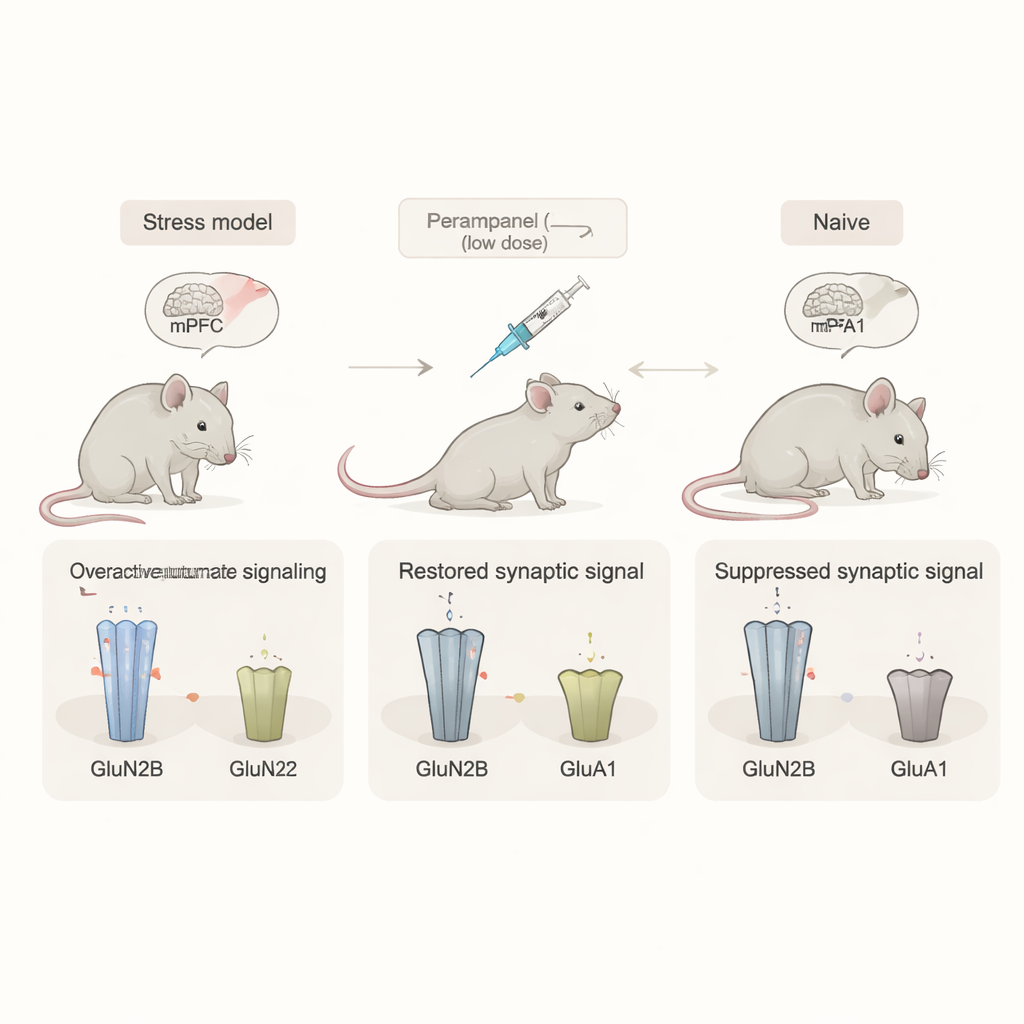
Opposite effects in healthy brains raise a caution flag
Strikingly, when the same perampanel dose was given to healthy, non-stressed mice, the outcome flipped. These animals began to show depression-like and anxiety-like behaviors: less social interaction, more immobility, and greater avoidance of open spaces. In their mPFC, both AMPA (GluA1) and NMDA (including GluN2B) signaling were dampened, and electrical recordings from brain slices confirmed a weakened excitatory signal between neurons. Importantly, the drug did not trigger signs of addiction or hallucination-like effects in these mice. This suggests that perampanel’s impact depends heavily on the starting state of the brain: in a stressed, glutamate-overdriven system, it restores balance, but in a normal system it can tip the balance too far toward underactivity.
Digging into the molecular switches
To understand how lowering GluN2B could increase GluA1 and improve signaling in stressed mice, the team used a virus to selectively reduce GluN2B in the mPFC. In stressed animals, this alone relieved depression-like behavior and raised GluA1 levels, without affecting basic movement. The researchers traced this to changes in two key enzymes: PKCα, which can stabilize AMPA receptors at the synapse, increased, while NEDD4L, which tags AMPA receptors for removal, decreased. Microscopy confirmed more AMPA receptors clustered at synaptic sites alongside a scaffolding protein called PSD-95. Electrical recordings showed that, after perampanel treatment or GluN2B knockdown, the frequency of tiny excitatory signals between neurons rose back toward normal, indicating stronger communication across these mood-related circuits. 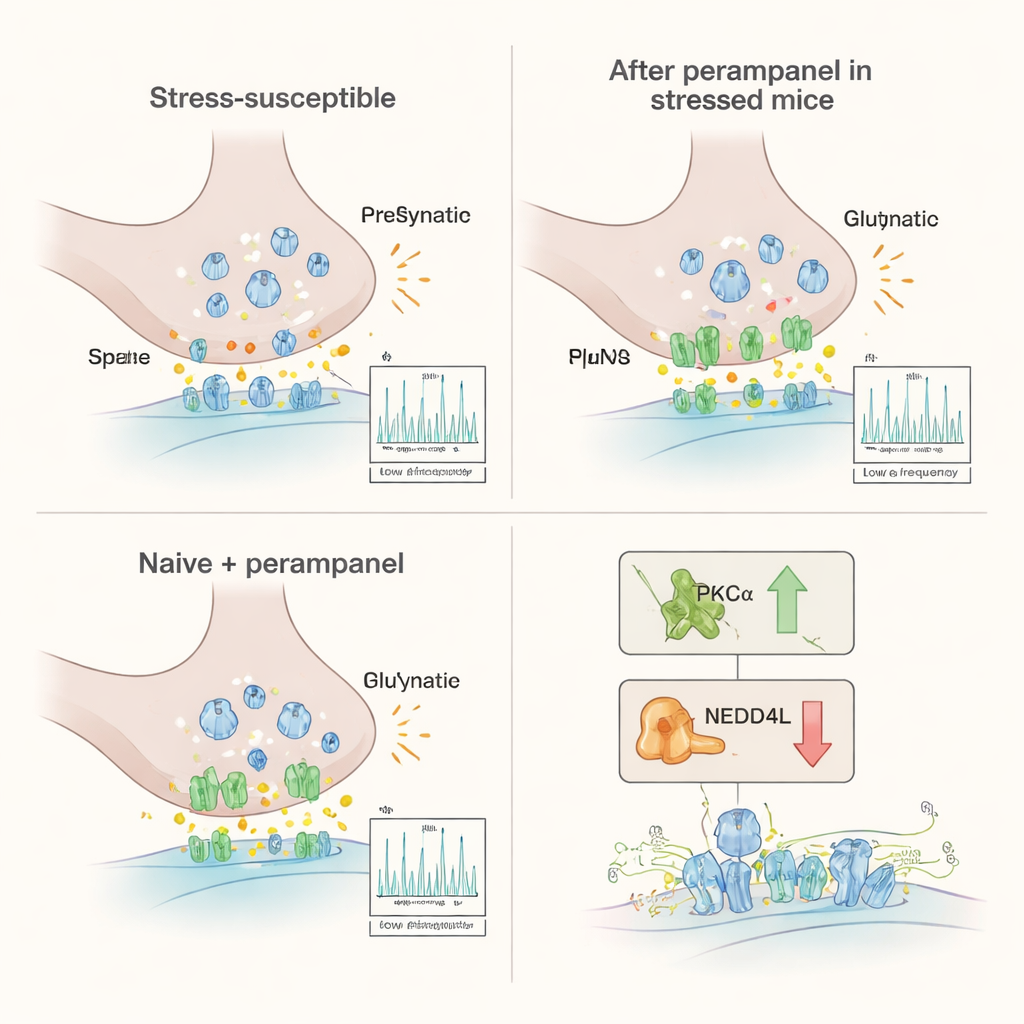
What this could mean for people
In plain terms, this work suggests that perampanel, a drug already approved for epilepsy, can quickly lift depression-like symptoms in stressed mice by dialing down an overactive glutamate pathway and strengthening key synapses in the prefrontal cortex. The effect lasts at least 12 hours and does not seem to carry ketamine-like risks of addiction or hallucinations. However, because the same dose can trigger depression-like behavior in otherwise healthy mice, the authors stress that perampanel should be used cautiously and likely only in people whose brain circuits are already disturbed, such as patients with depression or epilepsy combined with depression. While more studies in humans are needed, these findings hint at a future in which precisely targeting glutamate receptors could offer rapid, tailored relief for difficult-to-treat depression.
Citation: Liu, JM., Zhang, YL., Guo, F. et al. Treatment with perampanel alleviates depression-like behavior in mice via modulating GluN2B expression to improve excitatory synaptic transmission. Transl Psychiatry 16, 90 (2026). https://doi.org/10.1038/s41398-026-03874-1
Keywords: glutamate, perampanel, depression, synaptic transmission, medial prefrontal cortex