Clear Sky Science · en
DNA methylation signatures associated with early-onset schizophrenia in Chinese patients
Why Some Minds Break Earlier
Schizophrenia often appears in late adolescence or adulthood, but in some young people, disabling symptoms such as hearing voices or strong delusional beliefs emerge before age 18. These early cases tend to be more severe and harder to treat. This study asks a simple but profound question: do young people whose illness starts earlier carry a different “chemical punctuation” on their DNA that helps explain why their minds break sooner?
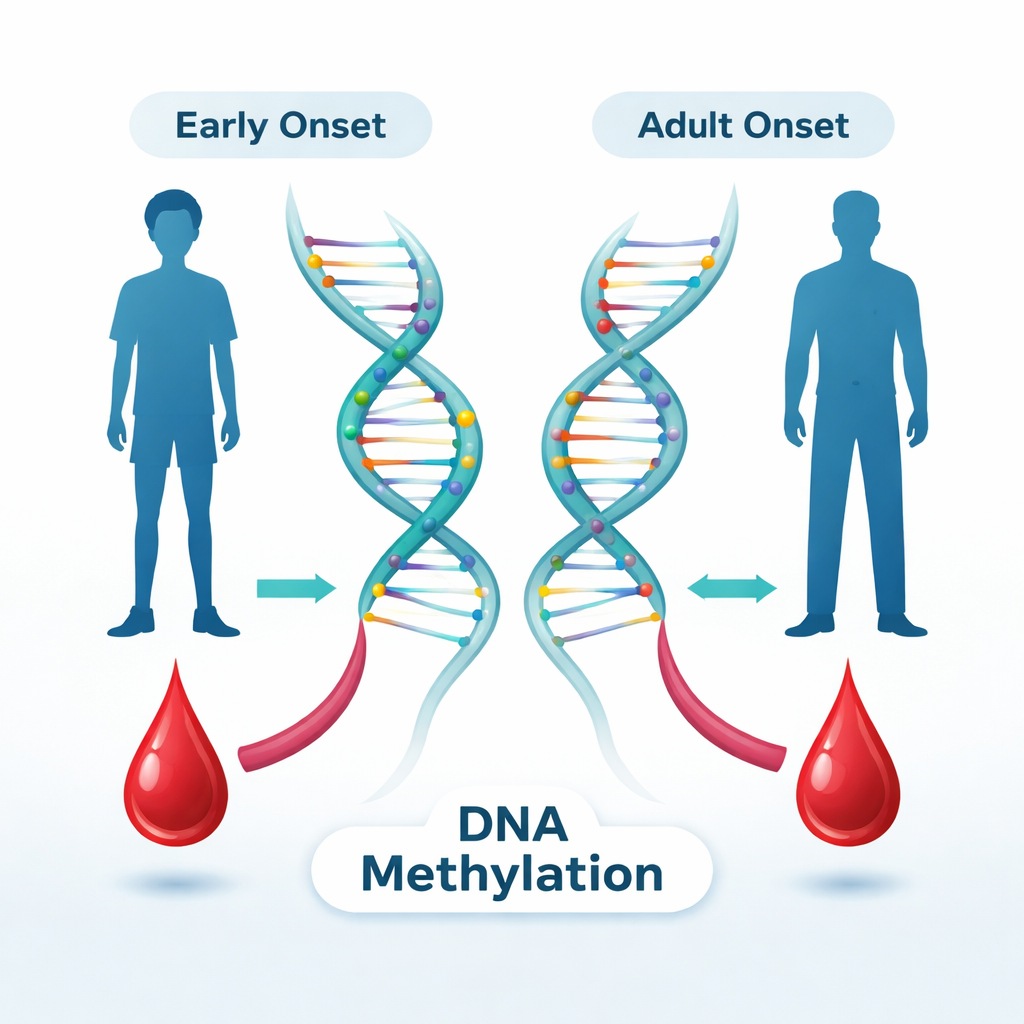
Signals Written On Our DNA
Our genes are not just fixed strings of letters. They are decorated by small chemical tags, one of the best studied being DNA methylation, which acts like a dimmer switch for gene activity. These marks can be influenced by both inherited factors and life experiences, without changing the underlying genetic code. The researchers focused on these methylation marks in blood cells from 120 Chinese patients with schizophrenia: 49 who developed the illness before age 18 (early-onset) and 71 whose symptoms appeared later in life (adult-onset). By scanning nearly 900,000 sites across the genome, they looked for consistent differences linked to the age at which the disease began.
Comparing Early And Late Starters
To tease out meaningful patterns, the team carefully adjusted their analyses for factors that can alter methylation, such as sex, current age, smoking, and differences in blood cell types. They first compared early-onset to adult-onset patients as two groups and found 49 DNA sites where methylation levels differed strongly. Many of these sites sat near genes already tied to schizophrenia or to brain development and thinking ability, including genes involved in how nerve cells grow, communicate, and respond to their environment. Some changes appeared to turn down activity in certain regions, while others seemed to turn them up, hinting at a different epigenetic balance in those who become ill younger.
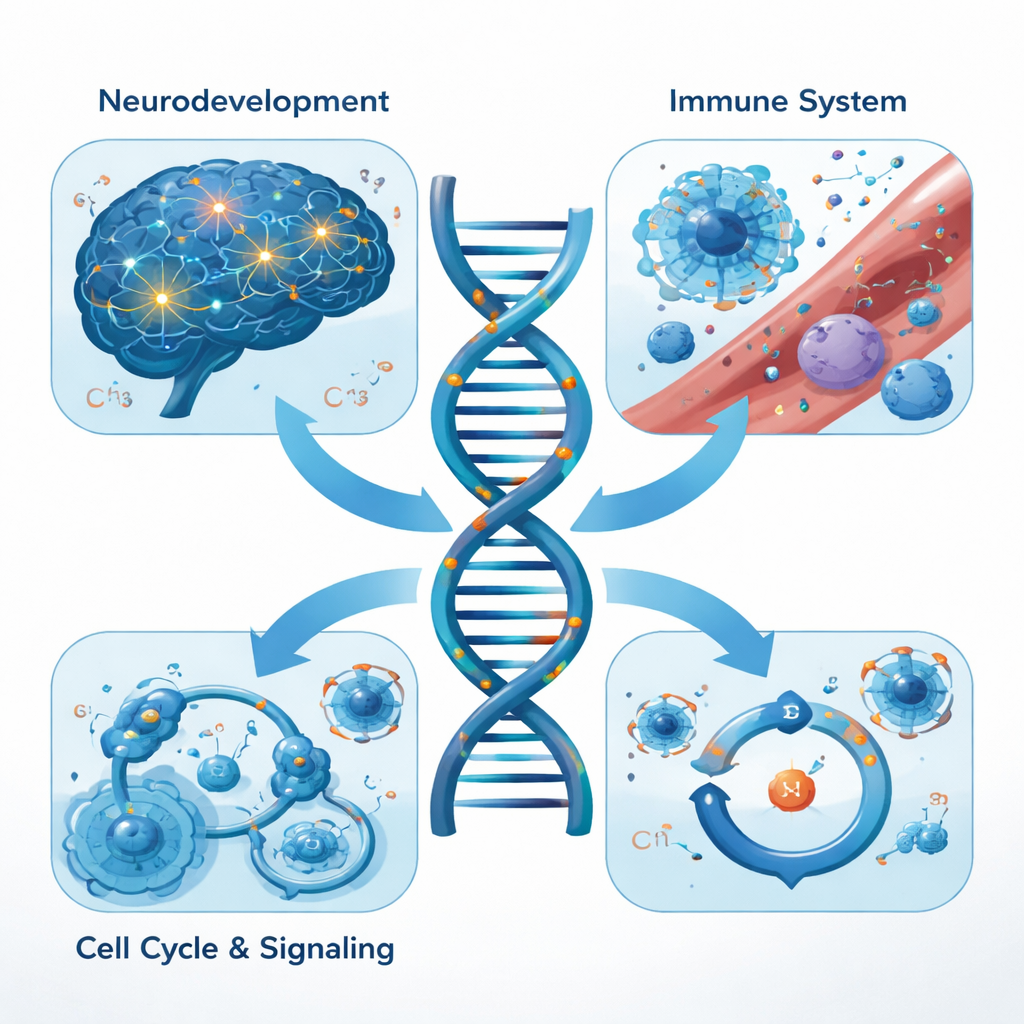
Tracing Biological Pathways
Next, the researchers treated age at onset as a sliding scale rather than a simple early-versus-late split. This revealed over a hundred methylation sites whose chemical tagging rose or fell in step with the age when symptoms first appeared. One standout region lay within a gene called SF1, which helps manage how RNA is spliced—a process that shapes which protein versions brain cells make. Another important signal involved GPRC5C, part of a large family of receptors that mediate brain cell communication. When the team mapped all these genes into known biological networks, several themes emerged: cell growth and division, chemical signaling inside cells, small regulatory molecules called microRNAs, and immune-related processes such as white blood cell movement.
Links To Immune Cells And Brain Development
The study also uncovered hints that the body’s defense system may be wired differently in early-onset cases. Natural killer cells—a type of white blood cell that forms part of the innate immune response—were more strongly tied to early-onset schizophrenia than other blood cell types. The balance between two major classes of T cells also tracked with age at onset. Together with the methylation signals in genes involved in cell cycle control and cancer-related pathways, these findings suggest that how cells grow, divide, and defend the body may be intertwined with how the developing brain becomes vulnerable to psychosis.
What This Means For Patients And Families
For families living with schizophrenia, these results do not yet translate into a clinical test or new treatment, and the authors note important limits, including a modest sample size and the fact that blood may not fully mirror the brain. Still, the work provides the first detailed map of DNA methylation changes linked to early-onset schizophrenia in Chinese patients. It shows that age of onset is not just a matter of chance, but is associated with specific chemical signatures on the genome that touch brain development, immune function, and cellular housekeeping. Over time, such epigenetic fingerprints may help doctors better understand why some young people are hit so early and so hard—and could eventually point the way toward more tailored prevention and treatment strategies.
Citation: Zhan, N., Leung, P.B.M., Zhong, Y. et al. DNA methylation signatures associated with early-onset schizophrenia in Chinese patients. Transl Psychiatry 16, 84 (2026). https://doi.org/10.1038/s41398-026-03869-y
Keywords: schizophrenia, early onset, DNA methylation, epigenetics, Chinese patients