Clear Sky Science · en
Eukaryotic initiation factor 4E: a key factor of traumatic stress-induced depression-related cognitive decline at different age
When Stress, Mood, and Memory Collide
Why do some people who live through trauma go on to develop stubborn depression and memory problems, while others do not—and why does risk rise in midlife? This study uses mice to probe that puzzle, focusing on how stress affects brain chemistry tied to both mood and thinking. By tracking changes in specific brain messengers and a protein that controls how neurons make other proteins, the researchers uncover clues that may one day help prevent dementia in people with long-lasting, hard-to-treat depression.
Depression That Ignores Usual Medicines
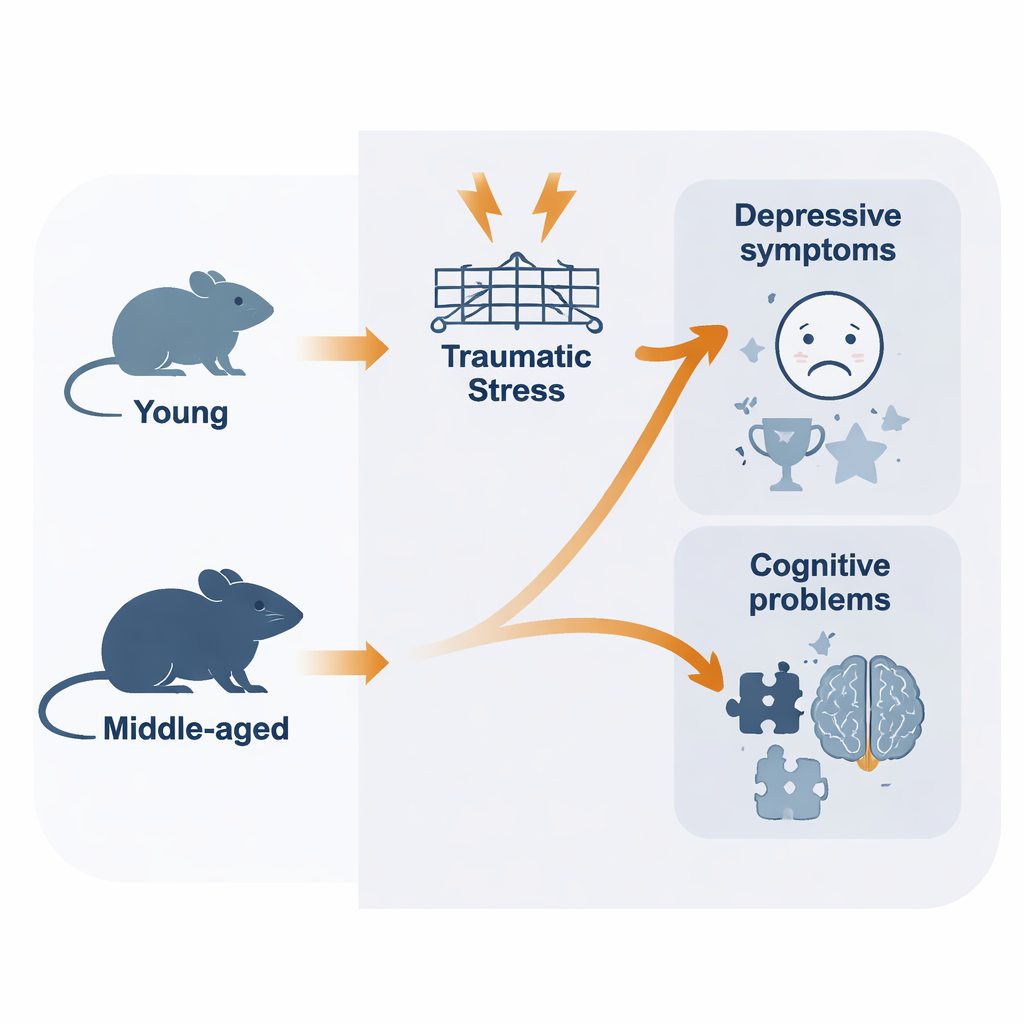
Psychiatrists call it treatment-resistant depression when standard antidepressants fail to lift mood. People with this form of depression often struggle with memory, attention, and decision-making, and they face a higher risk of dementia later in life. The authors recreated this clinical picture in mice by exposing them to brief but intense traumatic stress: tones paired with mild foot shocks. Afterward, the mice showed classic “depression-like” behaviors such as reduced interest in sweet solutions, less effort in stressful situations, and lower motivation for normally rewarding smells. Importantly, three commonly used antidepressants—fluoxetine, imipramine, and venlafaxine—did not reverse these changes, closely mirroring treatment resistance seen in patients.
Stress Hits Middle-Aged Thinking Harder
The team compared young adult mice with middle-aged mice to ask how age shapes the impact of stress. Both age groups developed similar depression-like behaviors after trauma, but their thinking abilities diverged. Using tasks that test working memory and recognition of new objects, the researchers found that only the middle-aged mice developed pronounced cognitive problems. Young stressed mice could still navigate mazes and distinguish new from familiar objects fairly well, whereas middle-aged stressed mice made more mistakes and failed to show a normal preference for novelty. This age-by-stress interaction echoes human studies in which long-standing depression in midlife predicts later-life cognitive decline and dementia.
A Quieting Signal and a Master Switch for Protein Making
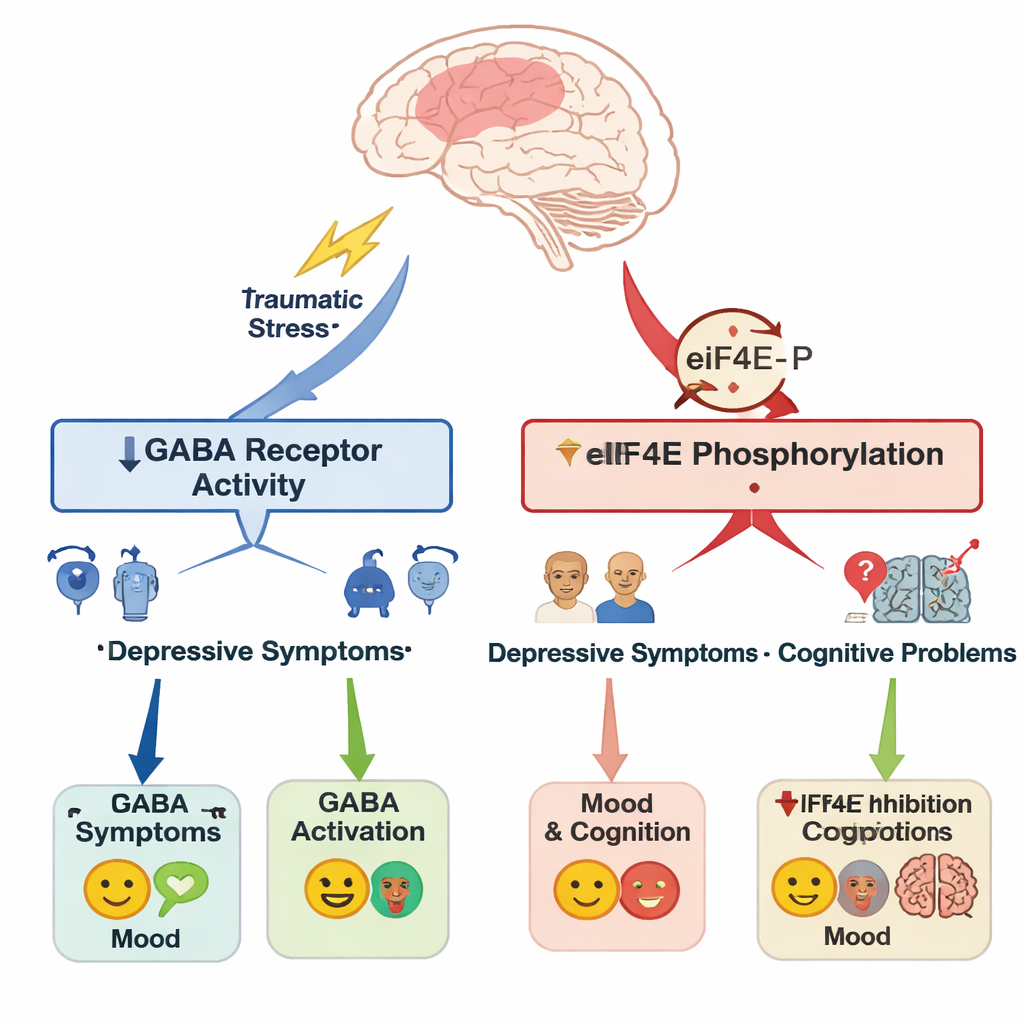
The study then zoomed in on two key biological players in the prefrontal cortex, a brain area crucial for planning, mood regulation, and flexible thinking. The first player is the GABA system, a major “brake” signal that helps calm overactive brain circuits. After traumatic stress, both young and middle-aged mice showed reduced levels of several GABA receptors, suggesting weaker braking power. The second player is eIF4E, a protein that acts like a master switch for protein production at synapses. Its activity rises when it is chemically tagged (phosphorylated). The researchers found that this tagging was already higher in middle-aged mice than in young ones and climbed even further after stress in middle-aged animals. In other words, aging and trauma together pushed this protein-making switch into an overactive state.
Turning Molecular Dials to Restore Mood and Memory
To test cause and effect, the scientists gently adjusted these brain dials. When they blocked eIF4E’s interaction with its partner protein in the prefrontal cortex of middle-aged stressed mice, both mood-like behaviors and thinking performance improved: the animals regained interest in rewards, struggled less in stress tests, and did better on memory and recognition tasks. Activating GABA receptors told a different story. Drugs that boosted GABA signaling eased depression-like behaviors, but they did not fix the memory and thinking problems. This suggests that while weakened GABA braking contributes mainly to low mood, the overactive eIF4E switch is a crucial link between traumatic stress, aging, and cognitive decline.
What This Could Mean for People
For a layperson, the message is that not all depression is the same, especially as we age. This mouse work supports the idea that long-lasting, trauma-related depression in midlife can quietly erode thinking skills, partly through an overdriven protein-making switch in key brain circuits. Standard antidepressants may not be enough to address this. Therapies that rebalance eIF4E-related pathways could, in principle, help protect memory and thinking while easing mood symptoms. Although much work remains before such approaches reach the clinic, this study highlights a promising biological target at the crossroads of stress, depression, aging, and dementia risk.
Citation: Lee, CW., Yang, TJ., Chu, MC. et al. Eukaryotic initiation factor 4E: a key factor of traumatic stress-induced depression-related cognitive decline at different age. Transl Psychiatry 16, 93 (2026). https://doi.org/10.1038/s41398-026-03860-7
Keywords: treatment-resistant depression, traumatic stress, cognitive decline, GABA signaling, eIF4E phosphorylation