Clear Sky Science · en
Social valence dictates sex differences in identity recognition
Why some bad social experiences may hit females harder
Most of us know that harsh social experiences—being excluded, bullied or rejected—can leave deep marks on our mood. Women are more likely than men to develop depression and anxiety after such stress, but why is that? This study uses mice to probe how the brain handles good and bad social encounters, and whether males and females process these experiences differently at the level of memory and emotion.
Good company, good memories
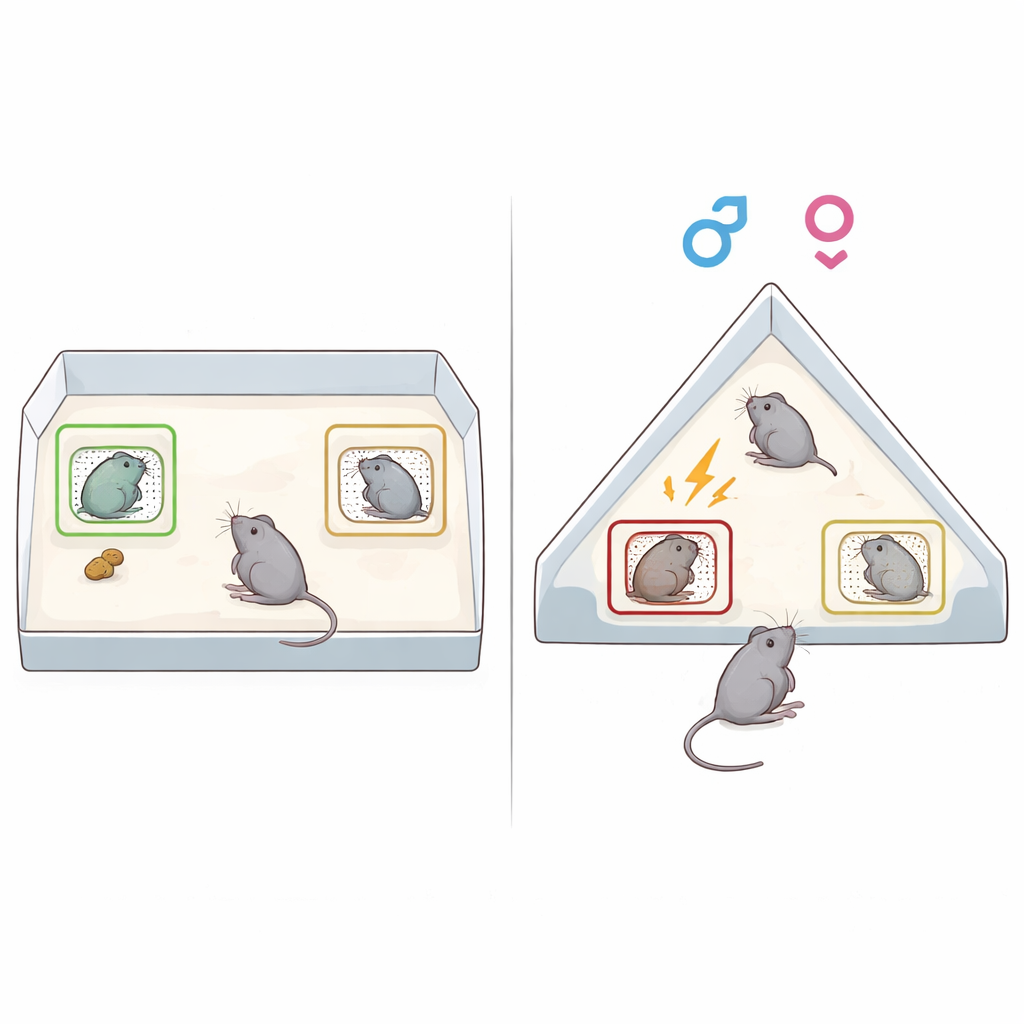
The researchers first asked a simple question: can male and female mice remember which other mouse was linked to something pleasant? In one task, a “friendly” mouse delivered food rewards whenever the subject mouse came close, while a second, neutral mouse offered no bonus. Later, both partner mice were presented without food. Both male and female subjects preferentially approached the one previously paired with treats. This showed that, when social encounters carry positive emotional weight, males and females are equally able to remember who was who. The same was true when the rewarding partner was not another mouse but an attractive object, indicating that both sexes learned positive associations with people and things just fine.
When social encounters turn sour
The picture changed when the team linked specific mice with mildly aversive events. In one version, contact with a particular mouse was paired with brief footshocks. In another, an aggressive “bully” mouse could freely attack the subject, while a second mouse remained non-threatening. After these experiences, males clearly avoided the individual that had been associated with shocks or attacks, proving they could recognize and steer clear of a previously harmful partner. Females, however, did not selectively shun the “bad” mouse. Instead, they reduced interaction with both the aggressive and neutral animals, as if the whole social situation had become threatening. Crucially, females still learned to avoid shock-paired objects, so the problem was not a general learning deficit, but something specific about negative social experiences.
A memory hub that treats social stress differently in males and females
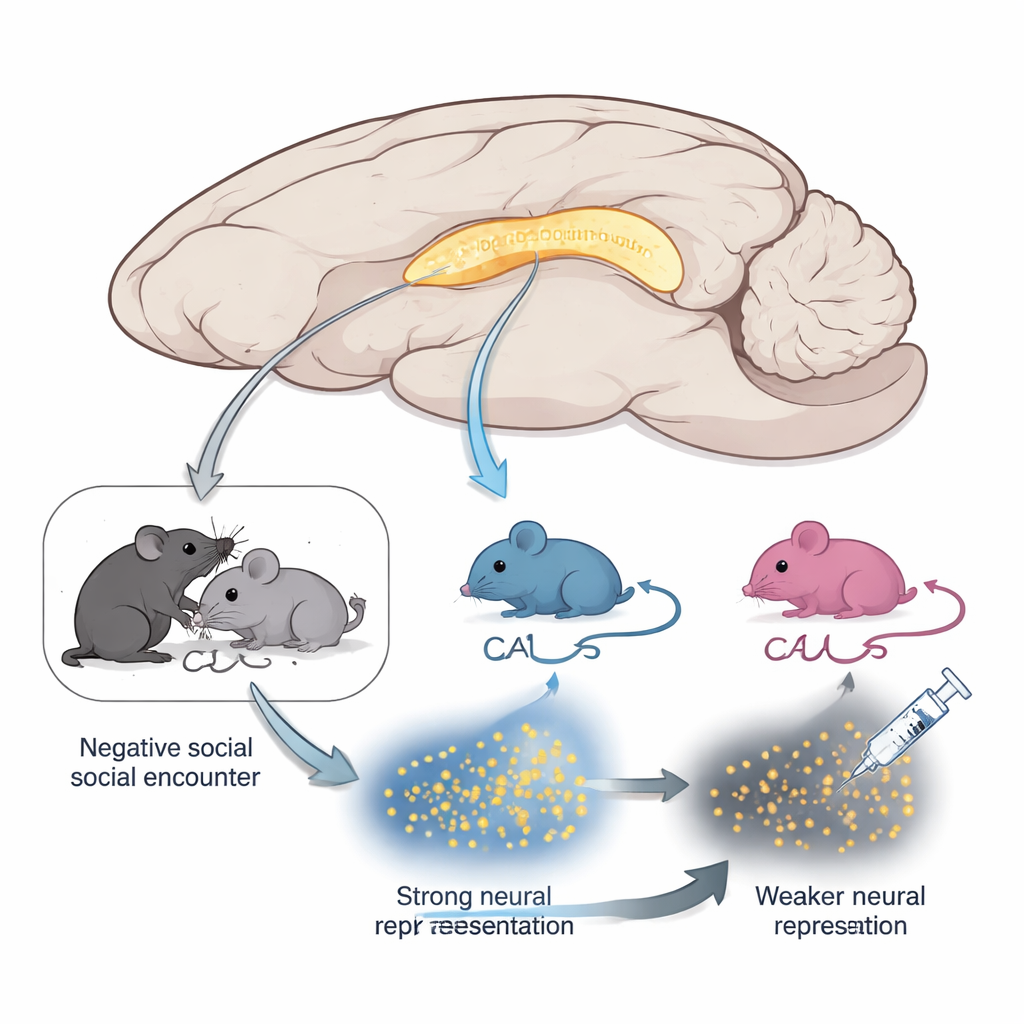
The scientists then turned to a brain region called the hippocampus, long known for its role in memory and context. Using tiny head-mounted microscopes, they recorded the activity of dorsal CA1 neurons—cells that help represent where and with whom events occur—while mice performed the social recognition tests. In males, patterns of CA1 activity reliably distinguished the aggressive mouse from the neutral one, and specific groups of neurons fired strongly during interactions with each individual. In females, overall CA1 activity was lower, and the neural patterns carried much weaker information about who the subject was interacting with. Yet, when the same analysis was applied to non-social cues such as empty cups and objects, males and females showed similar hippocampal representations, underscoring that the difference emerges specifically for negative social information.
Tuning the brain and easing overgeneralized fear
The team next tested whether strengthening either experience or brain activity could restore recognition in females. When female mice were gently pre-exposed to both partner animals for several days before any shocks, they later learned to distinguish the aggressive from the neutral mouse. Likewise, directly boosting CA1 excitability with a drug called an ampakine before stressful training allowed females to show male-like avoidance of the harmful individual. These interventions did not change the basic shock procedure but reduced the tendency to treat all social partners as equally dangerous, pointing to a role for hippocampal signals in sharpening which memories become tagged as bad.
What this means for human mental health
Altogether, the study suggests that males and females handle negative social experiences in distinct ways at both behavioral and brain levels. Females were capable of rich social and object memories, yet under social stress they were more prone to “fear generalization,” treating safe and unsafe individuals as similarly threatening. This pattern mirrors clinical observations that women often show stronger emotional and hormonal reactions to social rejection and are more vulnerable to mood disorders after interpersonal stress. By highlighting the dorsal CA1 region as a key site where social valence—how good or bad an encounter feels—shapes identity recognition differently by sex, the work points toward brain mechanisms that may contribute to women’s heightened risk for stress-related depression and anxiety, and suggests that carefully tuning how negative social memories are encoded could be a future therapeutic avenue.
Citation: Larosa, A., Xu, Q.W., Yaghoubi, M. et al. Social valence dictates sex differences in identity recognition. Transl Psychiatry 16, 53 (2026). https://doi.org/10.1038/s41398-026-03854-5
Keywords: social memory, sex differences, hippocampus, stress, mood disorders