Clear Sky Science · en
Single-dose DMT reverses anhedonia and cognitive deficits via restoration of neurogenesis in a stress-induced depression model
Why a single dose might matter
Many people with depression wait weeks or months before current medications start to help, and even then, a large share never feel fully better. This study explores an intriguing possibility: could a single dose of the psychedelic compound DMT, the main active ingredient in the Amazonian brew ayahuasca, quickly ease depression-like symptoms by helping the brain repair itself? Using a well-established mouse model of chronic stress, the researchers tested whether one injection of DMT could restore both mood-related behaviors and memory, and what changes inside the brain might underlie these effects.
From chronic stress to low mood
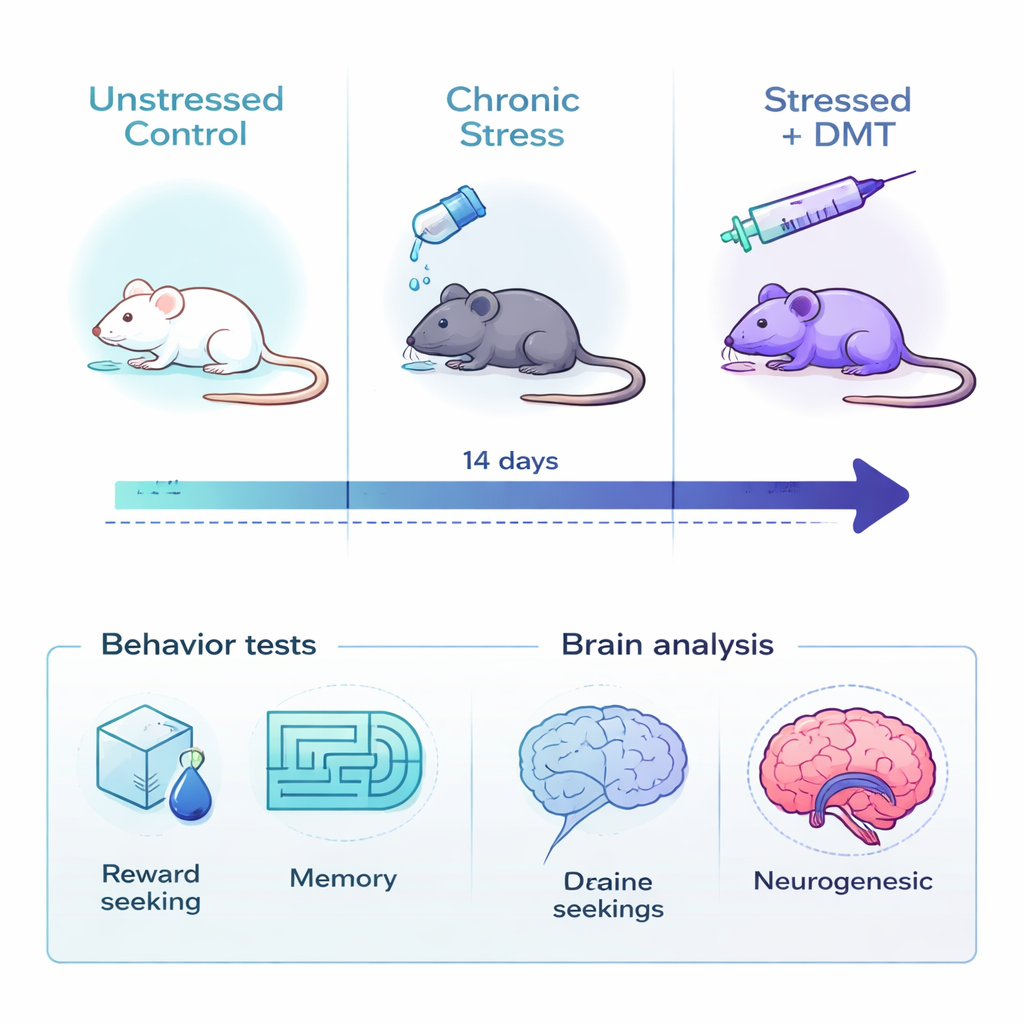
To mimic key aspects of major depression, mice were exposed for eight weeks to a shifting mix of mild but unpleasant experiences, such as confinement, tilted cages, and altered light cycles. This “chronic unpredictable mild stress” made the animals show classic depression-like features: their fur became shaggy, they gained less weight, they lost interest in sweetened water (a sign of reduced ability to feel pleasure, or anhedonia), and they gave up more quickly in a test of behavioral despair. They also became worse at a challenging memory task that requires telling apart similar locations, a function closely linked to a brain structure called the hippocampus. Together, these changes created a multi-faceted picture resembling human depression rather than simple short-term anxiety.
A single psychedelic dose versus standard treatment
The team compared several treatment strategies. Some stressed mice received a single injection of DMT after the stress period. Others got the same DMT dose while under anesthesia, so they likely did not have a conscious psychedelic experience. A separate group received the common antidepressant fluoxetine (better known as Prozac) every day for a month, overlapping with the stress. Another group received DMT halfway through the stress period, to see whether it could blunt the impact of ongoing adversity. Remarkably, a single DMT dose given after stress restored interest in sweetened water, reduced despair-like immobility, and rescued performance on the difficult memory task—often more strongly than chronic fluoxetine. DMT given under anesthesia produced very similar behavioral benefits, hinting that its lasting effects might not depend entirely on the psychedelic trip itself.
Repairing brain circuits through new neurons
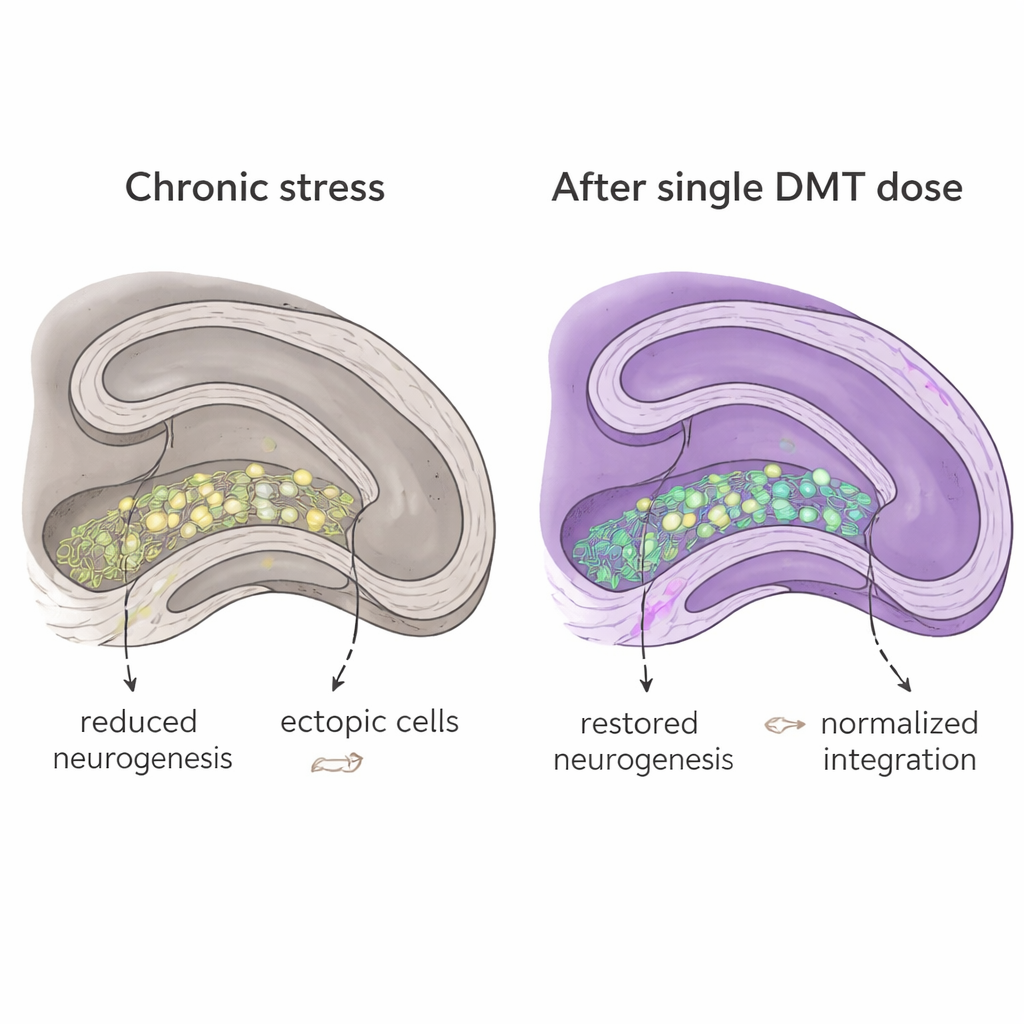
The hippocampus continuously generates new nerve cells in adulthood, especially in a region called the dentate gyrus. This process, known as adult neurogenesis, is thought to help support flexible thinking and emotional resilience. Chronic stress in the mice reduced the birth of new neurons and caused some newborn cells to settle in the wrong place, outside their usual layer—so‑called ectopic cells that may disrupt normal circuit function. After treatment, the researchers examined labeled newborn cells under the microscope. All treatments increased the number of new neurons, but DMT stood out: it boosted neurogenesis more than fluoxetine and almost completely normalized the misplacement of newborn cells, particularly when given after the stress ended. Mice with fewer ectopic cells tended to show better mood-related behavior and sharper memory, linking structural repair in the hippocampus to improved functioning.
Clues about consciousness and long-term impact
One hotly debated question in psychedelic medicine is whether the vivid, often life-changing experiences are required for lasting benefit, or whether the drugs could work as “plasticity enhancers” even without conscious visions. In this study, mice that received DMT while anesthetized improved in mood and cognition and showed increased neurogenesis, similar to awake DMT-treated animals. This suggests that at least part of DMT’s action may come from direct effects on brain cells and growth-related signaling pathways, not just from altered perception. However, because the anesthetic itself can influence brain plasticity, more work is needed to untangle these contributions and to see whether similar principles hold in humans.
What this could mean for people
For a general reader, the key message is that a single dose of DMT, in stressed mice, not only lifted depression-like behavior and sharpened memory but also appeared to repair underlying brain wiring by increasing healthy new neurons and reducing miswired ones. DMT’s benefits were broader and more robust than those of a standard antidepressant in this model, and they did not clearly require a conscious psychedelic state. While these findings are still in animals and many safety, dosing, and ethical questions remain before clinical use, the work supports the idea that psychedelics like DMT could form the basis of future fast-acting antidepressants that help the brain rebuild itself after chronic stress.
Citation: Lima da Cruz, R.V., Costa, R.B.G.d.M., de Queiroz, G.M. et al. Single-dose DMT reverses anhedonia and cognitive deficits via restoration of neurogenesis in a stress-induced depression model. Transl Psychiatry 16, 101 (2026). https://doi.org/10.1038/s41398-026-03852-7
Keywords: depression, DMT, psychedelics, neurogenesis, stress