Clear Sky Science · en
Treating autism with Bumetanide: Identification of responders using Q-Finder machine learning algorithm
Why this research matters to families
Many families of children with autism spectrum disorder (ASD) are searching for treatments that genuinely help with everyday challenges such as social interaction, communication, and coping with change. A drug called bumetanide had shown promise in earlier, smaller studies, but two large, final‑stage clinical trials appeared to fail. This study revisits those disappointing results using a machine‑learning approach to ask a crucial question: was the treatment actually helping some children, but the benefit was hidden when everyone was averaged together?
A promising drug that seemed to fall short
Bumetanide is an old water pill repurposed for brain disorders because it affects how brain cells handle chloride, a key player in how calming signals work in the brain. Earlier phase 2 trials in more than a thousand children suggested that bumetanide could ease core autism symptoms and improve social behaviors and emotional responses. On the strength of these findings, two large phase 3 trials were run in over 400 children and teenagers across multiple countries, comparing bumetanide with a placebo over six months. When the results were analyzed in the usual way, looking at the whole group at once, there was no clear difference between the drug and placebo on standard autism rating scales. 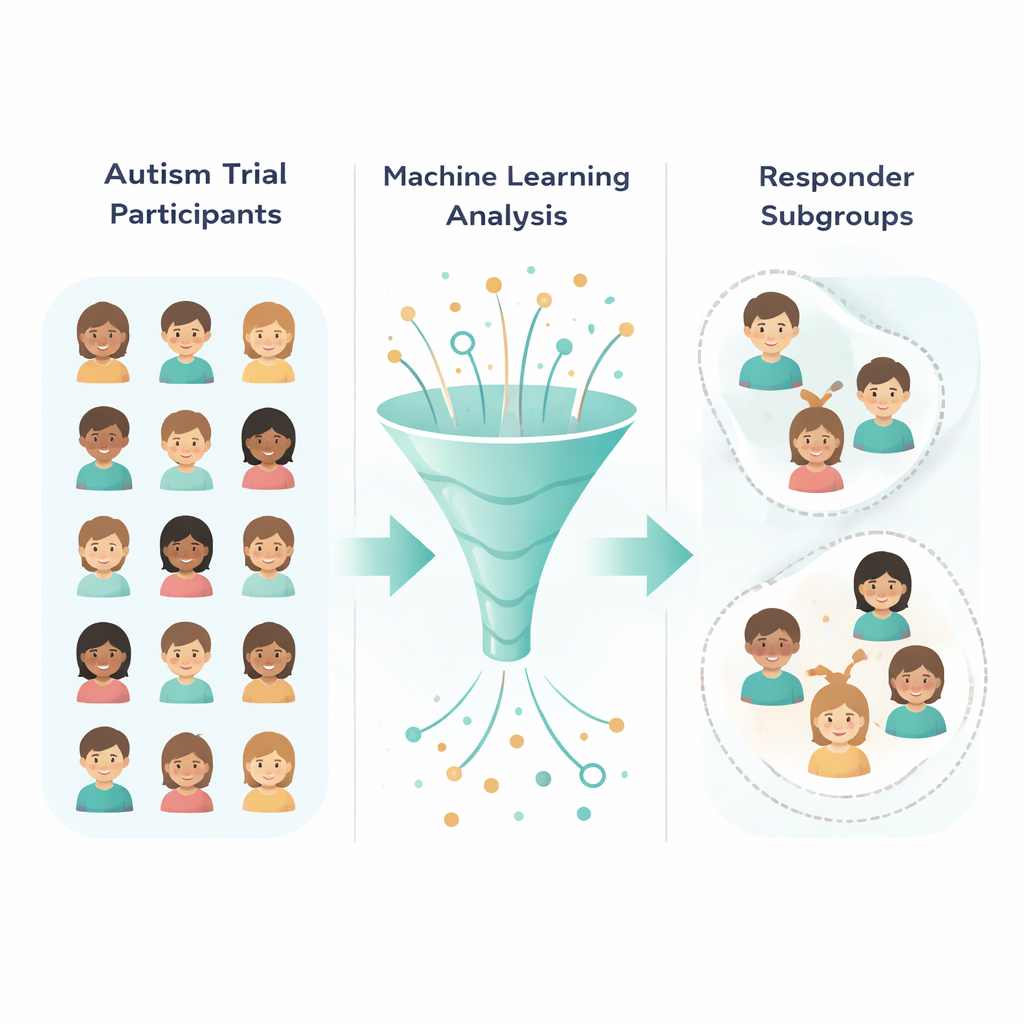
Looking inside the data instead of averaging everyone
The researchers suspected that autism’s wide variety of symptom patterns might be masking real benefits in certain types of children. Instead of assuming that all participants were alike, they used a supervised machine‑learning tool called Q‑Finder to search for subgroups of children, defined only by information collected at the start of the trial: detailed ratings of social interaction, repetitive behaviors, sensory issues, daily living skills, and overall clinical impressions. The algorithm systematically tested many simple “profiles” (for example, children mildly disturbed by changes in routine but with severe social difficulties) and checked whether children fitting each profile improved more on bumetanide than on placebo, while also making sure the rest of the group did not show the same effect.
Finding the children who actually responded
Applied separately to younger children (ages 2–6) and older children and adolescents (ages 7–17), and to two major rating scales, the method uncovered a number of patient profiles in which bumetanide clearly outperformed placebo. Some subgroups were small but showed large improvements, while others covered up to about 40% of the trial population and still displayed meaningful benefits. A consistent pattern emerged: responders often had specific combinations of social and communication difficulties, repetitive behaviors, and problems adapting to changes, rather than extreme difficulties across all areas. Importantly, several of these responder profiles were confirmed when tested in the other age group, lending credibility to the findings.
Clues to who may benefit in future trials
Across both trials, one feature kept reappearing in the validated responder groups: children rated as “mildly abnormal” in their ability to adapt to changes in their environment—things like shifts in routine or new situations—combined with other signs of social or behavioral difficulty. In these children, bumetanide led to larger improvements on a widely used social responsiveness scale than placebo. The study did not show that bumetanide helps every child with autism, nor did it prove exactly which behaviors change the most. Instead, it suggests that if future trials focus on children with these particular clinical profiles, they may see stronger and more reliable benefits. 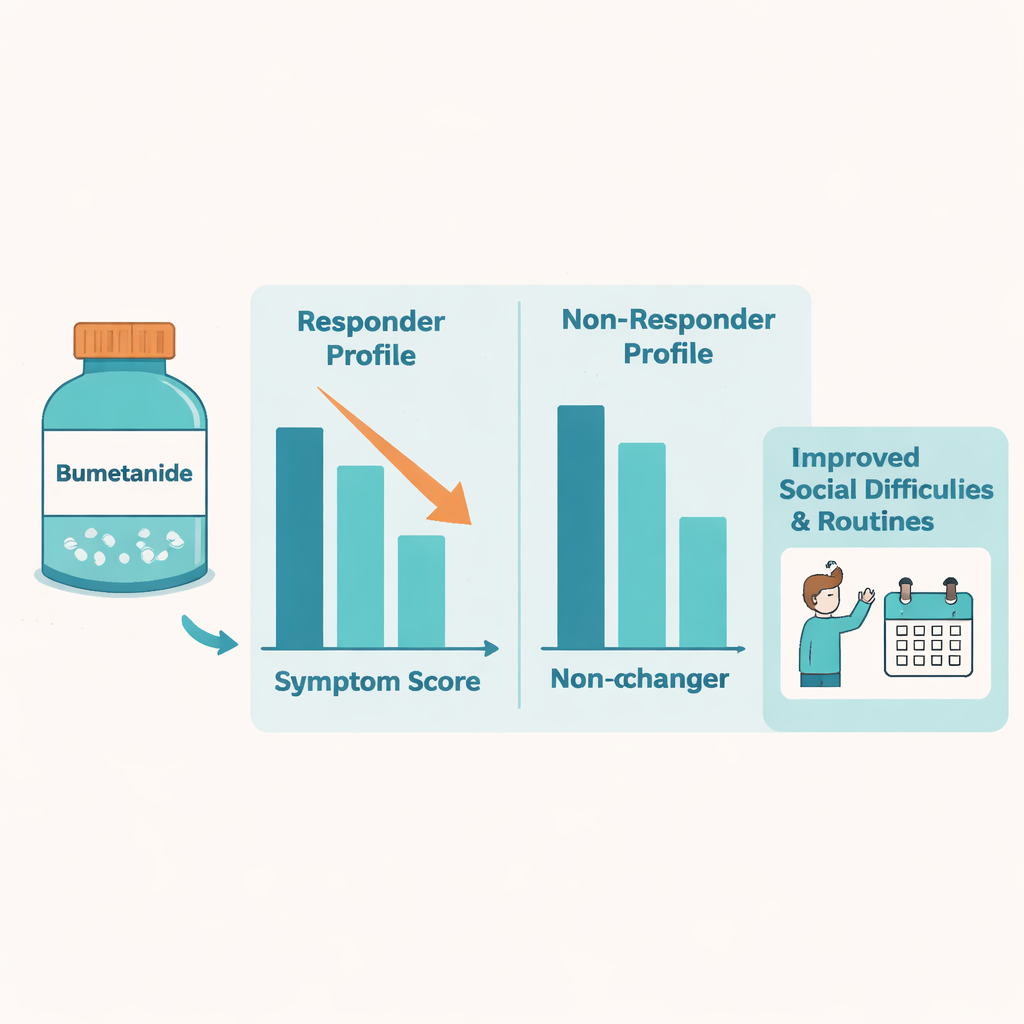
What this means for personalized autism care
For a layperson, the takeaway is that a “one‑size‑fits‑all” drug trial can hide real benefits if autism is treated as a single condition rather than a spectrum of different patterns. By using machine learning to sort children into clinically understandable profiles, this study was able to rescue meaningful signals from trials that were originally labeled negative. While more research is needed to confirm these subgroups in new groups of children and to monitor long‑term safety, the work points toward a future in which autism treatments, including bumetanide, are targeted to the children most likely to benefit, rather than offered blindly to all.
Citation: Rabiei, H., Begnis, M., Lemonnier, E. et al. Treating autism with Bumetanide: Identification of responders using Q-Finder machine learning algorithm. Transl Psychiatry 16, 66 (2026). https://doi.org/10.1038/s41398-026-03848-3
Keywords: autism treatment, precision medicine, machine learning, bumetanide, clinical trial subgroups